Book view
Forging Fraternity in Late Medieval Society
The Palmers' Guild of Ludlow
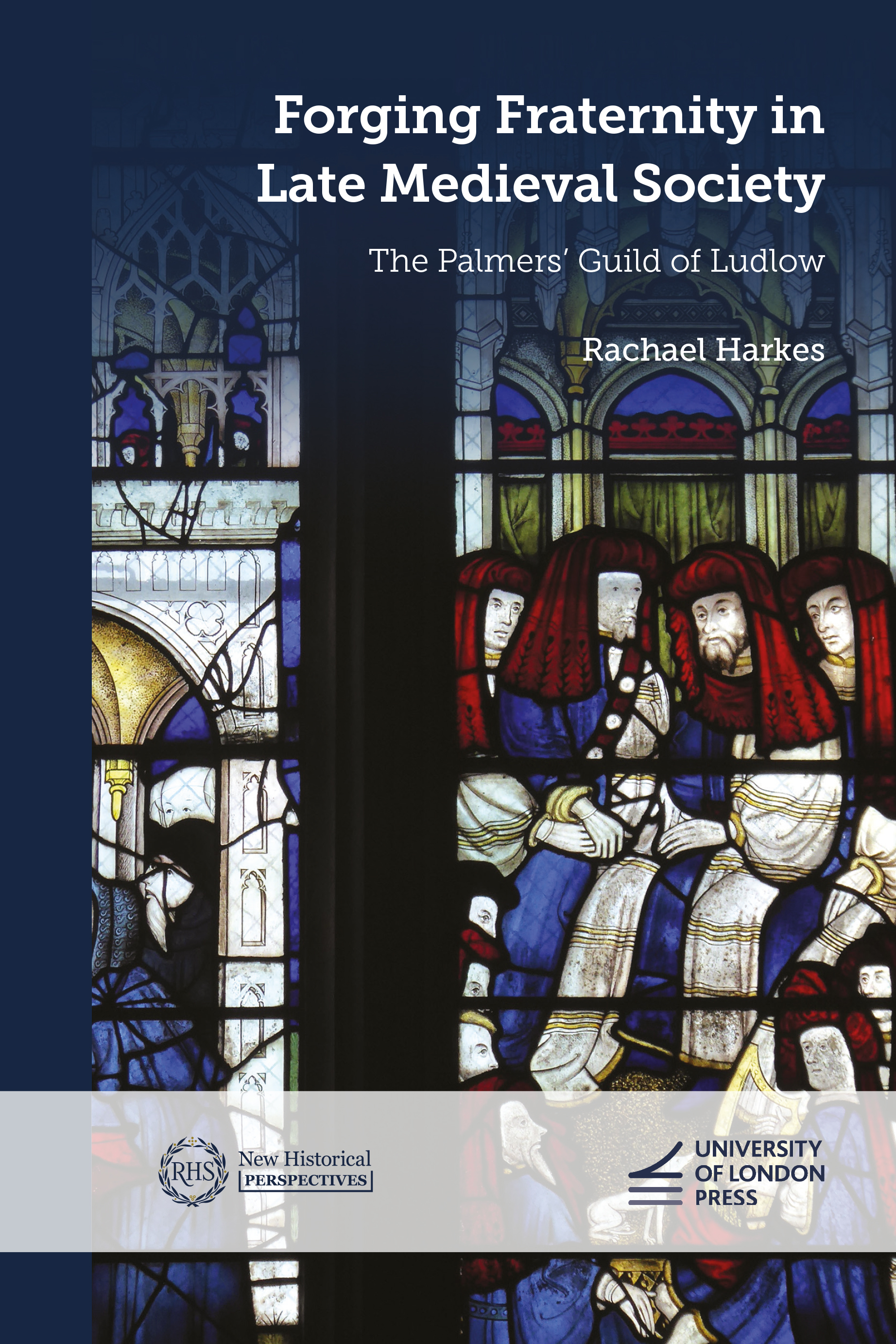
Book information
- Publisher
- University of London Press
- Publication
- Published 6 November 2025
- Place
- London, GB
- Series
- New Historical Perspectives
- Catalogue record
- View in the catalogue
Abstract
The untold story of how a medieval guild united the worlds of commerce and religion and changed local life and international influence on the eve of the Reformation.
Forging Fraternity in Late Medieval Society is an ambitious and innovative study of the social, political and religious histories of medieval England and Wales. Using the Palmers’ Guild of Ludlow as a prism, it sets out to consider the almost ubiquitous membership of religious guilds in both urban and rural society on the eve of the Reformation. With over 18,000 members recorded in the guild’s massive extant archive, drawn from across the social spectrum and spread throughout Wales, England, Iberia, Ireland and France, the Palmers offer a unique opportunity to investigate the interplay between institutions and individuals in the Middle Ages.
Why did thousands of men and women join this particular organization in the fifteenth and sixteenth centuries? What influenced people’s decision to become a member, how can we reconstruct these decisions from surviving documents, and what do they reveal about the communities that made up late medieval society? By posing these questions, this book charts individual and collective experiences, reconstructing the life-stages, political circumstances, and social pressures incumbent on individuals as they engaged in a moral and fiscal commitment to a guild. Departing from traditional guild studies, Forging Fraternity crosses conventional historiographical boundaries to reconceptualise guild membership as both a structure for and mirror of complex social relations and identities, demonstrating with ingenuity how medieval sources can be put to use in unconventional ways.
Where its authors and editors are based
Countries of the institutions the book's authors, editors and chapter authors were affiliated to when it was published.
- AUTHORS / EDITORS
- CITATIONS Phase 2
- USAGE Phase 3
| Country | Authors / editors |
|---|---|
| United Kingdom | 1 |
About this data
These figures cover 1 work. Each value comes from the most trusted source that has it; a correction made by OJC or OBC staff outranks every source.
| Source | Confidence | Works |
|---|---|---|
| Thoth | 90 / 100 | 1 |
| Works with a publication date | 100% |
|---|---|
| Works with a DOI | 100% |
| Works with a funder recorded | 0% |
| Authors with an affiliation | 100% |
| Affiliations matched to an institution (ROR) | 100% |
| Affiliations with a country | 100% |
Countries come from the institution each author was affiliated to when they published, as recorded in ROR. A country is never guessed, so authors without a matched institution are not counted on the maps.
Funders come from OpenAlex for articles and Thoth for books, where publishers recorded them. Most works record none, so a funder's figures show what is recorded, not everything it funded.
Chapters count as works: their authors and editors, and the countries of their institutions, are in every figure where Thoth records an affiliation for them.
Citations (Phase 2) and usage (Phase 3) are not collected yet.