Book information
- Publisher
- University of London Press
- Publication
- Published 12 June 2020
- Place
- London, GB
- Catalogue record
- View in the catalogue
Abstract
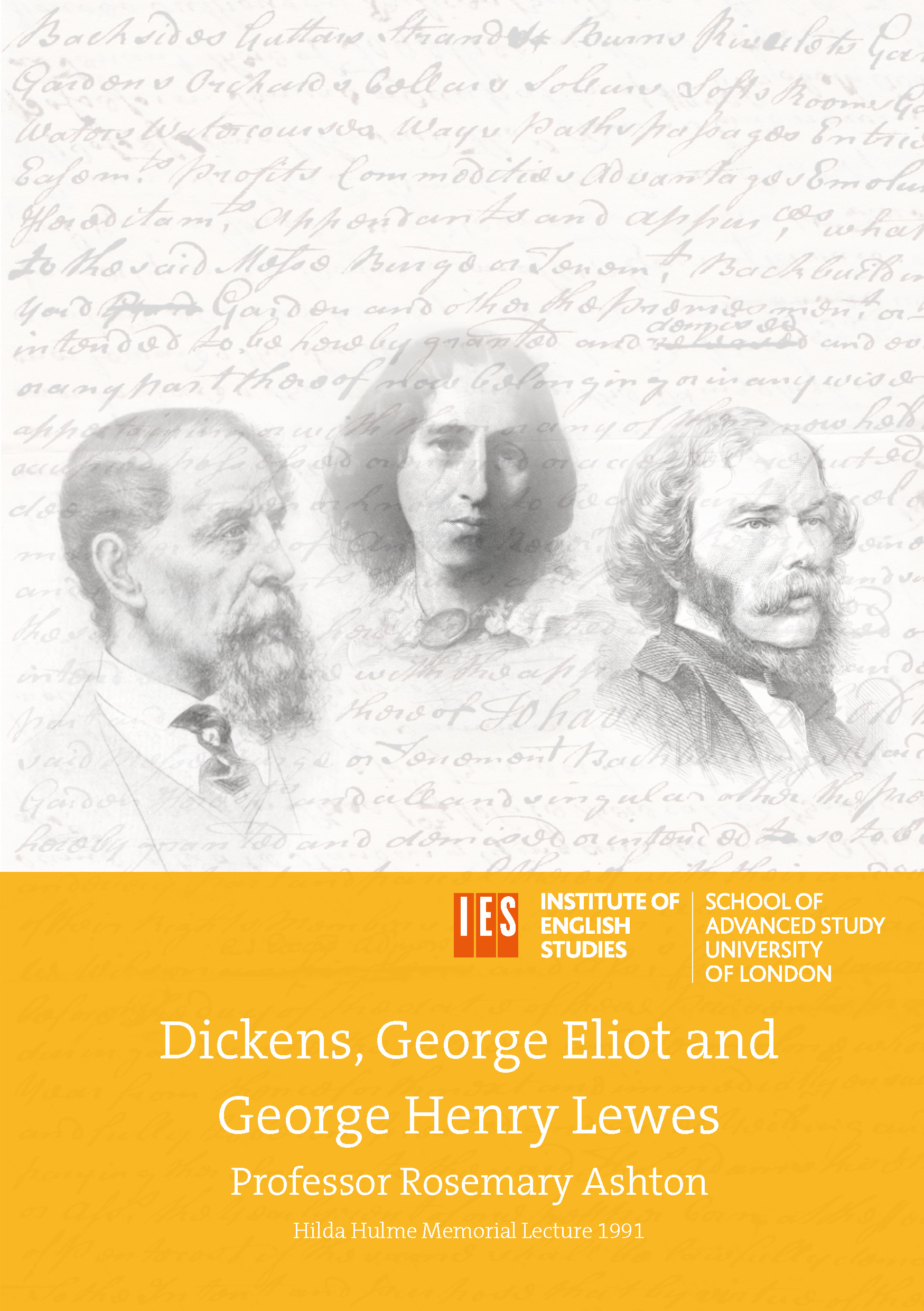
When the Victorian journalist and critic, George Henry Lewes invited George Eliot and Charles Dickens to dinner in 1859, few imagined it would lead to one of the greatest creative exchanges in literary history.
From the non-traditional ‘marriage’ of Eliot and Lewes, to the unconventional eye Lewes cast over Dickens’ work, this book throws fresh light on the chief subject of their critical interest by looking at the complex relationships between Dickens, Eliot and Lewes. It contends that Lewes saw something in Dickens and Eliot that his contemporaries could not grasp, and traces the birth of ‘psychological realism’ as a literary device in English literature.
The book is based on a lecture given as part of the Hilda Hulme Memorial Lectures, established in 1985 following a donation from Mr Mohamed Aslam in memory of his wife, Dr Hilda Hulme. The lectures are on the subject of English literature and relate to one of ‘the three fields in which Dr Hulme specialised, namely Shakespeare, language in Elizabethan drama, and the nineteenth-century novel’.
This lecture by Professor Rosemary Ashton was originally published by the Institute of English Studies, University of London in 1991.
Where its authors and editors are based
Countries of the institutions the book's authors, editors and chapter authors were affiliated to when it was published.
- AUTHORS / EDITORS
- CITATIONS Phase 2
- USAGE Phase 3
No affiliations with a known country in these years yet.
About this data
These figures cover 1 work. Each value comes from the most trusted source that has it; a correction made by OJC or OBC staff outranks every source.
| Source | Confidence | Works |
|---|---|---|
| Thoth | 90 / 100 | 1 |
| Works with a publication date | 100% |
|---|---|
| Works with a DOI | 100% |
| Works with a funder recorded | 0% |
| Authors with an affiliation | 0% |
Countries come from the institution each author was affiliated to when they published, as recorded in ROR. A country is never guessed, so authors without a matched institution are not counted on the maps.
Funders come from OpenAlex for articles and Thoth for books, where publishers recorded them. Most works record none, so a funder's figures show what is recorded, not everything it funded.
Chapters count as works: their authors and editors, and the countries of their institutions, are in every figure where Thoth records an affiliation for them.
Citations (Phase 2) and usage (Phase 3) are not collected yet.