Book information
- Publisher
- University of London Press
- Publication
- Published 1 August 2022
- Place
- London, GB
- Catalogue record
- View in the catalogue
Abstract
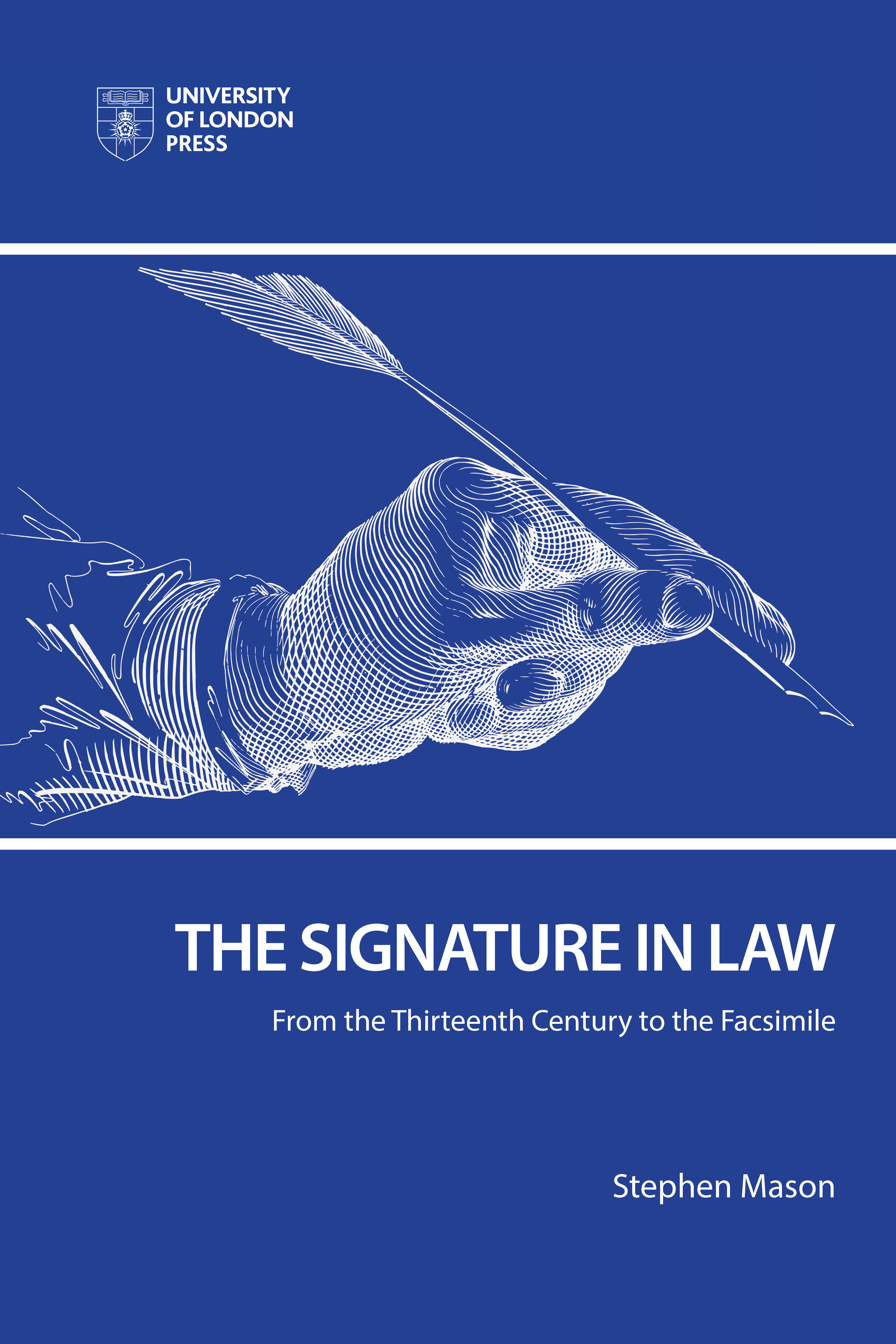
This book explores the judicial development of the concept of the signature from the thirteenth century to the age of the facsimile transmission. It puts the concept of the signature into a broad legal context to set out the purposes that can be attributed to a signature, and to explain the functions a signature is capable of performing. Drawing on cases from common law jurisdictions across the world, the book demonstrates that judges expanded the meaning of a signature as technologies developed and were used in unanticipated ways.
Following an overview of the methods used to demonstrate proof of intent and authentication, the book considers the judicial response to the array of variations in the form that manuscript signatures have been subject over the past two hundred years, from initials, partial signatures and fingerprints, to rubber stamps and typewriting. Past judicial decision-making not only demonstrates the flexibility of the form a signature can take, but also confirms that judges had the flexibility of mind to accept the first forms of electronic signature (telex, facsimile transmission) as merely one further development without the aid of special legislation.
Where its authors and editors are based
Countries of the institutions the book's authors, editors and chapter authors were affiliated to when it was published.
- AUTHORS / EDITORS
- CITATIONS Phase 2
- USAGE Phase 3
No affiliations with a known country in these years yet.
About this data
These figures cover 1 work. Each value comes from the most trusted source that has it; a correction made by OJC or OBC staff outranks every source.
| Source | Confidence | Works |
|---|---|---|
| Thoth | 90 / 100 | 1 |
| Works with a publication date | 100% |
|---|---|
| Works with a DOI | 100% |
| Works with a funder recorded | 0% |
| Authors with an affiliation | 0% |
Countries come from the institution each author was affiliated to when they published, as recorded in ROR. A country is never guessed, so authors without a matched institution are not counted on the maps.
Funders come from OpenAlex for articles and Thoth for books, where publishers recorded them. Most works record none, so a funder's figures show what is recorded, not everything it funded.
Chapters count as works: their authors and editors, and the countries of their institutions, are in every figure where Thoth records an affiliation for them.
Citations (Phase 2) and usage (Phase 3) are not collected yet.