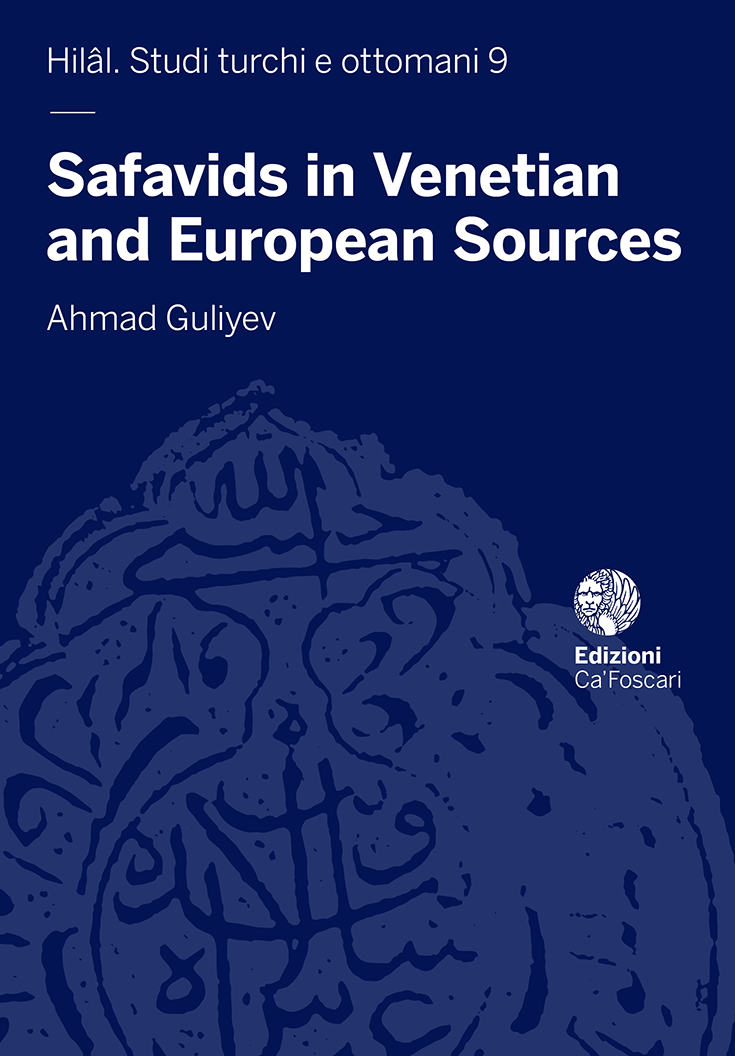
Book information
- Publisher
- Edizioni Ca' Foscari
- Publication
- Published 8 April 2022
- Place
- Venice, Italy
- Series
- Hilâl
- Catalogue record
- View in the catalogue
Abstract
The emergence of the Safavid Empire in the early sixteenth century marked a significant change in the geopolitics of the Middle East. This momentous change coincided with the widening of Ottoman expansion eastward and the exploration by European powers, especially by Venice, of the possibilities of forming alliances against the Ottomans with the involvement of the Safavids. Thus, Ottoman threat and commercial interests contributed to the emergence and development of diplomatic, cultural, and trade relations between the Republic of Venice and the Safavid Empire, which lasted until the end of the seventeenth century. Drawing on the documents from the Venetian State Archives and other contemporary sources, this book focuses mainly on some aspects of Safavid diplomacy, including the language of the Safavid polity, the role of European subjects as interpreters for the shahs, material and visual characteristics of Safavid diplomatic letters to Venice, the attitude of the Safavids towards resident diplomacy, the reception of the European envoys in the Safavid court and Europeans’ perception of Safavid diplomatic practices, as well as the characteristics of the Safavid embassies to Venice. We have tried to explain the role of Turkish as a language of diplomacy and communication in Safavid-Venetian encounters. We have also attempted to explore briefly how the Venetians distinguished Safavid subjects according to their ethno-linguistic affiliations. Finally, we examine the Ottoman factor in Safavid-Venetian relations in order to establish to what extent, if any, the Ottomans had an impact on the overall character of Safavid-Venetian relations.
Where its authors and editors are based
Countries of the institutions the book's authors, editors and chapter authors were affiliated to when it was published.
- AUTHORS / EDITORS
- CITATIONS Phase 2
- USAGE Phase 3
| Country | Authors / editors |
|---|---|
| Azerbaijan | 1 |
About this data
These figures cover 1 work. Each value comes from the most trusted source that has it; a correction made by OJC or OBC staff outranks every source.
| Source | Confidence | Works |
|---|---|---|
| Thoth | 90 / 100 | 1 |
| Works with a publication date | 100% |
|---|---|
| Works with a DOI | 100% |
| Works with a funder recorded | 0% |
| Authors with an affiliation | 100% |
| Affiliations matched to an institution (ROR) | 100% |
| Affiliations with a country | 100% |
Countries come from the institution each author was affiliated to when they published, as recorded in ROR. A country is never guessed, so authors without a matched institution are not counted on the maps.
Funders come from OpenAlex for articles and Thoth for books, where publishers recorded them. Most works record none, so a funder's figures show what is recorded, not everything it funded.
Chapters count as works: their authors and editors, and the countries of their institutions, are in every figure where Thoth records an affiliation for them.
Citations (Phase 2) and usage (Phase 3) are not collected yet.