Book view
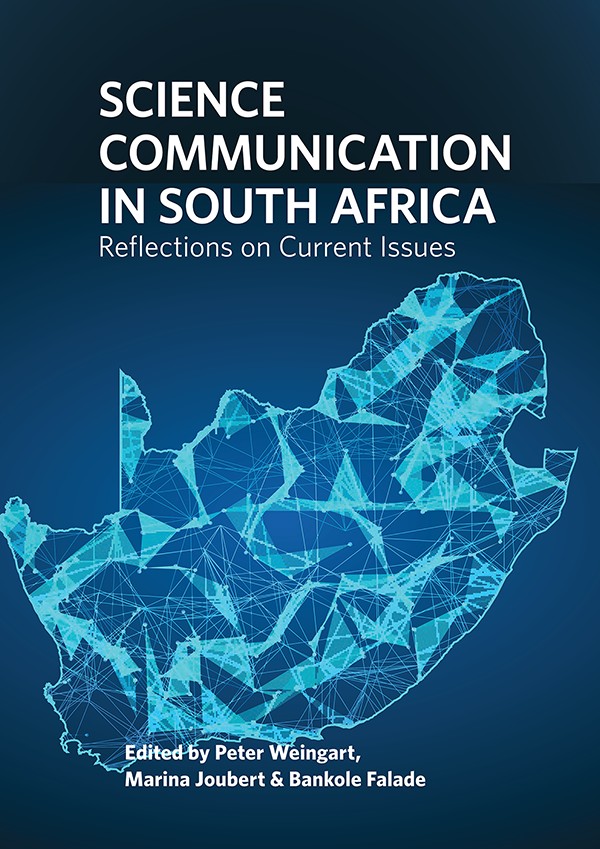
Science Communication in South Africa
Reflections on Current Issues
Edited by Peter Weingart, Marina Joubert, Bankole Falade
Book information
- Publisher
- African Minds
- Publication
- Published 28 November 2019
- Place
- Cape Town, South Africa
- Catalogue record
- View in the catalogue
Abstract
Why do we need to communicate science? Is science, with its highly specialised language and its arcane methods, too distant to be understood by the public? Is it really possible for citizens to participate meaningfully in scientific research projects and debate? Should scientists be mandated to engage with the public to facilitate better understanding of science? How can they best communicate their special knowledge to be intelligible? These and a plethora of related questions are being raised by researchers and politicians alike as they have become convinced that science and society need to draw nearer to one another. Once the persuasion took hold that science should open up to the public and these questions were raised, it became clear that coming up with satisfactory answers would be a complex challenge. The inaccessibility of scientific language and methods, due to ever increasing specialisation, is at the base of its very success. Thus, translating specialised knowledge to become understandable, interesting and relevant to various publics creates particular perils. This is exacerbated by the ongoing disruption of the public discourse through the digitisation of communication platforms. For example, the availability of medical knowledge on the internet and the immense opportunities to inform oneself about health risks via social media are undermined by the manipulable nature of this technology that does not allow its users to distinguish between credible content and misinformation. In countries around the world, scientists, policy-makers and the public have high hopes for science communication: that it may elevate its populations educationally, that it may raise the level of sound decision-making for people in their daily lives, and that it may contribute to innovation and economic well-being. This collection of current reflections gives an insight into the issues that have to be addressed by research to reach these noble goals, for South Africa and by South Africans in particular.
Where its authors and editors are based
Countries of the institutions the book's authors, editors and chapter authors were affiliated to when it was published.
- AUTHORS / EDITORS
- CITATIONS Phase 2
- USAGE Phase 3
No affiliations with a known country in these years yet.
About this data
These figures cover 1 work. Each value comes from the most trusted source that has it; a correction made by OJC or OBC staff outranks every source.
| Source | Confidence | Works |
|---|---|---|
| Thoth | 90 / 100 | 1 |
| Works with a publication date | 100% |
|---|---|
| Works with a DOI | 100% |
| Works with a funder recorded | 0% |
| Authors with an affiliation | 0% |
Countries come from the institution each author was affiliated to when they published, as recorded in ROR. A country is never guessed, so authors without a matched institution are not counted on the maps.
Funders come from OpenAlex for articles and Thoth for books, where publishers recorded them. Most works record none, so a funder's figures show what is recorded, not everything it funded.
Chapters count as works: their authors and editors, and the countries of their institutions, are in every figure where Thoth records an affiliation for them.
Citations (Phase 2) and usage (Phase 3) are not collected yet.