Book view
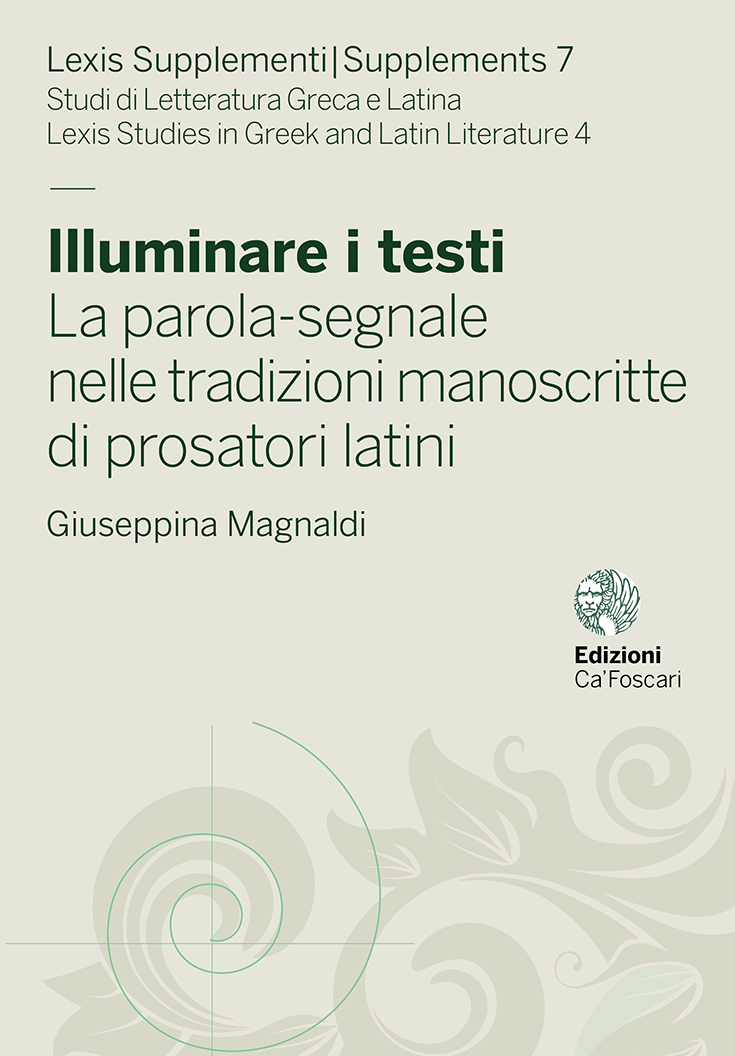
Illuminating Texts
The Word-Signal in the Manuscript Traditions of Latin Prose Writers
Book information
- Publisher
- Edizioni Ca' Foscari
- Publication
- Published 23 May 2022
- Place
- Venice, Italy
- Series
- Lexis Supplements
- Catalogue record
- View in the catalogue
Abstract
The volume collects the most significant results of thirty years of research on the manuscript traditions of Latin prose-writers from the Republican age to late antiquity: Cicero, Varro, Livy, Seneca the Elder, Seneca, Petronius, Suetonius, Tacitus, Gellius, Apuleius and Pseudo-Apuleius, and Macrobius. The author argues that some of the serious corruptions in their works are caused by the intrusion in the text of ancient additions and corrections with signal-words, which the copyists transcribed mechanically before or after the right point. Chapter One describes this particular usus emendandi, practised by correctors who not only replaced or rectified the omitted or mistaken terms, but also duplicated one or more words (or letters) before or after, with the aim of indicating as clearly as possible the location of the lacuna or error; it is precisely this diplography that enables us even now to decipher and correct the text, and thus restore the more ancient reading. Chapters Two and Three provide examples of emendations and additions with a signal-word deduced by collating late-antique, medieval and humanist manuscripts. Chapter Four discusses suggestions of modern editors and scholars who have identified the presence of signal-words in loci uexati and have corrected them persuasively. Using this procedure for correcting, Chapter Five defends suggestions unsuccessfully advanced in the past, while in Chapter Six the author presents dozens of her own textual suggestions (some already published, others not), all based on recognising ancient signal-words or signal-letters. Each passage is followed by an apparatus and notes of commentary. Finally, the Appendix cites recent proposals by other scholars (Ammannati, Balbo, Braccini, Mastandrea, Piccioni, Stefani) who have successfully applied the methodological tool of the signal-word to problematic points in the text they were studying.
Where its authors and editors are based
Countries of the institutions the book's authors, editors and chapter authors were affiliated to when it was published.
- AUTHORS / EDITORS
- CITATIONS Phase 2
- USAGE Phase 3
| Country | Authors / editors |
|---|---|
| Italy | 1 |
About this data
These figures cover 1 work. Each value comes from the most trusted source that has it; a correction made by OJC or OBC staff outranks every source.
| Source | Confidence | Works |
|---|---|---|
| Thoth | 90 / 100 | 1 |
| Works with a publication date | 100% |
|---|---|
| Works with a DOI | 100% |
| Works with a funder recorded | 0% |
| Authors with an affiliation | 100% |
| Affiliations matched to an institution (ROR) | 100% |
| Affiliations with a country | 100% |
Countries come from the institution each author was affiliated to when they published, as recorded in ROR. A country is never guessed, so authors without a matched institution are not counted on the maps.
Funders come from OpenAlex for articles and Thoth for books, where publishers recorded them. Most works record none, so a funder's figures show what is recorded, not everything it funded.
Chapters count as works: their authors and editors, and the countries of their institutions, are in every figure where Thoth records an affiliation for them.
Citations (Phase 2) and usage (Phase 3) are not collected yet.