Book view
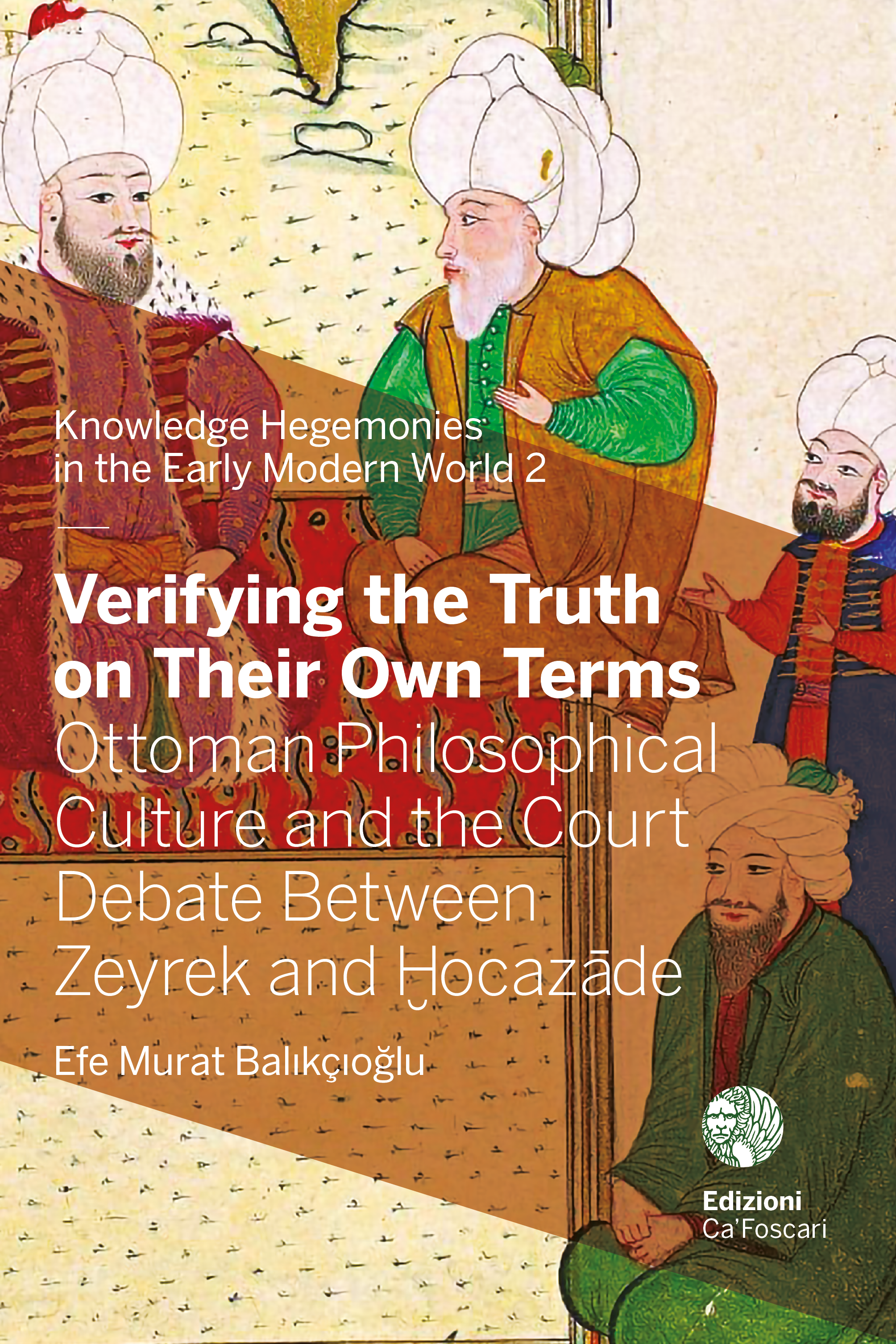
Verifying the Truth on Their Own Terms
Ottoman Philosophical Culture and the Court Debate Between Zeyrek (d. 903/1497-98 [?]) and Ḫocazāde (d. 893/1488)
Book information
- Publisher
- Edizioni Ca' Foscari
- Publication
- Published 7 March 2023
- Place
- Venice, Italy
- Series
- Knowledge Hegemonies in the Early Modern World
- Catalogue record
- View in the catalogue
Abstract
The present volume offers a detailed analysis of a fifteenth-century court debate on God’s unicity (tawḥīd), involving the Ottoman scholars Mollā Zeyrek (d. 903/1497-98 [?]) and Ḫocazāde Muṣliḥuddīn Muṣṭafā (d. 893/1488), as a chance to highlight the dynamics of knowledge production at the time: in post-classical Islamic scholarship, an essential element of the process was scholars’ adroitness in synthesizing arguments from differing schools of philosophy and theology – via close readings of past masters. This dialectic unfolded during a period of imperial restructuring, at a time when Sultan Meḥmed II (d. 886/1481) realized his cosmopolitan and universalistic ambitions through his persistent patronage of philosophy and science, a case that is illustrated by his glorious palatine library. The setting, audience, and format of the debate, along with the analyses reveal that the production of knowledge in the early modern Islamic world was intricate, vibrant, and dynamic – not stale or derivative as previously thought. This book attempts at reconstructing the debate through the information found in bio-bibliographical sources, and comments on certain social and cultural aspects of the fifteenth-century Ottoman scholarship. Analyses of lemmata in the plethora of commentaries and glosses reveal that Ottoman scholars could posit numerous and disparate doctrinal positions, each referencing specific texts, through which the scholars gave their own syntheses based on their unique perspectives. This method of scholarly arbitration is called ‘verification’ (taḥqīq) and is exemplified here in Ḫocazāde’s defense and recontextualization of Avicennan philosophy in early Ottoman philosophical theology. The court debate at hand concerns Avicenna’s often-contested ontological formulation, which equaled God’s quiddity/essence to His existence and necessity, a view that went against the theological principle of God’s singularity according to a tradition of Muslim theologians. Ḫocazāde’s defense of the philosophers’ proof demonstrated that one of the senses of the ontological term ‘necessity’ that Avicenna put forth was identical to God’s quiddity/essence, as well as His ‘pure existence’. Having gained the upper hand in the debate by verifying Avicenna’s thesis, Ḫocazāde’s argumentative efforts proved that not only could the philosophers’ claim be reconciled with post-classical Islamic theology, but this proof also held true on their own terms despite Zeyrek’s (and the theologians’) objections.
Where its authors and editors are based
Countries of the institutions the book's authors, editors and chapter authors were affiliated to when it was published.
- AUTHORS / EDITORS
- CITATIONS Phase 2
- USAGE Phase 3
| Country | Authors / editors |
|---|---|
| United States | 1 |
About this data
These figures cover 1 work. Each value comes from the most trusted source that has it; a correction made by OJC or OBC staff outranks every source.
| Source | Confidence | Works |
|---|---|---|
| Thoth | 90 / 100 | 1 |
| Works with a publication date | 100% |
|---|---|
| Works with a DOI | 100% |
| Works with a funder recorded | 0% |
| Authors with an affiliation | 100% |
| Affiliations matched to an institution (ROR) | 100% |
| Affiliations with a country | 100% |
Countries come from the institution each author was affiliated to when they published, as recorded in ROR. A country is never guessed, so authors without a matched institution are not counted on the maps.
Funders come from OpenAlex for articles and Thoth for books, where publishers recorded them. Most works record none, so a funder's figures show what is recorded, not everything it funded.
Chapters count as works: their authors and editors, and the countries of their institutions, are in every figure where Thoth records an affiliation for them.
Citations (Phase 2) and usage (Phase 3) are not collected yet.