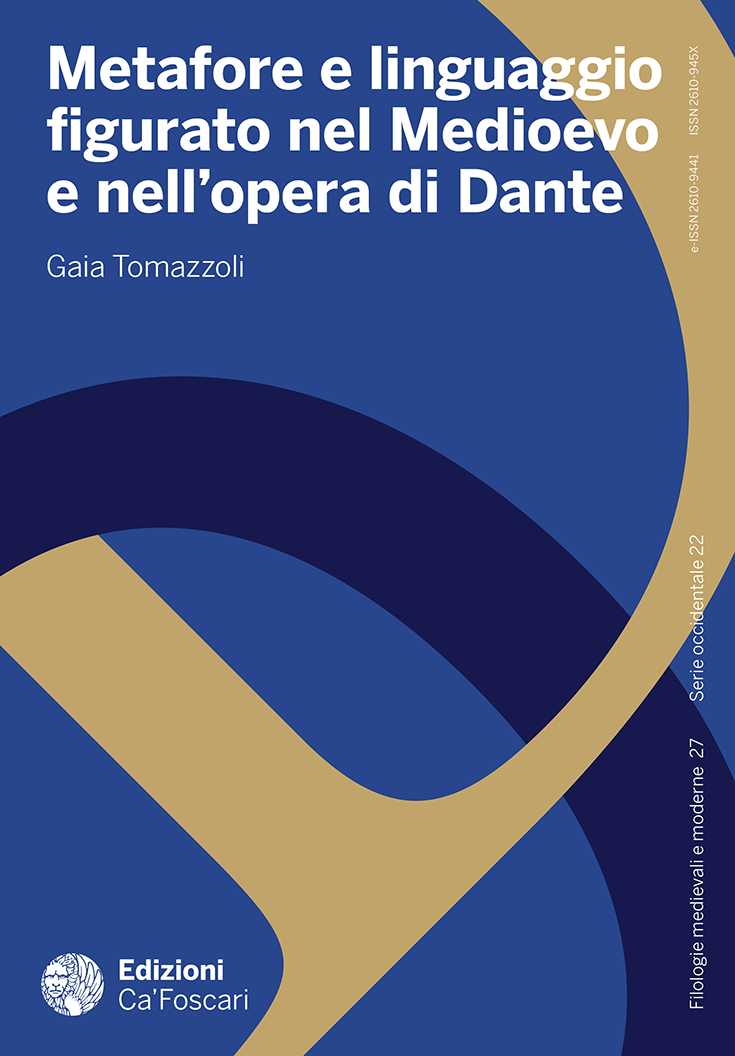
Book information
- Publisher
- Edizioni Ca' Foscari
- Publication
- Published 6 June 2023
- Place
- Venice, Italy
- Series
- Medieval and Modern Philologies
- Catalogue record
- View in the catalogue
Abstract
This book offers an innovative analysis of Dante’s figurative language in relation to both the theoretical framework developed in his works and the discursive strategies realised in his poetry. In doing so, it also provides an overview of Medieval theories of figurative language, with their respective concerns and overlaps. The first part, composed of four chapters, explores how Dante discusses figurative language in a selection of crucial passages from Vita nova, De vulgari eloquentia, Convivio, the epistle to Cangrande, Monarchia, and the Commedia. Each of these passages is investigated with respect to the specific issues at stake in each work, thus tracing a clear progression in Dante’s thought on figurative language, which is mirrored by an increasingly complex and conscious metaphorical practice. Such issues are then contextualised in the wider picture of the various theories of figurative language established by different Medieval disciplines (artes poetriae; artes dictaminis; biblical exegesis; artes praedicandi; epistemology). The second part provides an in-depth analysis of metaphors in Dante’s Commedia, through a close reading of multiple case studies. This section presents the methodology adopted for the identification and classification of Dante’s metaphors, and its main outcomes in terms of both quantitative and qualitative data. Its three chapters explore the linguistic components of the metaphors (meaning shift, morphology, syntax), then their stylistic features (semantics and pragmatics), and finally their distribution and mutual connections. The contemporary approaches adopted throughout the book contribute to the increasing complexity of Medieval disciplines dealing with figurative language.
Where its authors and editors are based
Countries of the institutions the book's authors, editors and chapter authors were affiliated to when it was published.
- AUTHORS / EDITORS
- CITATIONS Phase 2
- USAGE Phase 3
| Country | Authors / editors |
|---|---|
| Italy | 1 |
About this data
These figures cover 1 work. Each value comes from the most trusted source that has it; a correction made by OJC or OBC staff outranks every source.
| Source | Confidence | Works |
|---|---|---|
| Thoth | 90 / 100 | 1 |
| Works with a publication date | 100% |
|---|---|
| Works with a DOI | 100% |
| Works with a funder recorded | 0% |
| Authors with an affiliation | 100% |
| Affiliations matched to an institution (ROR) | 100% |
| Affiliations with a country | 100% |
Countries come from the institution each author was affiliated to when they published, as recorded in ROR. A country is never guessed, so authors without a matched institution are not counted on the maps.
Funders come from OpenAlex for articles and Thoth for books, where publishers recorded them. Most works record none, so a funder's figures show what is recorded, not everything it funded.
Chapters count as works: their authors and editors, and the countries of their institutions, are in every figure where Thoth records an affiliation for them.
Citations (Phase 2) and usage (Phase 3) are not collected yet.