Book view
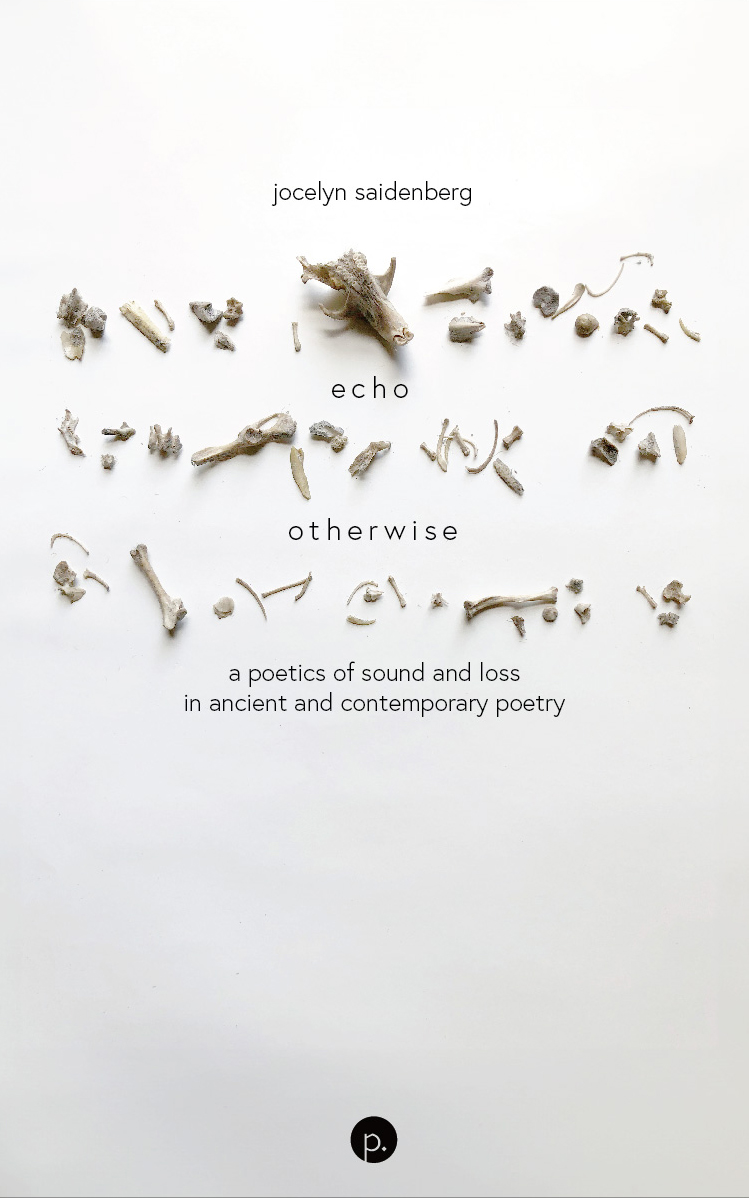
Echo Otherwise
A Poetics of Sound and Loss in Ancient and Contemporary Poetry
Book information
- Publisher
- punctum books
- Publication
- Published 17 June 2026
- Place
- Earth, Milky Way
- Catalogue record
- View in the catalogue
Abstract
At the heart of this book is a story about reading, about reading and pedagogy, about pedagogy’s readers, about readers who listen, listening while reading, about poems and their sonic materials, about the demands that poetic sounds make on writers and readers, about seduction, about echoes and repetition, about the resounding qualities of poetic matter. How might the inarticulate (or inarticulable) communicate in the sounds of poetry? And how might poetry teach us to attend to what is beyond language or even beyond figuration? Reading for the excluded or absent, that which remains after erasure, might be said to be a hermeneutical commandment. But how might we “read” for the faint echoes of words, the shared, phonic resonances that remain and continue to sound afterwards?
In Echo Otherwise, framed as a series of slow, recursive readerly meditations, Saidenberg sets about attending to these questions by bringing together two writers, Lucretius and Ferdinand de Saussure, whose selected works surprisingly disclose a set of interconnected and overlapping concerns with how sound works and in what sounds and resounds in the universe of poems and atoms, and they are also attentive to what sound tells us about poems and atoms. In addition to her readings of Lucretius and de Saussure on sound in the company of other readers — as reading, for Saidenberg, is a collective affair — there are garden walks in Little Sparta with Robert Glück and sustained engagements with m. nourbeSe philip’s Zong!, several works by Saidiya Hartman, and the global pandemic. Ultimately, Echo Otherwise attests to the richness of the encounters that transpire in the process of reading and its transformative effects, encouraging forms of relation that would be receptive to and solicitous of unexpected otherness.
Where its authors and editors are based
Countries of the institutions the book's authors, editors and chapter authors were affiliated to when it was published.
- AUTHORS / EDITORS
- CITATIONS Phase 2
- USAGE Phase 3
| Country | Authors / editors |
|---|---|
| United States | 1 |
About this data
These figures cover 1 work. Each value comes from the most trusted source that has it; a correction made by OJC or OBC staff outranks every source.
| Source | Confidence | Works |
|---|---|---|
| Thoth | 90 / 100 | 1 |
| Works with a publication date | 100% |
|---|---|
| Works with a DOI | 100% |
| Works with a funder recorded | 0% |
| Authors with an affiliation | 100% |
| Affiliations matched to an institution (ROR) | 100% |
| Affiliations with a country | 100% |
Countries come from the institution each author was affiliated to when they published, as recorded in ROR. A country is never guessed, so authors without a matched institution are not counted on the maps.
Funders come from OpenAlex for articles and Thoth for books, where publishers recorded them. Most works record none, so a funder's figures show what is recorded, not everything it funded.
Chapters count as works: their authors and editors, and the countries of their institutions, are in every figure where Thoth records an affiliation for them.
Citations (Phase 2) and usage (Phase 3) are not collected yet.