Book view
Gazing at the Puerto Rican Anthropological Landscape
The “Natives” Look Far and Wide
Edited by Marisol Ramos, Manuel Valdés Pizzini
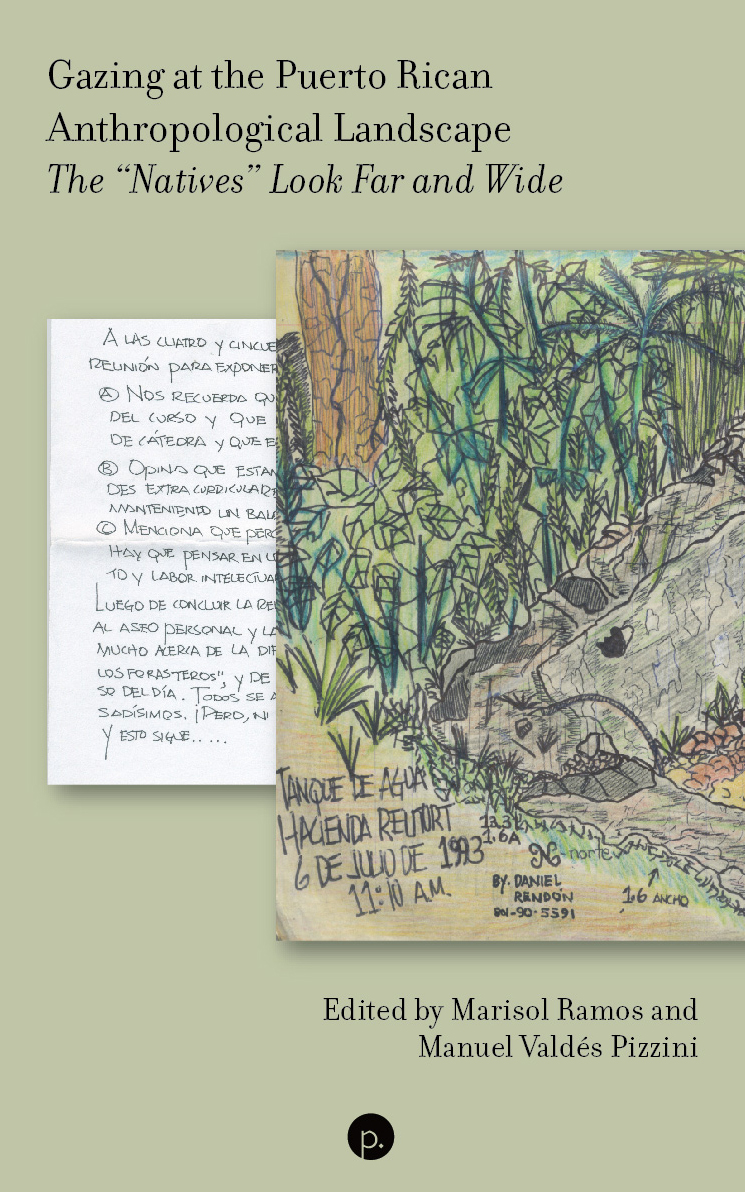
Book information
- Publisher
- punctum books
- Publication
- Published 25 April 2026
- Place
- Earth, Milky Way
- Catalogue record
- View in the catalogue
Abstract
Before World War II, most anthropological research in Puerto Rico was led by US anthropologists. The most famous project, The People of Puerto Rico, was directed by American anthropologist Julian Steward and launched the career of renowned scholars such as Sidney Mintz and Eric Wolf. Gazing at the Puerto Rican Anthropological Landscape aims to delineate the development of the post-WWII anthropological field in Puerto Rico by Puerto Rican anthropologists, the so-called “native” anthropologists. The contributors to Gazing at the Puerto Rican Anthropological Landscape deploy the term “native” somewhat ironically, but they also know that who they are affects their positionality vis-à-vis their research subjects. Thus, they retain the term to spark a conversation addressing the complicated feelings that such labels still evoke among non-mainstream anthropologists.
Gazing at the Puerto Rican Anthropological Landscape purposely avoids making Puerto Rico and Puerto Ricans a problem to study and instead focuses on a wide variety of epistemological and methodological questions related to the study of Puerto Rico and Puerto Ricans by “native” anthropologists within local, regional, and global spheres. We posit that the Puerto Rican anthropological landscape transcends the confines of the island of Puerto Rico to encompass its connection and engagement with the larger world, and that it is not limited to the inhabitants of the island of Puerto Rico but embraces members of its diaspora, as well as other groups and ethnicities. On that note, this book seeks to reflect critically on how the academic field of anthropology (research and teaching) in Puerto Rico has evolved, post-WWII, in various engagements with the current debates of contemporary anthropology — theoretical, methodological, socio-cultural, political, and otherwise.
Chapters
| Chapter | Author | Institution at publication |
|---|---|---|
| Frontmatter | Marisol Ramos, Manuel Valdés Pizzini | |
| Introduction | Marisol Ramos, Manuel Valdés Pizzini | University of California, Santa Barbara; University of Puerto Rico-Mayaguez |
| Anabasis and Katabasis | Manuel Valdés Pizzini | University of Puerto Rico-Mayaguez |
| Investigative Praxis, the (Self-)Deconstruction of Ethnographic Texts, and Multisited Ethnography | Waleska Sanabria León | Pontifical Catholic University of Puerto Rico |
| From Dialectic to Dialogic | Samiri Hernández Hiraldo | Florida A&M University - Florida State University College of Engineering |
| Where Do Islands Go? | Carlo Cubero | Tallinn University |
| Unforgiving Islands | Ricardo Pérez | Eastern Connecticut State University |
| From Chiapas to Florida | Jessica Santos López | Brooklyn College |
| A Personal Reflection on the Anthropology of Puerto Rico and Puerto Ricans | Ismael García Colón | College of Staten Island; The Graduate Center, CUNY |
| From Guayama to Cambridge to Santa Rita | Jorge Duany | |
| Backmatter | Marisol Ramos, Manuel Valdés Pizzini |
Where its authors and editors are based
Countries of the institutions the book's authors, editors and chapter authors were affiliated to when it was published.
- AUTHORS / EDITORS
- CITATIONS Phase 2
- USAGE Phase 3
| Country | Authors / editors |
|---|---|
| United States | 5 |
| Puerto Rico | 2 |
| Estonia | 1 |
About this data
These figures cover 12 works. Each value comes from the most trusted source that has it; a correction made by OJC or OBC staff outranks every source.
| Source | Confidence | Works |
|---|---|---|
| Thoth | 90 / 100 | 12 |
| Works with a publication date | 100% |
|---|---|
| Works with a DOI | 17% |
| Works with a funder recorded | 0% |
| Authors with an affiliation | 69% |
| Affiliations matched to an institution (ROR) | 100% |
| Affiliations with a country | 100% |
Countries come from the institution each author was affiliated to when they published, as recorded in ROR. A country is never guessed, so authors without a matched institution are not counted on the maps.
Funders come from OpenAlex for articles and Thoth for books, where publishers recorded them. Most works record none, so a funder's figures show what is recorded, not everything it funded.
Chapters count as works: their authors and editors, and the countries of their institutions, are in every figure where Thoth records an affiliation for them.
Citations (Phase 2) and usage (Phase 3) are not collected yet.