Book view
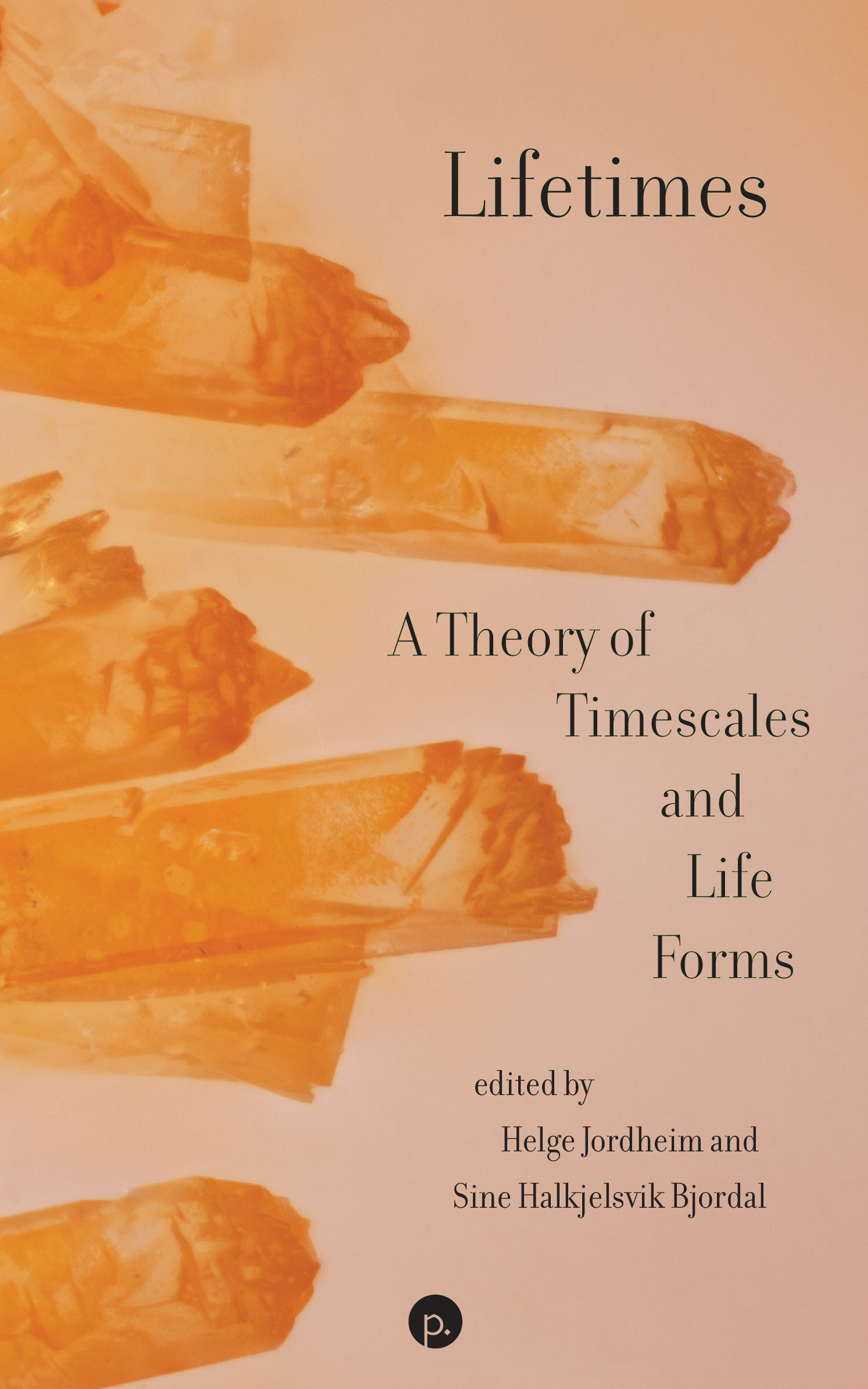
Lifetimes
A Theory of Timescales and Life Forms
Edited by Helge Jordheim, Sine Halkjelsvik Bjordal
Book information
- Publisher
- punctum books
- Publication
- Published 21 May 2026
- Place
- Earth, Milky Way
- Catalogue record
- View in the catalogue
Abstract
At the beginning of the twenty-first century, many of our most well-known and dependable forms of keeping, managing, and representing time are losing their grasp on the real. Clocks cannot measure how societies speed up, or come to a standstill during crisis, modern historiography is unable to come up with meaningful narratives about mankind as the sixth extinction event, and calendars are insufficient as tools for societal and political change. Lifetimes: A Theory of Timescales and Life Forms presents an alternative framework for studying lives and times, and the relationships between them.
Building on post-war theories of history, as well as several historical sub-disciplines, such as cultural history, history of science, and medical history, Lifetimes integrates approaches from anthropology, game studies, cultural studies, literary studies, critical heritage studies, science & technology studies, and critical time studies. Times are understood as always existing in plural, as embodied and emergent—in things, in assemblages of things, and in the relations between things. Among them are the lives of humans, but also the lives of viruses, plants, animals, rocks, computers, nations, concepts, policies, technologies, infrastructures, etc.
Lifetimes explores theoretical foundations while at the same time developing them through case studies in individual chapters. The result is a bottom-up theory of temporal multiplicity, conceptually and theoretically open enough to be productive across various academic disciplines. Rather than discussing how different disciplines relate to time, the authors in this edited collection present a theoretically sustained, empirically diverse range of cases, in which times in plural become politically and historically salient. Out of these case studies a new theory emerges: a theory of lifetimes.
Chapters
Where its authors and editors are based
Countries of the institutions the book's authors, editors and chapter authors were affiliated to when it was published.
- AUTHORS / EDITORS
- CITATIONS Phase 2
- USAGE Phase 3
| Country | Authors / editors |
|---|---|
| Norway | 10 |
| Sweden | 2 |
| The Netherlands | 1 |
| United States | 1 |
About this data
These figures cover 19 works. Each value comes from the most trusted source that has it; a correction made by OJC or OBC staff outranks every source.
| Source | Confidence | Works |
|---|---|---|
| Thoth | 90 / 100 | 19 |
| Works with a publication date | 100% |
|---|---|
| Works with a DOI | 100% |
| Works with a funder recorded | 0% |
| Authors with an affiliation | 95% |
| Affiliations matched to an institution (ROR) | 100% |
| Affiliations with a country | 100% |
Countries come from the institution each author was affiliated to when they published, as recorded in ROR. A country is never guessed, so authors without a matched institution are not counted on the maps.
Funders come from OpenAlex for articles and Thoth for books, where publishers recorded them. Most works record none, so a funder's figures show what is recorded, not everything it funded.
Chapters count as works: their authors and editors, and the countries of their institutions, are in every figure where Thoth records an affiliation for them.
Citations (Phase 2) and usage (Phase 3) are not collected yet.