Book view
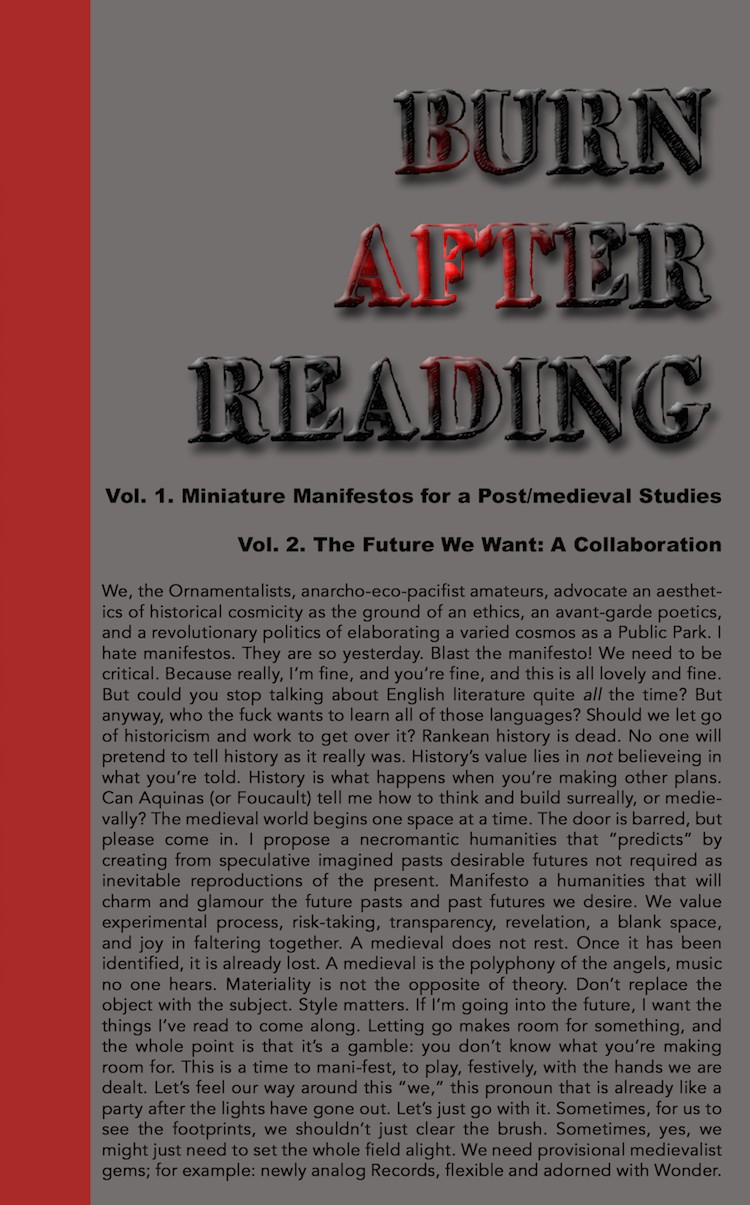
Burn after Reading
Vol. 1, Miniature Manifestos for a Post/medieval Studies + Vol. 2, The Future We Want: A Collaboration
Edited by Eileen A. Joy, Myra Seaman, Jeffrey Jerome Cohen
Book information
- Publisher
- punctum books
- Publication
- Published 28 April 2014
- Place
- Brooklyn, NY
- Catalogue record
- View in the catalogue
Abstract
The essays, manifestos, rants, screeds, pleas, soliloquies, telegrams, broadsides, eulogies, songs, harangues, confessions, laments, and acts of poetic terrorism in these two volumes — which collectively form an academic “rave” — were culled, with some later additions, from roundtable sessions at the International Congress on Medieval Studies in 2012 and 2013, organized by postmedieval: a journal for medieval cultural studies and the BABEL Working Group (“Burn After Reading: Miniature Manifestos for a Post/medieval Studies,” “Fuck This: On Letting Go,” and “Fuck Me: On Never Letting Go”) and George Washington University’s Medieval and Early Modern Studies Institute (“The Future We Want: A Collaboration”), respectively. Gathering together a rowdy multiplicity of voices from within medieval and early modern studies, these two volumes seek to extend and intensify a conversation about how to shape premodern studies, and also the humanities, in the years ahead.
Authors in both volumes, in various ways, lay claim to the act(s) of manifesting, and also anti-manifesting, as a collective endeavor that works on behalf of the future without laying any belligerent claims upon it, where we might craft new spaces for the University-at-large, which is also a University that wanders, that is never just somewhere, dwelling in the partitive — of a particular place — but rather, seeks to be everywhere, always on the move, pandemic, uncontainable, and always to-come, while also being present/between us (manifest). This is not a book, but a blueprint. It is also an ephemeral gathering in the present tense.
Chapters
Where its authors and editors are based
Countries of the institutions the book's authors, editors and chapter authors were affiliated to when it was published.
- AUTHORS / EDITORS
- CITATIONS Phase 2
- USAGE Phase 3
| Country | Authors / editors |
|---|---|
| United States | 28 |
| Canada | 3 |
| United Kingdom | 3 |
| Germany | 2 |
| Australia | 1 |
| Philippines | 1 |
About this data
These figures cover 33 works. Each value comes from the most trusted source that has it; a correction made by OJC or OBC staff outranks every source.
| Source | Confidence | Works |
|---|---|---|
| Thoth | 90 / 100 | 33 |
| Works with a publication date | 100% |
|---|---|
| Works with a DOI | 100% |
| Works with a funder recorded | 0% |
| Authors with an affiliation | 89% |
| Affiliations matched to an institution (ROR) | 100% |
| Affiliations with a country | 100% |
Countries come from the institution each author was affiliated to when they published, as recorded in ROR. A country is never guessed, so authors without a matched institution are not counted on the maps.
Funders come from OpenAlex for articles and Thoth for books, where publishers recorded them. Most works record none, so a funder's figures show what is recorded, not everything it funded.
Chapters count as works: their authors and editors, and the countries of their institutions, are in every figure where Thoth records an affiliation for them.
Citations (Phase 2) and usage (Phase 3) are not collected yet.