Book view
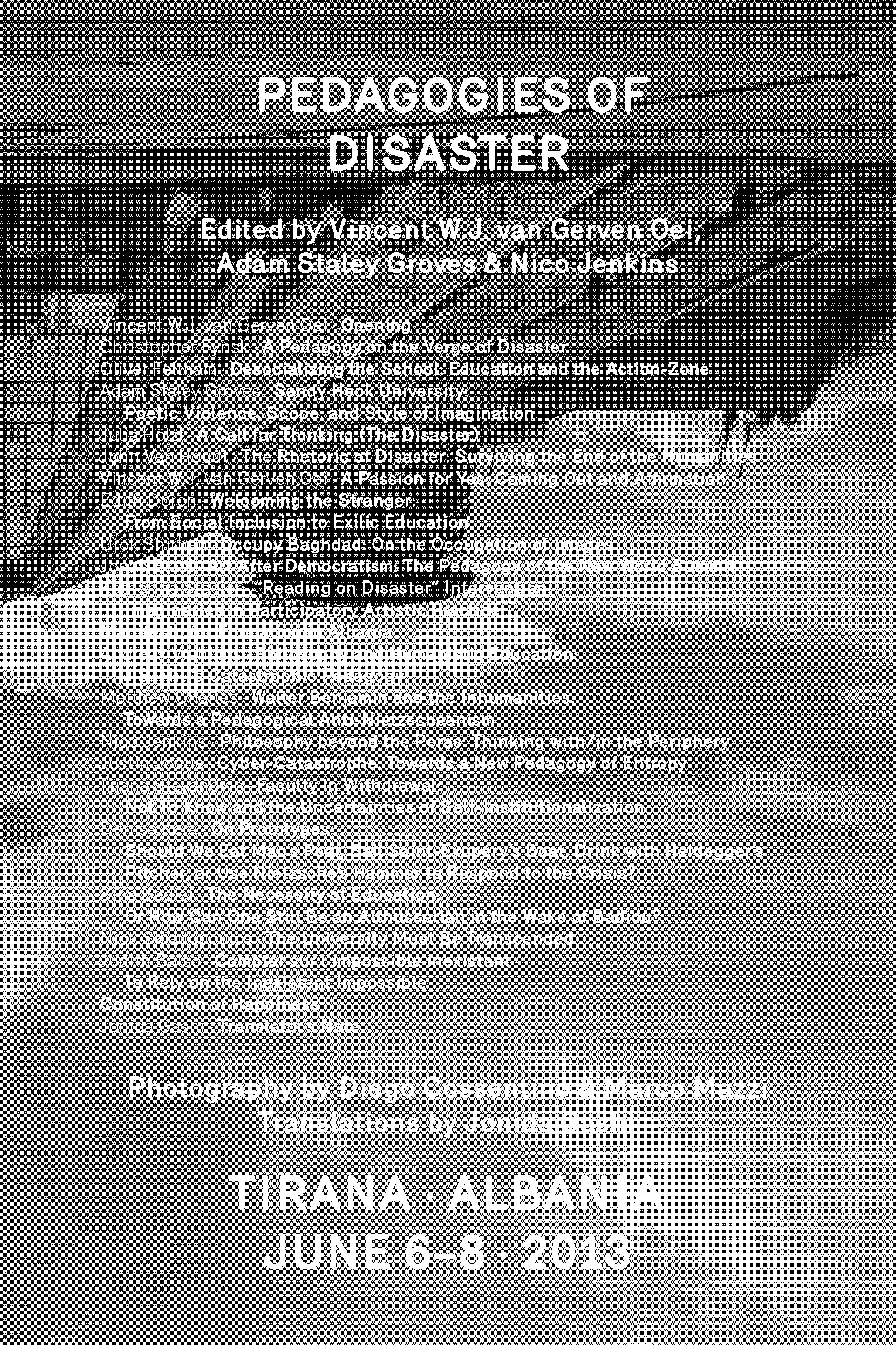
Pedagogies of Disaster
Edited by Adam Staley Groves, Nico Jenkins, Vincent W.J. van Gerven Oei
Book information
- Publisher
- punctum books
- Publication
- Published 7 October 2013
- Place
- Brooklyn, NY
- Catalogue record
- View in the catalogue
Abstract
We live in an era where the university system is undergoing great changes owing to developments in financing policies and research priorities, as well as changes in the society in which this system is embedded. This change toward a more market-oriented university, which also has immediate effects in academic peripheries such as the Balkans, the Middle East, or South-East Asia, is of great influence for the pedagogical practice of “less profitable” academic areas such as the Humanities: philosophy, languages, sociology, anthropology, history.
Because of the absence of a historically grounded establishment of the Humanities, academic peripheries, usually accompanied by a weak civil society infrastructure, seem to offer the most fertile ground for rethinking the Humanities, their pedagogical practice, and their politics, as well as the greatest threats, such as the ongoing capitalization of research, and profitability as the norm of educational achievement. The sprawling presence of for-profit universities and in academic peripheries such as Albania and Kosovo is indicative of this problematic, as are consistent underfunding of universities and the relentless budget cuts in American and English, and to a lesser extent European, universities. Motivations for this ongoing attack on the university are often driven by a political system or a politics with an aggressive stance to critical thought.
At the same time, such an absence of historical grounding may inspire a rejuvenation and reinvigoration of research in the Humanities, such as may be seen in academic centers around Asia, as many young scholars are attracted to an educational environment which is not yet completely petrified in bureaucratic procedures. In this case, a different set of questions appear concerning the place of the scholar in societies with semi-democratic or even authoritarian rule. For civil society to flourish, an educational system that reflects and interrogates the values and concepts that underlie a healthy social fabric are of crucial importance.
This volume comprises papers culled from continent. journal’s Pedagogies of Disaster conference held in Tirana, Albania, hosted by The Department of Eagles (Departamenti i Shqiponjave) in June 2013, and organized to address the fate of relation and the future of pedagogical practice in the University, and especially as it concerns the humanities. The papers gathered here seek to address the infrastructural or interpersonal changes in the modes of production as it relates to current academia, examining the elements and spaces of the rifts opening up in the polis of the University—its students, professors, and administrators. The volume further addresses the pedagogical horizon at a critical limit, asking: for whom or for what are we teaching and from whom or from what are we learning?
Chapters
Where its authors and editors are based
Countries of the institutions the book's authors, editors and chapter authors were affiliated to when it was published.
- AUTHORS / EDITORS
- CITATIONS Phase 2
- USAGE Phase 3
| Country | Authors / editors |
|---|---|
| United Kingdom | 7 |
| Switzerland | 5 |
| United States | 3 |
| Cyprus | 2 |
| Singapore | 2 |
| France | 1 |
| The Netherlands | 1 |
About this data
These figures cover 48 works. Each value comes from the most trusted source that has it; a correction made by OJC or OBC staff outranks every source.
| Source | Confidence | Works |
|---|---|---|
| Thoth | 90 / 100 | 48 |
| Works with a publication date | 100% |
|---|---|
| Works with a DOI | 100% |
| Works with a funder recorded | 0% |
| Authors with an affiliation | 63% |
| Affiliations matched to an institution (ROR) | 100% |
| Affiliations with a country | 100% |
Countries come from the institution each author was affiliated to when they published, as recorded in ROR. A country is never guessed, so authors without a matched institution are not counted on the maps.
Funders come from OpenAlex for articles and Thoth for books, where publishers recorded them. Most works record none, so a funder's figures show what is recorded, not everything it funded.
Chapters count as works: their authors and editors, and the countries of their institutions, are in every figure where Thoth records an affiliation for them.
Citations (Phase 2) and usage (Phase 3) are not collected yet.