Book information
- Publisher
- punctum books
- Publication
- Published 27 February 2026
- Place
- Earth, Milky Way
- Catalogue record
- View in the catalogue
Abstract
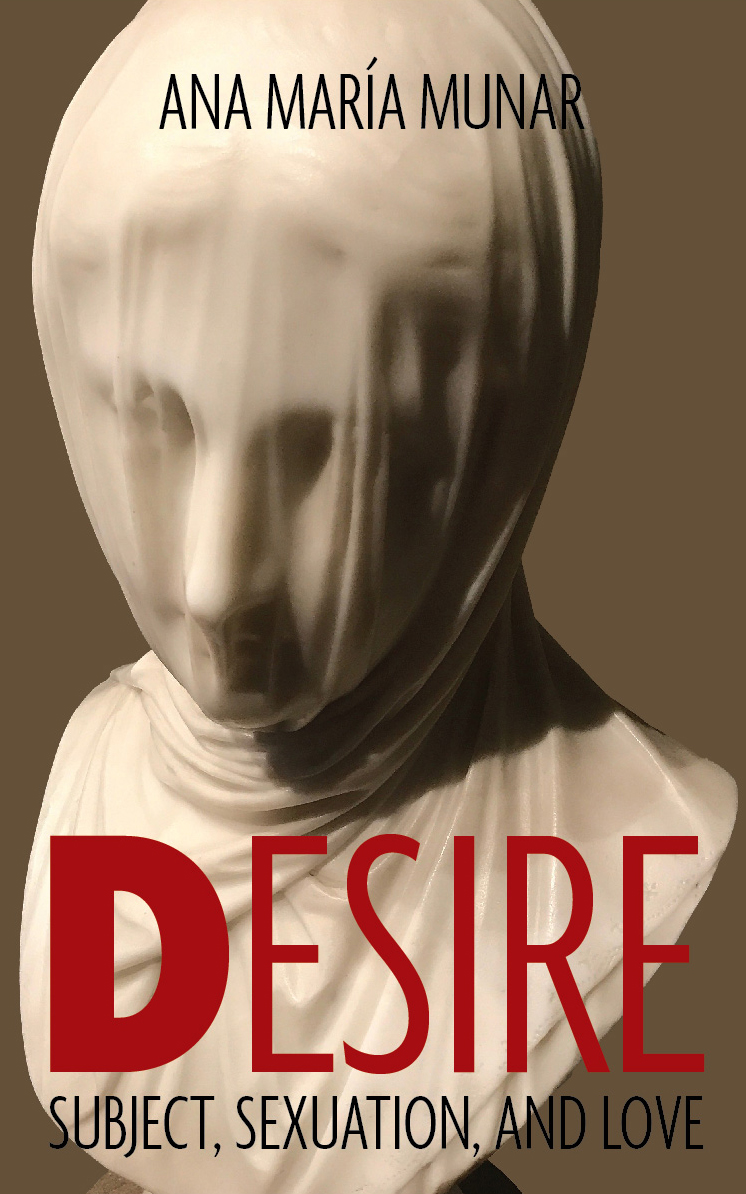
Have you ever wondered what makes you wake up in the morning? Why not just lay down, stay, and eventually disappear? What is the wanting, the energy, and the grace of liveliness? Desire is at the core of liveliness, and this book explains why it is so. Desire is much more than a mere appendix to love, sex, or our craving to have the latest fashion item. It is what allows the most personal and unique expression of each of us.
Desire: Subject, Sexuation, and Love is a work of gratitude to the Lacanian tradition and feminist philosophy. It creatively uses the story of “The Little Mermaid” by H.C. Andersen, as well as art and popular culture to explain the complex landscape of desire and its relation to love and sexuation. Much of the criticism of psychoanalysis from gender studies and poststructuralism is based on a superficial reading of Jacques Lacan, and Munar corrects this, providing in the first half of the book a rigorous and clear analysis of Lacanian subjectification and sexuation, elucidating their relationship to the nature of desire and love, in order to modify overly simplistic and erroneous interpretations of his thinking on desire.
Desire is essayistic and poetic philosophy, drawing upon and playing with psychoanalysis, philosophy, literature, biography, poetry, and art. As the reader enters the second part of the book, the focus on Lacanian theory recedes, opening a space that is more paradoxical and multiple where Munar engages in creative form as an expression of critique, transforming our understandings of desire and love, which always elude us while also always being present.
Where its authors and editors are based
Countries of the institutions the book's authors, editors and chapter authors were affiliated to when it was published.
- AUTHORS / EDITORS
- CITATIONS Phase 2
- USAGE Phase 3
| Country | Authors / editors |
|---|---|
| Denmark | 1 |
About this data
These figures cover 1 work. Each value comes from the most trusted source that has it; a correction made by OJC or OBC staff outranks every source.
| Source | Confidence | Works |
|---|---|---|
| Thoth | 90 / 100 | 1 |
| Works with a publication date | 100% |
|---|---|
| Works with a DOI | 100% |
| Works with a funder recorded | 0% |
| Authors with an affiliation | 100% |
| Affiliations matched to an institution (ROR) | 100% |
| Affiliations with a country | 100% |
Countries come from the institution each author was affiliated to when they published, as recorded in ROR. A country is never guessed, so authors without a matched institution are not counted on the maps.
Funders come from OpenAlex for articles and Thoth for books, where publishers recorded them. Most works record none, so a funder's figures show what is recorded, not everything it funded.
Chapters count as works: their authors and editors, and the countries of their institutions, are in every figure where Thoth records an affiliation for them.
Citations (Phase 2) and usage (Phase 3) are not collected yet.