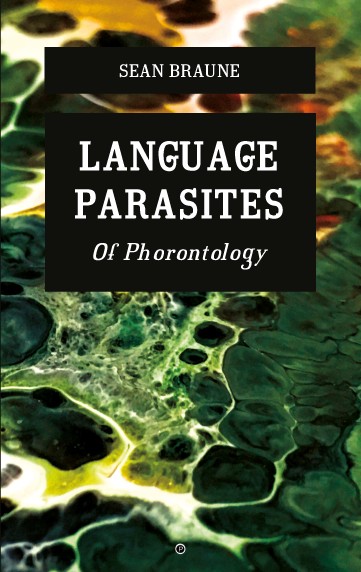
Book information
- Publisher
- punctum books
- Publication
- Published 4 May 2017
- Place
- Earth, Milky Way
- Catalogue record
- View in the catalogue
Abstract
Who speaks when you speak? Who writes when you write? Is it “you”—is it the “I” that you think you are? Or are we the chance inheritors of an invasive, exterior parasite—a parasite that calls itself “Being” or “Language?” If our sense of self is best defined on the basis of an exterior, parasitical force that enters us from the outside, then the “self” is no longer a centralized or agential “inside,” but rather becomes reconfigured as the result of an “outside” that parasitizes the “inside”-as-host. Rough versions of this model can be found in several traditions of continental philosophy: in Lacan, Derrida, Serres, Kristeva, Foucault, Baudrillard, to name a few. However, the full implications of this ontological model have yet to be addressed: what are its consequences for a theory of subjects, objects, and the agencies that intersect with them? How does this framework alter our understandings of the human and the non-human, the vital and the material?
An off-kilter point of view is required to consider this historical and philosophical situation. Language Parasites argues that the best way to conceive of the “self” or “subject” as something linguistically and ontologically constituted by an aggressive and parasitical outside is by asking the following question: “what is the being of a parasite?” In addressing this challenge, Braune combines speculative philosophy with ’Pataphysics (the absurdist science, invented by Alfred Jarry, that theorizes a physics beyond both the para and the meta, resulting in the pata). These theoretical collisions betray a variety of swerves that extend to the social (as a parasite semiotics), the cultural (as the invasive force of memes), the aesthetic (as the transition of postmodernism to postmortemism), the linguistic (as found in Saussure’s paranoid researches into the paragram), the poetic (as seen in Christopher Dewdney’s journey into “Parasite Maintenance” and Christian Bök’s attempts to embed a poem in a bacterium), and the literary (as para-cited in Henry Miller’s experience of housing a parasite named “Conrad Moricand”). The “voice” of the parasite can be found in what Saussure calls the “paragram”—the uncanny messages that lurk hidden underneath the written word. And what does the parasite say? Or, does its speech reject human ears?
If the voice of the parasite mutters in the ear of the subject, then an anterior theoretical listening—a phorontology—is required, one that can negate the anthropocentric regimes of binaristic thought: the dyads of good and evil, right and wrong, male and female, inside and outside, etc. Language Parasites effectively transjects these dyads and emerges from these revealed sites and para-sites with a banquet of new philosophical concepts. Each of these concepts—such as “postmortemism,” “hyperhistory,” “the subject-of” or the “transject”—is selected for its intrinsic usefulness: they are scalpels and tools that can helpfully transcend anthropocentric dyads in order to unveil the continua of the non-human.
The careful reader will already realize that Language Parasites is the result of a philosophical continental infection: it is the location of a meeting between the Derrida-parasite, the Serres-parasite, the Lacan-parasite, the Foucault-parasite, the Hegel-parasite, the Laruelle-parasite, and many other philosophical parasites. These parasites act as the hosts of other philosophies, each parasiting the other. Philosophy qua philosophy becomes the complex locale of a vigorous negotiation between host and parasite—a complex world that also implicates the author (lying on the postmortem slab) and the reader (requiring some form of medical or philosophical intervention). Language Parasites offers exactly this kind of medico-philosophical treatment: it is a tincture and a curative for your philosophical needs and ailments. You will feel full after reading this book.
Where its authors and editors are based
Countries of the institutions the book's authors, editors and chapter authors were affiliated to when it was published.
- AUTHORS / EDITORS
- CITATIONS Phase 2
- USAGE Phase 3
No affiliations with a known country in these years yet.
About this data
These figures cover 1 work. Each value comes from the most trusted source that has it; a correction made by OJC or OBC staff outranks every source.
| Source | Confidence | Works |
|---|---|---|
| Thoth | 90 / 100 | 1 |
| Works with a publication date | 100% |
|---|---|
| Works with a DOI | 100% |
| Works with a funder recorded | 0% |
| Authors with an affiliation | 0% |
Countries come from the institution each author was affiliated to when they published, as recorded in ROR. A country is never guessed, so authors without a matched institution are not counted on the maps.
Funders come from OpenAlex for articles and Thoth for books, where publishers recorded them. Most works record none, so a funder's figures show what is recorded, not everything it funded.
Chapters count as works: their authors and editors, and the countries of their institutions, are in every figure where Thoth records an affiliation for them.
Citations (Phase 2) and usage (Phase 3) are not collected yet.