Book view
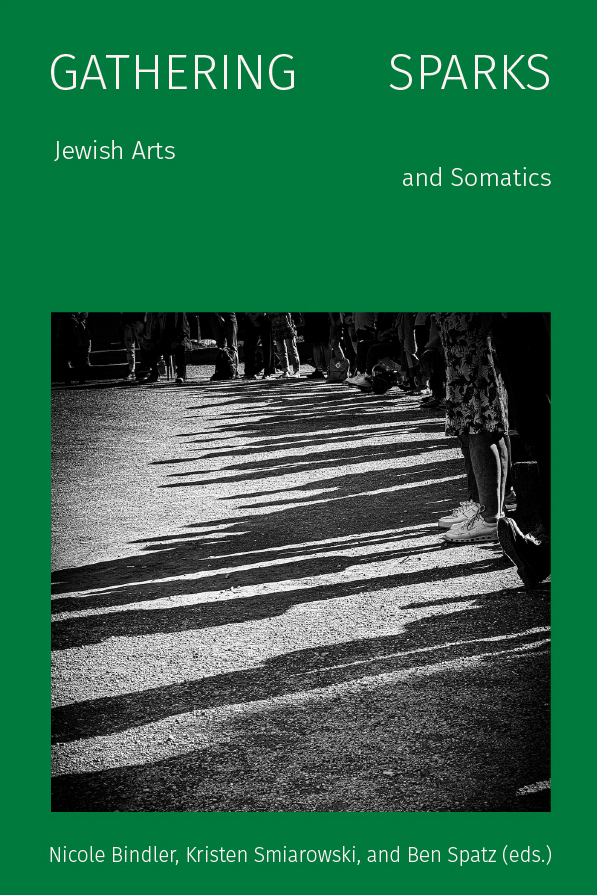
Gathering Sparks
Jewish Arts and Somatics
Edited by Nicole Bindler, Kristen Smiarowski, Ben Spatz
Book information
- Publisher
- punctum books
- Publication
- Forthcoming 1 April 2027
- Place
- Earth, Milky Way
- Catalogue record
- View in the catalogue
Abstract
Contemporary renewals of judaism and jewishness return again and again to the kabbalistic image of gathering sparks, an approach to tikkun olam or healing the world that recognizes fragmentation and incompleteness as central to our attempts at doing good. This volume arises out of a shared sense of the sparks that we gather as jewish movers, creators, and activists in the 2020s. The glimmers of hope that we steward are too often limited by logocentric assumptions about what is real, what is meaningful, and what is political. Yet we know that some of the most important knowledge is carried in our bodies: as dance technique, as somatic awareness, as ways of thinking and researching through practice.
The essays collected in Gathering Sparks: Jewish Arts and Somatics reveal a variety of ways to be jewish and a diversity of creative, spiritual, and political practices that are informed by a wide variety of contemporary jewish experiences. They are rooted in a commitment to decolonization, while at the same time holding space for different ideas about what that means. Even within non-zionist and anti-zionist circles, individuals in this volume do not always think or feel the same about how to move forward with ideas and practices of jewishness in the present. For some, explicit solidarity with the movement for a free Palestine must be central to any legitimate actions taken under the banner of jewishness or judaism. Others emphasize relations of solidarity and connection with indigenous and/or Black diasporic communities, with a difficult yet necessary untangling from whiteness, and with allied investigations of trans, queer, feminist, and nonbinary identities.
Although this is not a handbook or manual, we hope that the essays and images gathered here will serve as sparks to light the imaginations and activations of others—not as a single approach, but as a kaleidoscope of methods and pathways, traced by others that may resonate with your own life and work. Despite and because of their differences, we find that they work together to offer a breath of something new: a way of articulating with, through, and even sometimes against jewishness that is neither nostalgic nor solely critical but fresh, artistic, politically committed, historically informed, creative, and embodied.
Where its authors and editors are based
Countries of the institutions the book's authors, editors and chapter authors were affiliated to when it was published.
- AUTHORS / EDITORS
- CITATIONS Phase 2
- USAGE Phase 3
| Country | Authors / editors |
|---|---|
| United Kingdom | 1 |
About this data
These figures cover 1 work. Each value comes from the most trusted source that has it; a correction made by OJC or OBC staff outranks every source.
| Source | Confidence | Works |
|---|---|---|
| Thoth | 90 / 100 | 1 |
| Works with a publication date | 100% |
|---|---|
| Works with a DOI | 100% |
| Works with a funder recorded | 0% |
| Authors with an affiliation | 33% |
| Affiliations matched to an institution (ROR) | 100% |
| Affiliations with a country | 100% |
Countries come from the institution each author was affiliated to when they published, as recorded in ROR. A country is never guessed, so authors without a matched institution are not counted on the maps.
Funders come from OpenAlex for articles and Thoth for books, where publishers recorded them. Most works record none, so a funder's figures show what is recorded, not everything it funded.
Chapters count as works: their authors and editors, and the countries of their institutions, are in every figure where Thoth records an affiliation for them.
Citations (Phase 2) and usage (Phase 3) are not collected yet.