Book view
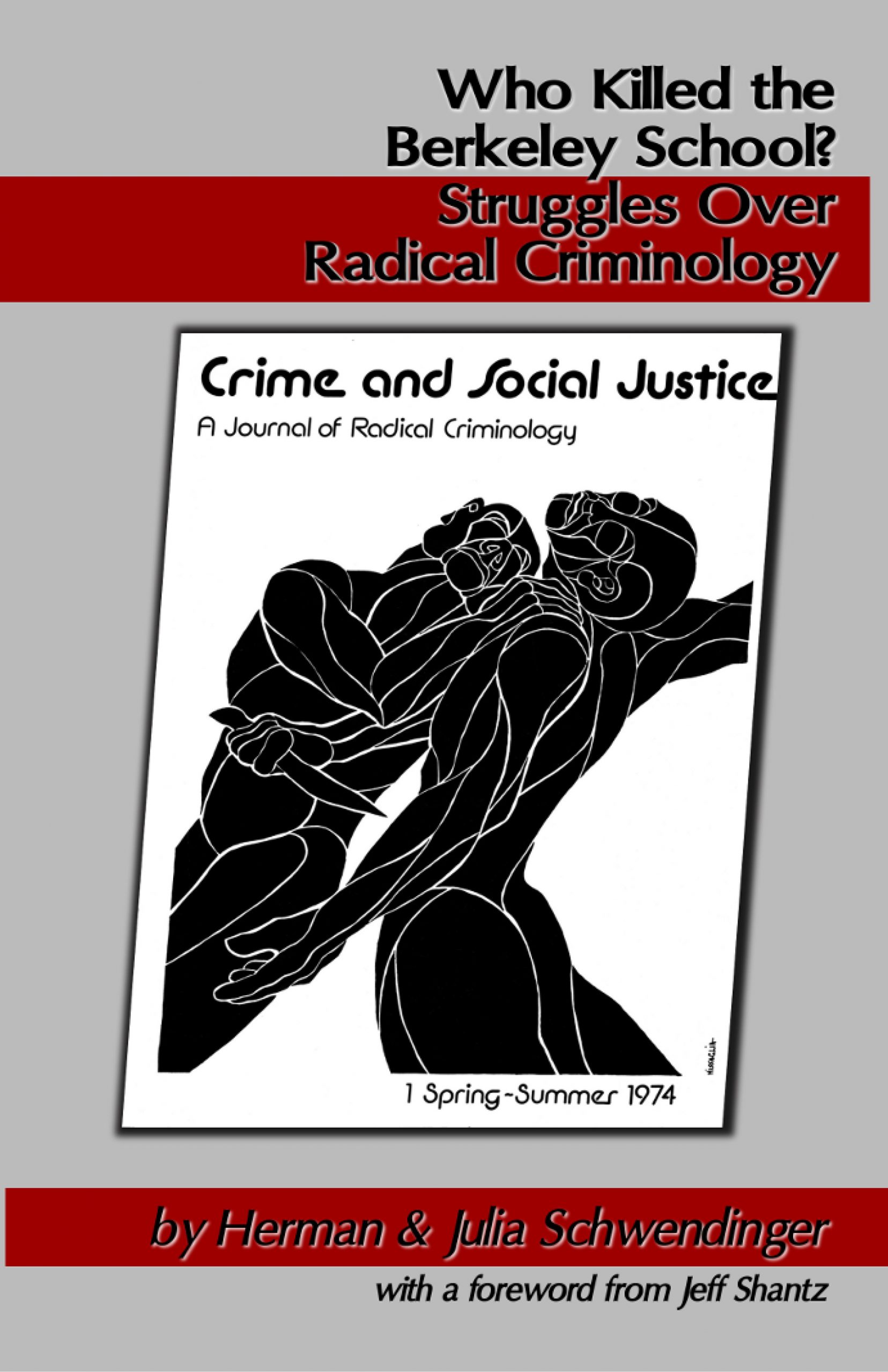
Who Killed the Berkeley School?
Struggles over Radical Criminology
Book information
- Publisher
- punctum books
- Publication
- Published 21 April 2014
- Place
- Brooklyn, NY
- Catalogue record
- View in the catalogue
Abstract
The Berkeley School of Criminology stands, to this day, as one of the most significant developments in criminological thought and action. Its diverse participants, students and faculty, were true innovators, producing radical social analyses (getting to the roots causes) of institutions of criminal justice as part of broader relations of inequality, injustice, exploitation, patriarchy, and white supremacy within capitalist societies. Even more they situated criminology as an active part of opposition to these social institutions and the relations of harm they uphold. Their criminology was directly engaged in, and connected with, the struggles of resistance that emerged in the late 1960s and early 1970s. Not surprisingly perhaps, they became a target of regressive and reactionary forces that sought to quiet those struggles. Notably the Berkeley School of Criminology was targeted by key players in the US military-industrial complex such as Ronald Reagan himself, then Governor of California and Regent of UC-Berkeley.
Who Killed the Berkeley School? by Julia and Herman Schwendinger, key players in the Berkeley School, is the first full-length, in-depth analysis, of the Berkeley School of Criminology, its participants, and the attack against it. It tells the story of an important infrastructure of resistance, a resource of struggle, and how it was dismantled. It lays bare the role not only of conservatives but of liberal academics and false critical theorists, who failed to stand up in defense of the School and its work when called upon.
This is a story with profound lessons in the current period of corporatization of campuses, neoliberal education, and market-driven curricula. It will be of interest to anyone concerned with developing resistance to the corporate campus and seeking critical alternatives. It also stands as a challenge to social science disciplines, including criminology, to develop a practice that identifies the roots of social injustice and organizes to confront it.
Where its authors and editors are based
Countries of the institutions the book's authors, editors and chapter authors were affiliated to when it was published.
- AUTHORS / EDITORS
- CITATIONS Phase 2
- USAGE Phase 3
| Country | Authors / editors |
|---|---|
| United States | 2 |
| Canada | 1 |
About this data
These figures cover 1 work. Each value comes from the most trusted source that has it; a correction made by OJC or OBC staff outranks every source.
| Source | Confidence | Works |
|---|---|---|
| Thoth | 90 / 100 | 1 |
| Works with a publication date | 100% |
|---|---|
| Works with a DOI | 100% |
| Works with a funder recorded | 0% |
| Authors with an affiliation | 100% |
| Affiliations matched to an institution (ROR) | 100% |
| Affiliations with a country | 100% |
Countries come from the institution each author was affiliated to when they published, as recorded in ROR. A country is never guessed, so authors without a matched institution are not counted on the maps.
Funders come from OpenAlex for articles and Thoth for books, where publishers recorded them. Most works record none, so a funder's figures show what is recorded, not everything it funded.
Chapters count as works: their authors and editors, and the countries of their institutions, are in every figure where Thoth records an affiliation for them.
Citations (Phase 2) and usage (Phase 3) are not collected yet.