Book information
- Publisher
- punctum books
- Publication
- Published 7 February 2020
- Place
- Earth, Milky Way
- Catalogue record
- View in the catalogue
Abstract
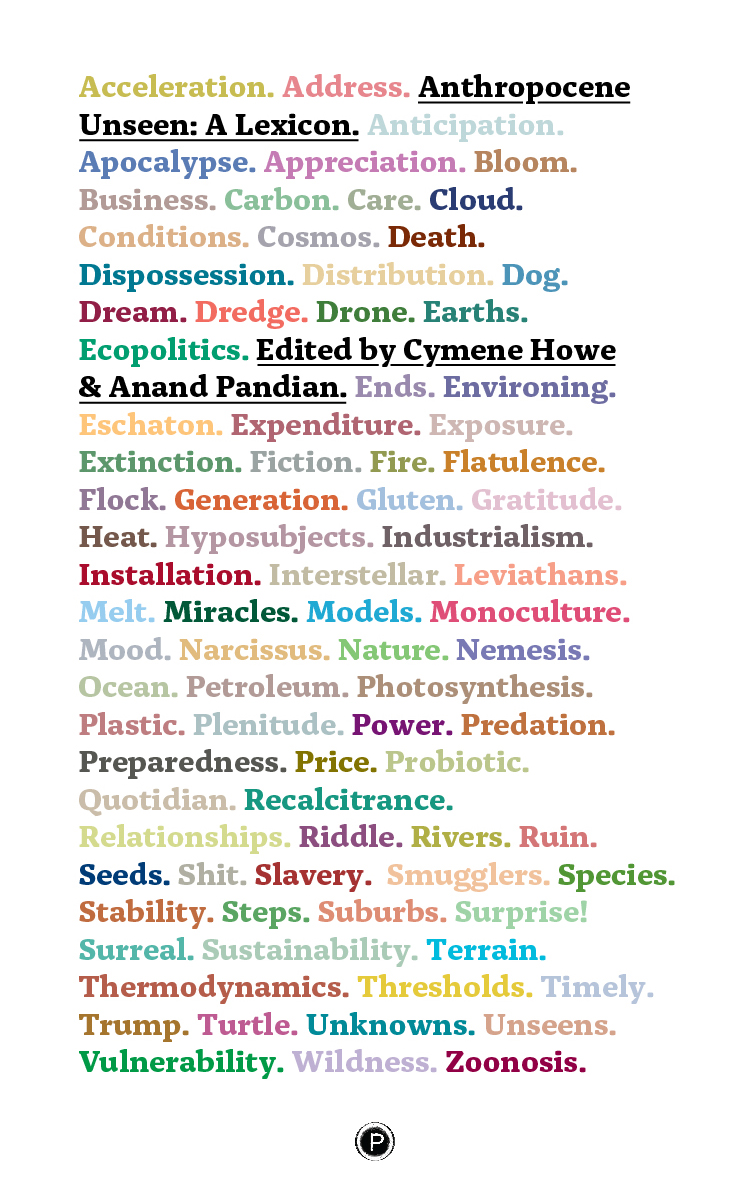
The idea of the Anthropocene often generates an overwhelming sense of abjection or apathy. It occupies the imagination as a set of circumstances that counterpose individual human actors against ungraspable scales and impossible odds. There is much at stake in how we understand the implications of this planetary imagination, and how to plot paths from this present to other less troubling futures. With Anthropocene Unseen: A Lexicon, the editors aim at a resource helpful for this task: a catalog of ways to pluralize and radicalize our picture of the Anthropocene, to make it speak more effectively to a wider range of contemporary human societies and circumstances. Organized as a lexicon for troubled times, each entry in this book recognizes the gravity of the global forecasts that invest the present with its widespread air of crisis, urgency, and apocalyptic possibility. Each also finds value in smaller scales of analysis, capturing the magnitude of an epoch in the unique resonances afforded by a single word.
The Holocene may have been the age in which we learned our letters, but we are faced now with circumstances that demand more experimental plasticity. Alternative ways of perceiving a moment can bring a halt to habitual action, opening a space for slantwise movements through the shock of the unexpected. Each small essay in this lexicon is meant to do just this, drawing from anthropology, literary studies, artistic practice, and other humanistic endeavors to open up the range of possible action by contributing some other concrete way of seeing the present. Each entry proposes a different way of conceiving this Earth from some grounded place, always in a manner that aims to provoke a different imagination of the Anthropocene as a whole.
The Anthropocene is a world-engulfing concept, drawing every thing and being imaginable into its purview, both in terms of geographic scale and temporal duration. Pronouncing an epoch in our own name may seem the ultimate act of apex species self-aggrandizement, a picture of the world as dominated by ourselves. Can we learn new ways of being in the face of this challenge, approaching the transmogrification of the ecosphere in a spirit of experimentation rather than catastrophic risk and existential dismay? This lexicon is meant as a site to imagine and explore what human beings can do differently with this time, and with its sense of peril.
Chapters
| Chapter | Author | Institution at publication |
|---|---|---|
| Introduction | Cymene Howe, Anand Pandian | Rice University; Johns Hopkins University |
| Acceleration | David Rojas | Bucknell University |
| Address | Marina Zurkow, Una Chaudhuri, Oliver Kellhammer, Fritz Ertl | New York University; Parsons School of Design |
| Anticipation | Joseph Masco | University of Chicago |
| Apocalypse | Roy Scranton | University of Notre Dame |
| Appreciation | Matthew Archer | Copenhagen Business School |
| Bloom | Chitra Venkataramani | National University of Singapore |
| Business | Gökçe Günel | Rice University |
| Carbon | Jerome Whitington | New York University |
| Care | Charis Boke | Saint Michael's College |
| Cloud | Vasundhara Bhojvaid | Shiv Nadar University |
| Conditions | Franz Krause | University of Cologne |
| Cosmos | Abou Farman | The New School |
| Death | Maria Whiteman | Indiana University |
| Dispossession | Paige West | Columbia University |
| Distribution | Timothy Choy | University of California, Davis |
| Dog | Ann Marie Thornburg | University of Notre Dame |
| Dream | Timothy Morton | Rice University |
| Dredge | Ashley Carse | Vanderbilt University |
| Drone | Marcel LaFlamme | Rice University |
| Earths | Joshua Reno | Binghamton University |
| Ecopolitics | Eduardo Kohn | McGill University |
| Ends | Imre Szeman | University of Waterloo |
| Environing | Jeffrey Jerome Cohen | Arizona State University |
| Eschaton | Jonathan Padwe | University of Hawaiʻi at Mānoa |
| Expenditure | Naveeda Khan | Johns Hopkins University |
| Exposure | Elizabeth F.S. Roberts | University of Michigan |
| Extinction | Noah Theriault, Audra Mitchell | Carnegie Mellon University; University of York |
| Fiction | Anindita Banerjee | Cornell University |
| Figures | Cymene Howe, Anand Pandian | Rice University; Johns Hopkins University |
| Fire | Daniel Fisher | University of California, Berkeley |
| Flatulence | Radhika Govindrajan | University of Washington |
| Flock | Anne Galloway | Victoria University of Wellington |
| Frontmatter | Cymene Howe, Anand Pandian | Rice University; Johns Hopkins University |
| Generation | Vincent Ialenti | Cornell University |
| Gluten | Jessica Barnes | University of South Carolina |
| Gratitude | Iza Kavedžija | University of Exeter |
| Heat | Alex Nading | Cornell University |
| Hyposubjects | Dominic Boyer, Timothy Morton | Rice University |
| Industrialism | Craig Campbell | The University of Texas at Austin |
| Installation | Serpil Oppermann | Cappadocia University |
| Interstellar | Michael P. Oman-Reagan | Memorial University of Newfoundland |
| Leviathans | Alex Golub | University of Hawaiʻi at Mānoa |
| Melt | Stefan Helmreich | Massachusetts Institute of Technology |
| Miracles | Diego Cagüeñas Rozo | The New School |
| Models | Jeremy Trombley | Western University |
| Monoculture | Sarah Besky | Cornell University |
| Mood | Atreyee Majumder | O. P. Jindal Global University |
| Narcissus | Naisargi N. Dave | University of Toronto |
| Nature | Stuart McLean | University of Minnesota |
| Nemesis | Laura Watts | University of Edinburgh |
| Ocean | Steve Mentz | St. John's University |
| Petroleum | Elizabeth Povinelli | Columbia University |
| Photosynthesis | Natasha Myers | York University |
| Plastic | Anand Pandian | Johns Hopkins University |
| Plenitude | Lora Koycheva | Ludwig-Maximilians-Universität München |
| Power | John Hartigan | The University of Texas at Austin |
| Predation | Nayanika Mathur | University of Oxford |
| Preparedness | Frédéric Keck | National Council for Scientific Research |
| Price | Maira Hayat | University of Notre Dame |
| Probiotic | Jamie Lorimer | University of Oxford |
| Quotidian | Eli Elinoff, Tyson Vaughan | Victoria University of Wellington; United States Army Corps of Engineers |
| Recalcitrance | Rijul Kochhar | University of Michigan |
| Relationships | Zoe Todd | Carleton University |
| Riddle | Michael Gossett | The Graduate Center, CUNY |
| Rivers | Rochelle Tobias | Johns Hopkins University |
| Ruin | Sophia Roosth | New York University |
| Seeds | Tracey Heatherington | University of British Columbia |
| Shit | Nicholas C. Kawa | The Ohio State University |
| Slavery | Claire Colebrook | Pennsylvania State University |
| Smugglers | Jason De León | University of California, Los Angeles |
| Species | Eben Kirksey | Deakin University |
| Stability | Elizabeth Reddy | Colorado School of Mines |
| Steps | smudge studio | The New School |
| Suburbs | Andrew Pendakis | Brock University |
| Surprise! | Zoe Nyssa | Purdue University West Lafayette |
| Surreal | Nicholas Shapiro | University of Oxford |
| Sustainability | María García Maldonado, Rosario García Meza, Emily Yates-Doerr | University of Amsterdam |
| Terrain | Gastón Gordillo | University of British Columbia |
| Thermodynamics | Cara New Daggett | Virginia Tech |
| Thresholds | P. Joshua Griffin | University of Washington |
| Timely | Cymene Howe | Rice University |
| Trump | Tom Cohen | York University |
| Turtle | Nomi Stone | Princeton University |
| Unknowns | Debbora Battaglia | Mount Holyoke College |
| Unseens | Celia Lowe | University of Washington |
| Vulnerability | Sarah E. Vaughn | University of California, Berkeley |
| Wildness | Dana J. Graef | Yale University |
| Zoonosis | Genese Marie Sodikoff | Rutgers, The State University of New Jersey |
Where its authors and editors are based
Countries of the institutions the book's authors, editors and chapter authors were affiliated to when it was published.
- AUTHORS / EDITORS
- CITATIONS Phase 2
- USAGE Phase 3
| Country | Authors / editors |
|---|---|
| United States | 61 |
| Canada | 11 |
| United Kingdom | 6 |
| Germany | 2 |
| India | 2 |
| New Zealand | 2 |
| Australia | 1 |
| Denmark | 1 |
All 13 countries
| Country | Authors / editors |
|---|---|
| United States | 61 |
| Canada | 11 |
| United Kingdom | 6 |
| Germany | 2 |
| India | 2 |
| New Zealand | 2 |
| Australia | 1 |
| Denmark | 1 |
| Lebanon | 1 |
| Singapore | 1 |
| Taiwan | 1 |
| The Netherlands | 1 |
| Turkey | 1 |
About this data
These figures cover 90 works. Each value comes from the most trusted source that has it; a correction made by OJC or OBC staff outranks every source.
| Source | Confidence | Works |
|---|---|---|
| Thoth | 90 / 100 | 90 |
| Works with a publication date | 100% |
|---|---|
| Works with a DOI | 100% |
| Works with a funder recorded | 1% |
| Authors with an affiliation | 98% |
| Affiliations matched to an institution (ROR) | 100% |
| Affiliations with a country | 100% |
Countries come from the institution each author was affiliated to when they published, as recorded in ROR. A country is never guessed, so authors without a matched institution are not counted on the maps.
Funders come from OpenAlex for articles and Thoth for books, where publishers recorded them. Most works record none, so a funder's figures show what is recorded, not everything it funded.
Chapters count as works: their authors and editors, and the countries of their institutions, are in every figure where Thoth records an affiliation for them.
Citations (Phase 2) and usage (Phase 3) are not collected yet.