Book information
- Publisher
- punctum books
- Publication
- Published 18 January 2024
- Place
- Earth, Milky Way
- Catalogue record
- View in the catalogue
Abstract
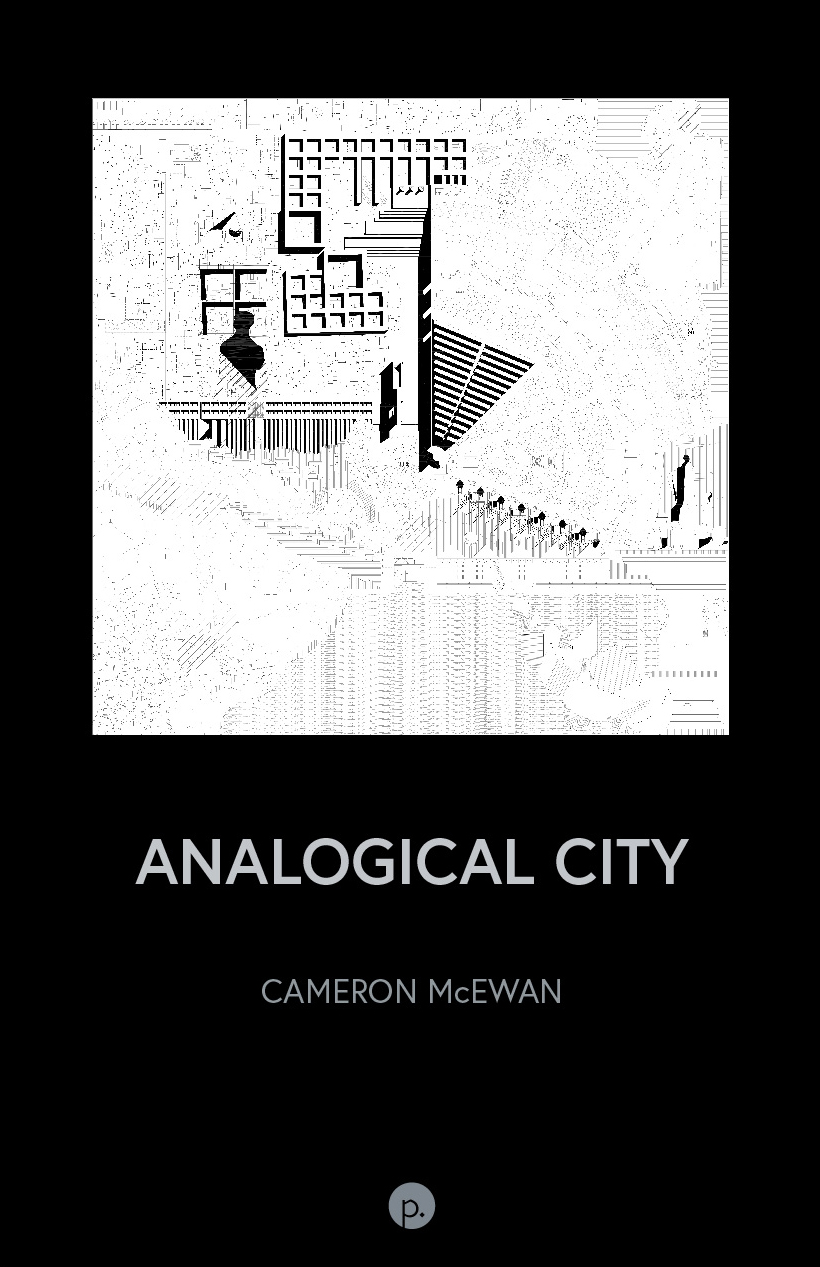
In Analogical City, Cameron McEwan argues for architecture’s status as a critical project. McEwan revisits architect Aldo Rossi as a paradigmatic figure of the critical rational tradition, studying a neglected aspect of his thought — the analogical city — to excavate its potential. McEwan develops a grammar of the analogical city under the headings of Imagination, Transformation, City, Multitude, and Project. McEwan argues that the analogical city is critical, collective, and emancipatory. Analogical thought and understanding cities as analogical might open the conditions of possibility for rethinking the critical project in architecture.
At a time when the humanities and the sciences are threatened by irrational thought, from climate denial to post-truth narratives, and when architecture has seemingly disavowed its critical capacity and political possibility through its commodification as an instrument of the neoliberal city, McEwan offers critical strategies, conceptual tools, figures of thought, and knowledge practices to articulate modes of thinking and acting differently within architectural criticism and practice. Today, knowledge is a common terrain of struggle and thought requires constant reinvention. The task of architecture, and critique more broadly, must be to interpret the world in order to change it. Consequently Analogical City proposes modes for imagining the city, the subject, and the world otherwise — towards a more egalitarian and critical architecture of the city.
Ultimately, the analogical city is not a fully developed theory, nor is it only an intuitive, poetic, or purely formal practice, as some critics propose. McEwan argues that the analogical city is poetic and political: it always refers beyond itself towards a collective and critical project of the city, and yet it invites a series of formal, spatial, and graphic operations comprising erasure and negativity followed by substitution and remontage.
Where its authors and editors are based
Countries of the institutions the book's authors, editors and chapter authors were affiliated to when it was published.
- AUTHORS / EDITORS
- CITATIONS Phase 2
- USAGE Phase 3
| Country | Authors / editors |
|---|---|
| United Kingdom | 1 |
About this data
These figures cover 1 work. Each value comes from the most trusted source that has it; a correction made by OJC or OBC staff outranks every source.
| Source | Confidence | Works |
|---|---|---|
| Thoth | 90 / 100 | 1 |
| Works with a publication date | 100% |
|---|---|
| Works with a DOI | 100% |
| Works with a funder recorded | 0% |
| Authors with an affiliation | 100% |
| Affiliations matched to an institution (ROR) | 100% |
| Affiliations with a country | 100% |
Countries come from the institution each author was affiliated to when they published, as recorded in ROR. A country is never guessed, so authors without a matched institution are not counted on the maps.
Funders come from OpenAlex for articles and Thoth for books, where publishers recorded them. Most works record none, so a funder's figures show what is recorded, not everything it funded.
Chapters count as works: their authors and editors, and the countries of their institutions, are in every figure where Thoth records an affiliation for them.
Citations (Phase 2) and usage (Phase 3) are not collected yet.