Book view
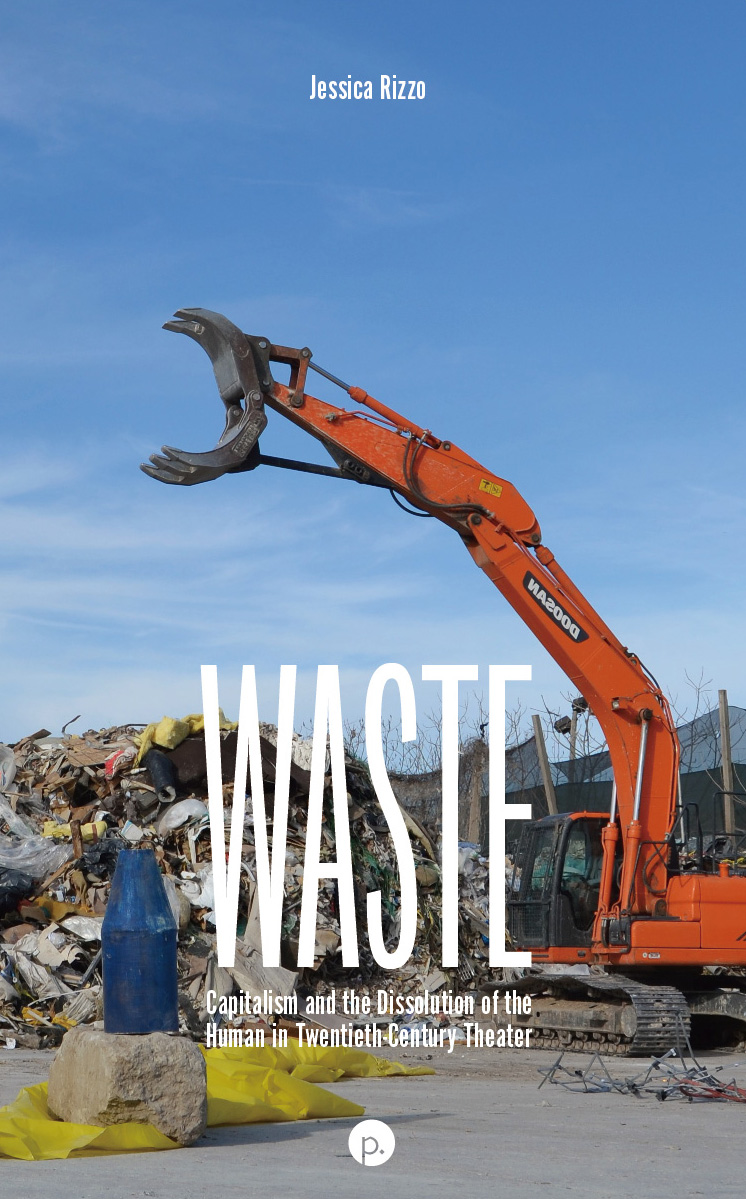
Waste
Capitalism and the Dissolution of the Human in Twentieth-Century Theater
Book information
- Publisher
- punctum books
- Publication
- Published 11 June 2020
- Place
- Earth, Milky Way
- Catalogue record
- View in the catalogue
Abstract
If at its most elemental, the theater is an art form of human bodies in space, what becomes of the theater as suicide capitalism pushes our world into a posthuman age?
Waste: Capitalism and the Dissolution of the Human in Twentieth-Century Theater traces the twentieth-century theater’s movement from dramaturgies of efficiency to dramaturgies of waste, beginning with the observation that the most salient feature of the human is her ability to be ashamed of herself, to experience herself as excess, the waster and the waste of the world. By examining theatrical representations of capitalism, war, climate change, and the permanent refugee crisis, Waste traces the ways in which these human-driven events signal a tendency toward prodigality that terminates with self-destruction. Defying its promise of abundance for all, capitalism poisons all relationships with competition and fear. The desire to dominate in war is revealed to be the desire to obliterate the self in collective conflagration. The refugee crisis raises the urgent question of our responsibility to the other, but the climate crisis renders the question of anthropocentric obligations moot.
Waste proposes that the theater is the form best suited to confronting the human’s perverse relationship to its finitude. Everything about the theater is suffused with existential shame, with an acute awareness of its provisionality. Unlike the dominant narrative of the human, which is bound up with a fantasy of infinite growth, the theater is not deluded about its nature, origins, and destiny. At its best, the theater gathers artist and audience in one space to die together for a little while, to consciously waste, and not spend, their time.
Where its authors and editors are based
Countries of the institutions the book's authors, editors and chapter authors were affiliated to when it was published.
- AUTHORS / EDITORS
- CITATIONS Phase 2
- USAGE Phase 3
| Country | Authors / editors |
|---|---|
| United States | 1 |
About this data
These figures cover 1 work. Each value comes from the most trusted source that has it; a correction made by OJC or OBC staff outranks every source.
| Source | Confidence | Works |
|---|---|---|
| Thoth | 90 / 100 | 1 |
| Works with a publication date | 100% |
|---|---|
| Works with a DOI | 100% |
| Works with a funder recorded | 0% |
| Authors with an affiliation | 100% |
| Affiliations matched to an institution (ROR) | 100% |
| Affiliations with a country | 100% |
Countries come from the institution each author was affiliated to when they published, as recorded in ROR. A country is never guessed, so authors without a matched institution are not counted on the maps.
Funders come from OpenAlex for articles and Thoth for books, where publishers recorded them. Most works record none, so a funder's figures show what is recorded, not everything it funded.
Chapters count as works: their authors and editors, and the countries of their institutions, are in every figure where Thoth records an affiliation for them.
Citations (Phase 2) and usage (Phase 3) are not collected yet.