Book information
- Publisher
- punctum books
- Publication
- Published 4 January 2019
- Place
- Earth, Milky Way
- Catalogue record
- View in the catalogue
Abstract
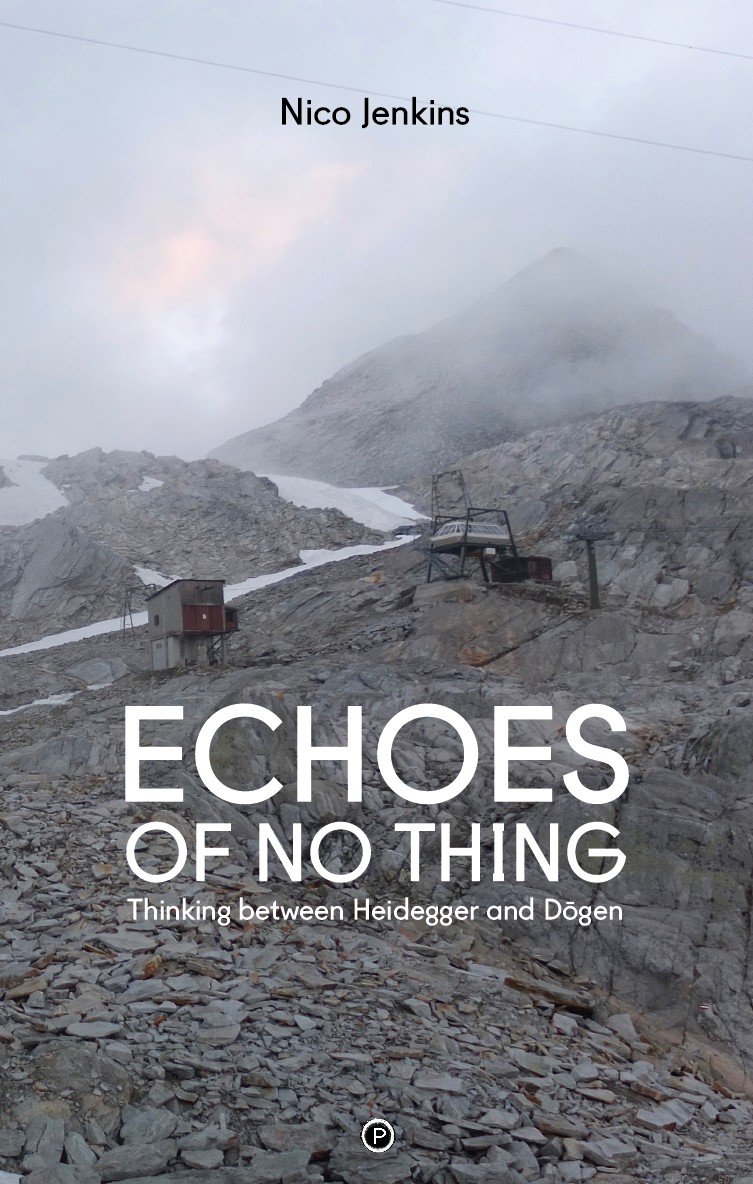
Echoes of No Thing seeks to understand the space between thinking which Martin Heidegger and the 13th-century Zen patriarch Eihei Dōgen explore in their writing and teachings. Heidegger most clearly attempts this in Contributions to Philosophy (of the Event) and Dōgen in his Shōbōgenzō, a collection of fascicles which he compiled in his lifetime. Both thinkers draw us towards thinking, instead of merely defining systems of thought. Both Heidegger and Dōgen imagine possibilities not apparent in the world we currently inhabit, but notably, find possible, through a refashioning of thinking as a soteriological reimagining that clears space for the presencing of an authentic experience in the space which emerges between certainties. Jenkins elucidates this soteriological reimagining through a close reading of both authors’ conceptions of time and space, and by developing a practice of listening that is attuned to the echoes that resonate between the two thinkers.
While Heidegger often wrote about new beginnings (as well as about gathering oneself, preparing the site, clearings, and practicing) in preparation for the evental un-concealing of truth, nowhere is this as present as in the enigmatic, difficult, and in fact beautiful, Contributions. To call a text beautiful, especially a work of philosophy, risks committing an act of disingenuity, and yet Contributions, like Jacques Derrida’s Glas or Walter Benjamin’s unfinished Arcades Project, rises to this acclaim through its very resistance to a system, its refusal to be easily digested, or even understood. Contributions is unfinished, partial, even at times muttered; it is the beginning of a thinking which takes place on a path and as such cannot imagine—or refuse—its final destination. It invites us to take up towards, but not to insist on, its thinking; it is a “turn” away from the reason and logic of a technologized world and returns philosophy—as a thinking—to a place of wonder and awe.
Dōgen’s Shōbogenzō, from another culture and time entirely, is also a beautiful text, for similar reasons. The Shōbogenzō, gathered first as a series of talks given by Eihei Dōgen (and later composed as written texts) details the process of understanding which leads, for Dōgen, to a position of pure seeing, or satori, and yet these talks are not simply rules for monks, nor merely imprecations and demands for a laity; rather, they open a being’s thinking to the possibility of something purely other and work as a transition across worlds that also opens us to an other world.
What both thinkers illustrate, as do the other thinkers drawn on in this project—most notably, those philosophers associated with the Kyoto School, who were both intimately aware of Dōgen’s work, and studied, or studied with, Heidegger—is that world is not a fixed, stable entity; rather it is a fugal composition of possibility, of as yet untraversed—and at times un-traversable—spaces. Echoes of No Thing seeks to examine, within the lacunal eddies of be-coming’s arrival, that space between which both thinkers point towards as possible sites of new beginnings.
Where its authors and editors are based
Countries of the institutions the book's authors, editors and chapter authors were affiliated to when it was published.
- AUTHORS / EDITORS
- CITATIONS Phase 2
- USAGE Phase 3
| Country | Authors / editors |
|---|---|
| United States | 1 |
About this data
These figures cover 1 work. Each value comes from the most trusted source that has it; a correction made by OJC or OBC staff outranks every source.
| Source | Confidence | Works |
|---|---|---|
| Thoth | 90 / 100 | 1 |
| Works with a publication date | 100% |
|---|---|
| Works with a DOI | 100% |
| Works with a funder recorded | 0% |
| Authors with an affiliation | 100% |
| Affiliations matched to an institution (ROR) | 100% |
| Affiliations with a country | 100% |
Countries come from the institution each author was affiliated to when they published, as recorded in ROR. A country is never guessed, so authors without a matched institution are not counted on the maps.
Funders come from OpenAlex for articles and Thoth for books, where publishers recorded them. Most works record none, so a funder's figures show what is recorded, not everything it funded.
Chapters count as works: their authors and editors, and the countries of their institutions, are in every figure where Thoth records an affiliation for them.
Citations (Phase 2) and usage (Phase 3) are not collected yet.