Book information
- Publisher
- punctum books
- Publication
- Published 11 September 2017
- Place
- Earth, Milky Way
- Catalogue record
- View in the catalogue
Abstract
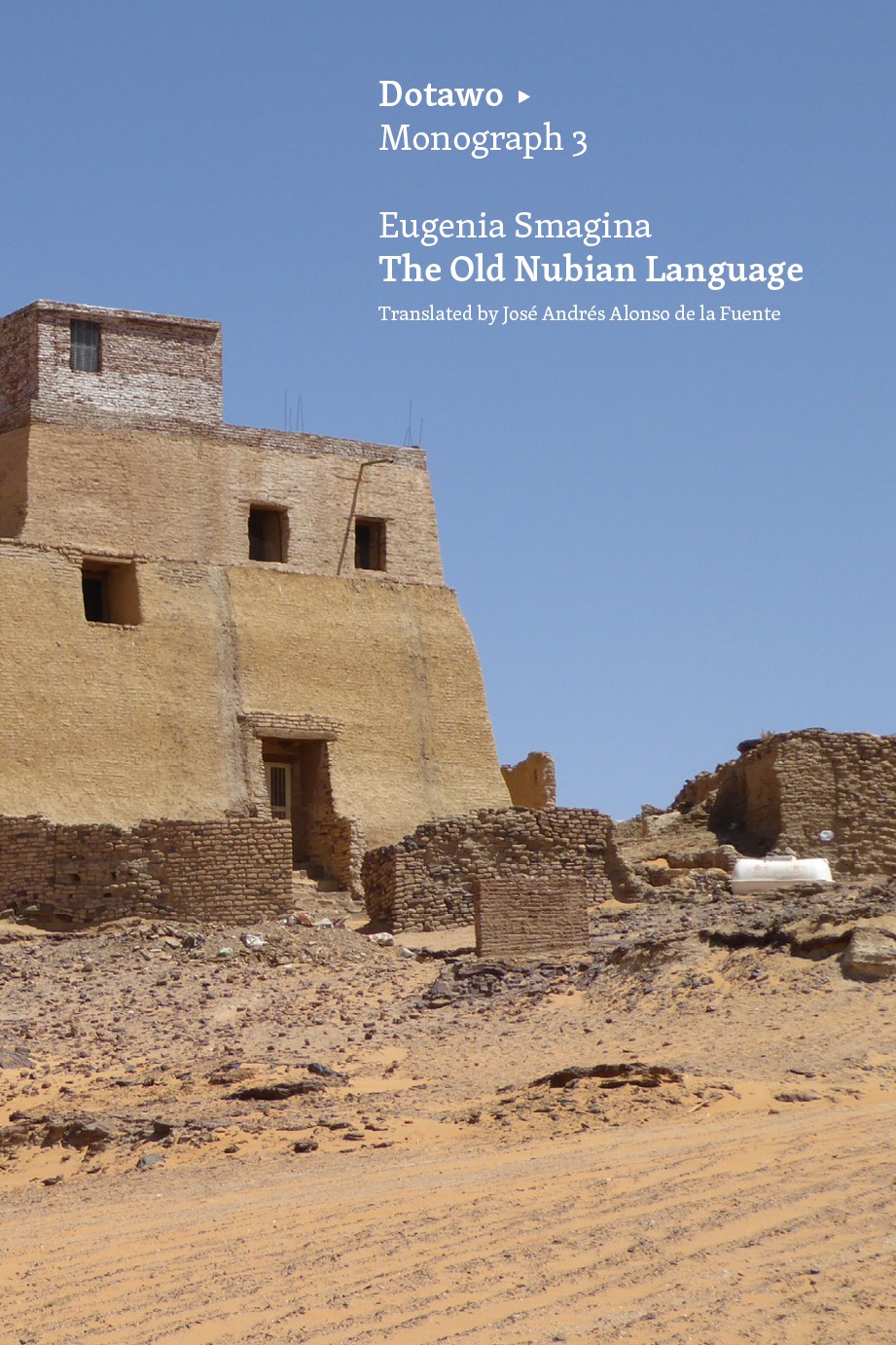
Eugenia Smagina (Евгeния Б. Смaгина) first published her grammar of the Old Nubian language in 1986 in Russian. For more than thirty years the work has remained untranslated, even though the late Gerald M. Browne affirmed that “this lucid, well-argued presentation should be available to all Nubiologists and ought therefore be translated into a western language.”
Slavicist José Andrés Alonso de la Fuente has prepared a first English translation of this concise but indispensable work, which forms a necessary counterpart to Browne’s classic Old Nubian Grammar. The grammar is divided into sections on script, lexicon, morphology, and syntax, and is followed by the analysis of a sample text, known as The Miracle of St. Mēnas.
Smagina’s The Old Nubian Language provides an excellent first introduction into the grammar of this medieval Nilo-Saharan language.
Where its authors and editors are based
Countries of the institutions the book's authors, editors and chapter authors were affiliated to when it was published.
- AUTHORS / EDITORS
- CITATIONS Phase 2
- USAGE Phase 3
| Country | Authors / editors |
|---|---|
| Russia | 1 |
About this data
These figures cover 1 work. Each value comes from the most trusted source that has it; a correction made by OJC or OBC staff outranks every source.
| Source | Confidence | Works |
|---|---|---|
| Thoth | 90 / 100 | 1 |
| Works with a publication date | 100% |
|---|---|
| Works with a DOI | 100% |
| Works with a funder recorded | 0% |
| Authors with an affiliation | 50% |
| Affiliations matched to an institution (ROR) | 100% |
| Affiliations with a country | 100% |
Countries come from the institution each author was affiliated to when they published, as recorded in ROR. A country is never guessed, so authors without a matched institution are not counted on the maps.
Funders come from OpenAlex for articles and Thoth for books, where publishers recorded them. Most works record none, so a funder's figures show what is recorded, not everything it funded.
Chapters count as works: their authors and editors, and the countries of their institutions, are in every figure where Thoth records an affiliation for them.
Citations (Phase 2) and usage (Phase 3) are not collected yet.