Book information
- Publisher
- punctum books
- Publication
- Published 4 November 2017
- Place
- Earth, Milky Way
- Catalogue record
- View in the catalogue
Abstract
Is it possible to conceive of a Hello Kitty Middle Ages or a Tickle Me Elmo Renaissance? The Oxford English Dictionary dates the first reference to “cute” in the sense of “attractive, pretty, charming” to 1834. More recently, Sianne Ngai has offered a critical overview of the cuteness of the twentieth-century avant-garde within the context of consumer culture. But if cuteness can get under the skin, what kinds of surfaces does it best infiltrate, particularly in the framework of historical forms, events, and objects that traditionally have been read as emergences around “big” aesthetics of formal symmetries, high affects, and resemblances?
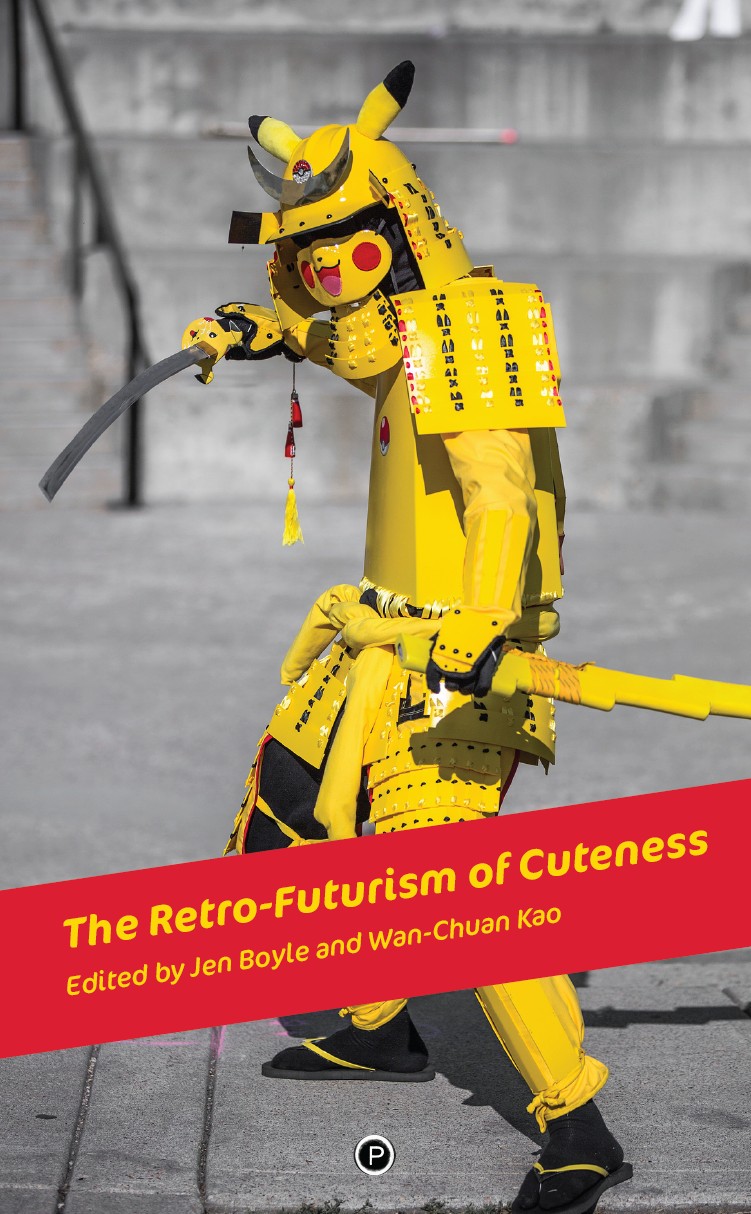
The Retrofuturism of Cuteness seeks to undo the temporal strictures surrounding aesthetic and affective categories, to displace a strict focus on commodification and cuteness, and to interrogate how cuteness as a minor aesthetics can refocus our perceptions and readings of both premodern and modern media, literature, and culture. Taking seriously the retro and the futuristic temporalities of cuteness, this volume puts in conversation projects that have unearthed remnants of a “cult of cute”—positioned historically and critically in between transitions into secularization, capitalist frameworks of commodification, and the enchantment of objects—and those that have investigated the uncanny haunting of earlier aesthetics in future-oriented modes of cuteness.
The Latin acutus, the etymological root of cute, embraces the sharpened, the pointed, the nimble, the discriminating, and the piercing. But as Michael O’Rourke notes, cuteness evokes a proximity that is at once potentially invasive and contaminating and yet softening and transfiguring. Deploying cuteness as a mode of inquiry across time, this volume opens up unexpected lines of inquiry and unusual critical and creative aporias, from Christian asceticism, medieval cycle drama, and Shakespeare to manga, Bollywood, and Second Life. The projects collected here point to a spectrum of aesthetic-affective assemblages related to racial, ethnic, gender, sexual, and class dimensions that exceed or trouble our contemporary perceptions of such registers within object-subject and subject-object entanglements.
Chapters
Where its authors and editors are based
Countries of the institutions the book's authors, editors and chapter authors were affiliated to when it was published.
- AUTHORS / EDITORS
- CITATIONS Phase 2
- USAGE Phase 3
| Country | Authors / editors |
|---|---|
| United States | 11 |
| Canada | 1 |
| South Korea | 1 |
About this data
These figures cover 15 works. Each value comes from the most trusted source that has it; a correction made by OJC or OBC staff outranks every source.
| Source | Confidence | Works |
|---|---|---|
| Thoth | 90 / 100 | 15 |
| Works with a publication date | 100% |
|---|---|
| Works with a DOI | 100% |
| Works with a funder recorded | 0% |
| Authors with an affiliation | 100% |
| Affiliations matched to an institution (ROR) | 95% |
| Affiliations with a country | 100% |
Countries come from the institution each author was affiliated to when they published, as recorded in ROR. A country is never guessed, so authors without a matched institution are not counted on the maps.
Funders come from OpenAlex for articles and Thoth for books, where publishers recorded them. Most works record none, so a funder's figures show what is recorded, not everything it funded.
Chapters count as works: their authors and editors, and the countries of their institutions, are in every figure where Thoth records an affiliation for them.
Citations (Phase 2) and usage (Phase 3) are not collected yet.