Book information
- Publisher
- punctum books
- Publication
- Forthcoming 1 December 2026
- Place
- Earth, Milky Way
- Catalogue record
- View in the catalogue
Abstract
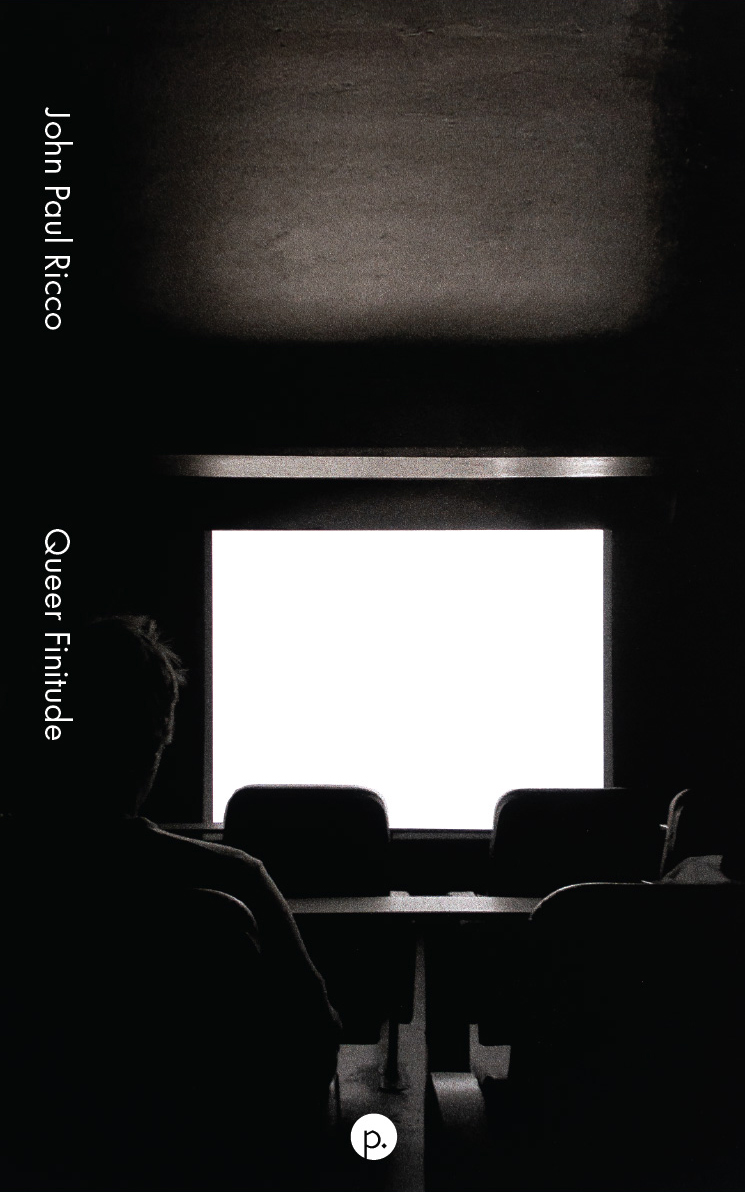
What if intimacy wasn’t defined by identities, couples, or other congruencies, but by incongruity and the seemingly empty moments of anonymity and solitude? In this compelling final volume of his trilogy on “the intimacy of the Outside,” John Paul Ricco articulates the aesthetics and ethics of finitude, exploring how the ordinary limits of our bodies, thoughts, and surroundings shape our deepest connections. The book asks us to consider the kind of attention that two or more people give to each other in their non-fused intimacy, mutual anonymity, or shared solitude (including as readers). Queer Finitude redefines intimacy through the lens of the unnoticed and the overlooked—the slight opening of a mouth, a fleeting touch, the clandestine and the fugitive. Ricco’s narrative brings to life the figures of the outsider, the self-excluded, and the unloved, as it offers glimpses of a world where intimacy thrives along the contours and edges of anonymity and solitude.
Drawing inspiration from iconic moments in contemporary art, film, photography, and literature, Ricco examines the lives of anonymous passersby and solitary strangers, elaborating a non-figural aesthetics and ethics. From Chiron in Barry Jenkins’s Moonlight to the unnamed Palestinian woman in Adania Shibli’s Minor Detail, and from an anonymous portrait by Shaan Syed to the reclusive silhouettes in Dean Sameshima’s photographs, Ricco illustrates the delicate balance between intimacy and solitude. Through philosophical close readings, meditations on the moment’s temporality, and a novel deployment of the concept of “the time that remains,” Ricco effectively challenges and transcends the dominant theoretical frameworks of optimism and pessimism that currently define queer theory.
Queer Finitude is not just a scholarly study; it’s an enactment of estrangement from figuration, dedicated to the itinerant and the anonymous. It reveals how ethical forms of intimacy can flourish through non-coerced solitude and a shared sense of the inappropriable, offering a fresh perspective on the queerly exorbitant pleasures of finitude. Ultimately, Queer Finitude asks, What kind of intimate connections lie beyond the visible and legible, in the commonality of our finitude?
Where its authors and editors are based
Countries of the institutions the book's authors, editors and chapter authors were affiliated to when it was published.
- AUTHORS / EDITORS
- CITATIONS Phase 2
- USAGE Phase 3
| Country | Authors / editors |
|---|---|
| Canada | 1 |
About this data
These figures cover 1 work. Each value comes from the most trusted source that has it; a correction made by OJC or OBC staff outranks every source.
| Source | Confidence | Works |
|---|---|---|
| Thoth | 90 / 100 | 1 |
| Works with a publication date | 100% |
|---|---|
| Works with a DOI | 100% |
| Works with a funder recorded | 0% |
| Authors with an affiliation | 100% |
| Affiliations matched to an institution (ROR) | 100% |
| Affiliations with a country | 100% |
Countries come from the institution each author was affiliated to when they published, as recorded in ROR. A country is never guessed, so authors without a matched institution are not counted on the maps.
Funders come from OpenAlex for articles and Thoth for books, where publishers recorded them. Most works record none, so a funder's figures show what is recorded, not everything it funded.
Chapters count as works: their authors and editors, and the countries of their institutions, are in every figure where Thoth records an affiliation for them.
Citations (Phase 2) and usage (Phase 3) are not collected yet.