Book information
- Publisher
- punctum books
- Publication
- Forthcoming 1 May 2027
- Place
- Earth, Milky Way
- Catalogue record
- View in the catalogue
Abstract
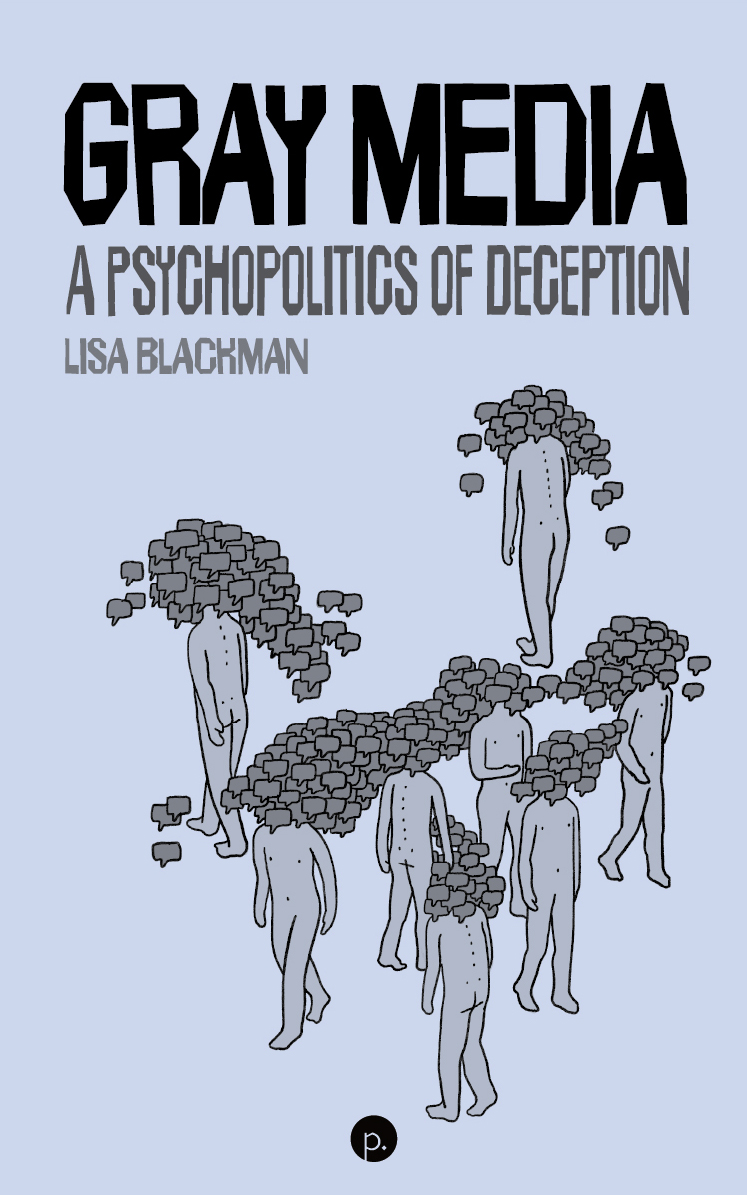
In the era of artificial intelligence, how can we tell we are being tricked? Indeed, is deception an anomaly or rather a defining force in contemporary media, culture, and politics? In Gray Media: A Psychopolitics of Deception, Lisa Blackman tracks deception as it emerges across AI and algorithmic systems, information warfare, and the psychological and emotional abuse of gaslighting. The approach is radically interdisciplinary, weaving together insights from cultural and media studies, affect studies, critical mental health and disability studies, speculative philosophy, and feminism and queer theory. The mixing of fields mirrors the unstable, shape-shifting nature of the deceptive phenomena the book investigates.
A central concept which links deception across the different areas is confabulation, a paradoxical form of reasoning, which blurs distinctions between the rational and irrational, legible vs. illegible, human vs. technical, intention vs. opportunity, emotional vs. reason, and moral vs. immoral. Linked to creativity and deception, Gray Media explores the longer histories of confabulating forms of reasoning and their tendencies towards cruelty, and dehumanization, shaping technologies of power, communication, and unfeeling within colonial and patriarchal rationalities. It offers new conceptual tools for understanding how contemporary subjects are shaped by – and navigate – the unstable conditions that are symptomatic of its operations, as well as opening to new forms of world-making and unlearning that are made possible, if (only) we can learn to feel differently.
Where its authors and editors are based
Countries of the institutions the book's authors, editors and chapter authors were affiliated to when it was published.
- AUTHORS / EDITORS
- CITATIONS Phase 2
- USAGE Phase 3
| Country | Authors / editors |
|---|---|
| United Kingdom | 1 |
About this data
These figures cover 1 work. Each value comes from the most trusted source that has it; a correction made by OJC or OBC staff outranks every source.
| Source | Confidence | Works |
|---|---|---|
| Thoth | 90 / 100 | 1 |
| Works with a publication date | 100% |
|---|---|
| Works with a DOI | 100% |
| Works with a funder recorded | 100% |
| Authors with an affiliation | 100% |
| Affiliations matched to an institution (ROR) | 100% |
| Affiliations with a country | 100% |
Countries come from the institution each author was affiliated to when they published, as recorded in ROR. A country is never guessed, so authors without a matched institution are not counted on the maps.
Funders come from OpenAlex for articles and Thoth for books, where publishers recorded them. Not every work records one, so a funder's figures show what is recorded, not everything it funded.
Chapters count as works: their authors and editors, and the countries of their institutions, are in every figure where Thoth records an affiliation for them.
Citations (Phase 2) and usage (Phase 3) are not collected yet.