Book information
- Publisher
- punctum books
- Publication
- Published 15 September 2016
- Place
- Earth, Milky Way
- Catalogue record
- View in the catalogue
Abstract
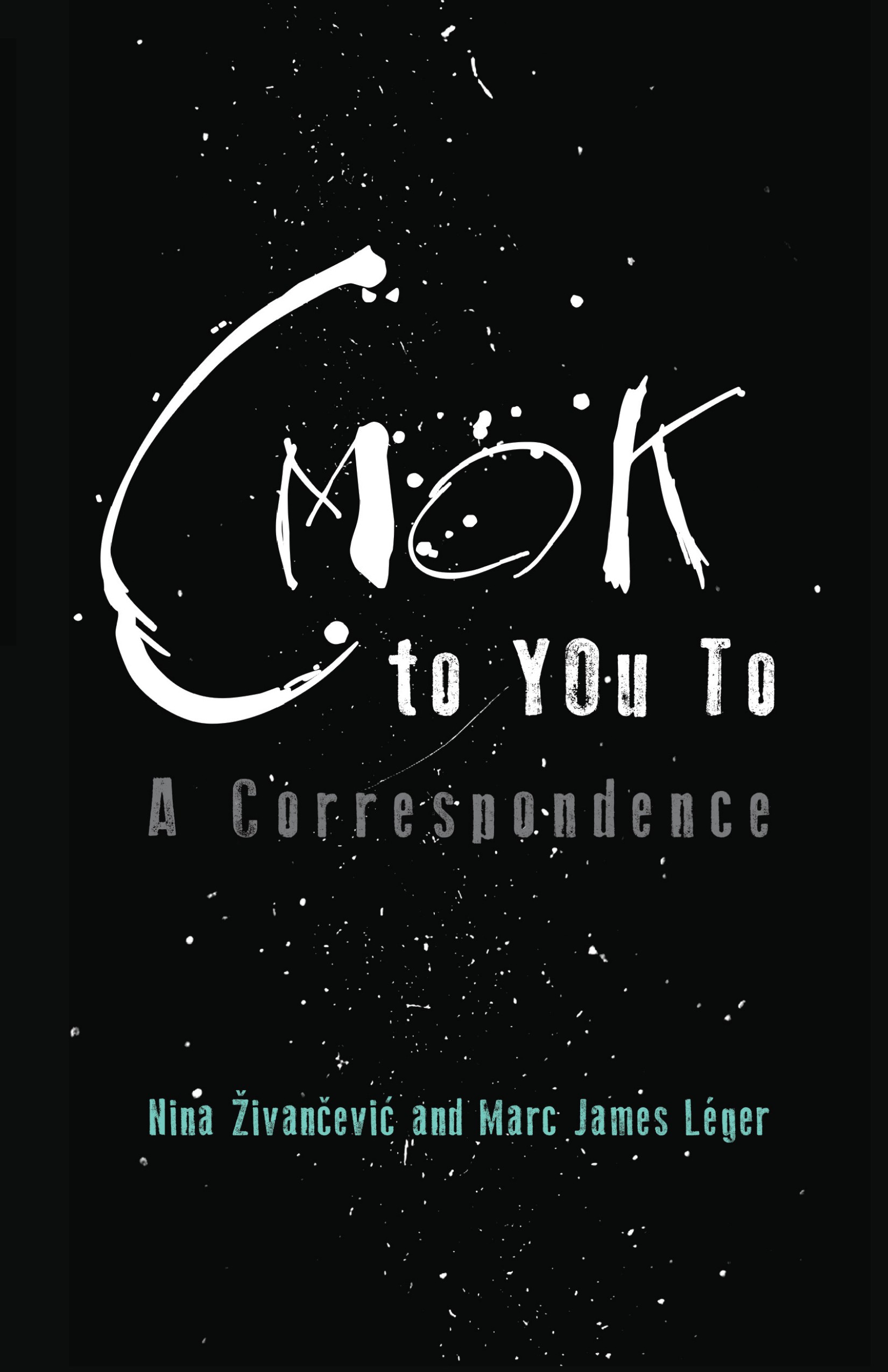
CMOK to YOu To presents the 2015 email correspondence of the Serbian-born poet, art critic and playwright Nina Živančević and Canadian cultural theorist Marc James Léger. In December of 2014 Léger invited Živančević to contribute a text to the second volume of the book he was editing, The Idea of the Avant Garde – And What It Means Today. Taken with each other’s idiosyncrasies, their correspondence gradually shifted from amiable professional exchanges and the eventual failure to organize a scholarly event to that of collaborating on some kind of writing project. Several titles were attempted for the eventual book – Marshmallow Muse: The Exact and Irreverent Letters of MJL and NZ, The Orange Jelly Bean, or, I Already Am Eating from the Trash Can All the Time: The Name of This Trash Can Is Ideology, The Secreted Correspondence of Mme Chatelet and Voltaire, and I’m Taken: The E-Pistolary Poetry of Kit le Minx and Cad – but none of these proved to be more telling than CMOK, the Serbian word for kiss, which sums up the authors’ quest for “harmony” in an altogether imperfect world and literary medium.
In this book, names of real people were changed in order to protect those who might otherwise be offended by the unguarded and absurdist commentary of its authors. Despite this fact, it is the fragility and elasticity of the writers’ superegos that is tested as they vacillate from personal registers to intellectual strata. At once a cis-avant-gardist’s exploration of anti-art and a poet’s claim to some weak form of autonomy, CMOK delights in both the pleasures of casual email and the sublime realizations of Jacques Lacan’s theory of sexuation. CMOK is a hybrid genre and a quest into the real of virtuality that defies the literary standards. Its authors, who never met, answer one another’s basic needs and questions, separated as they are by time zones and the ocean, but not culturally or spiritually.
Where its authors and editors are based
Countries of the institutions the book's authors, editors and chapter authors were affiliated to when it was published.
- AUTHORS / EDITORS
- CITATIONS Phase 2
- USAGE Phase 3
| Country | Authors / editors |
|---|---|
| France | 1 |
About this data
These figures cover 1 work. Each value comes from the most trusted source that has it; a correction made by OJC or OBC staff outranks every source.
| Source | Confidence | Works |
|---|---|---|
| Thoth | 90 / 100 | 1 |
| Works with a publication date | 100% |
|---|---|
| Works with a DOI | 100% |
| Works with a funder recorded | 0% |
| Authors with an affiliation | 50% |
| Affiliations matched to an institution (ROR) | 100% |
| Affiliations with a country | 100% |
Countries come from the institution each author was affiliated to when they published, as recorded in ROR. A country is never guessed, so authors without a matched institution are not counted on the maps.
Funders come from OpenAlex for articles and Thoth for books, where publishers recorded them. Most works record none, so a funder's figures show what is recorded, not everything it funded.
Chapters count as works: their authors and editors, and the countries of their institutions, are in every figure where Thoth records an affiliation for them.
Citations (Phase 2) and usage (Phase 3) are not collected yet.