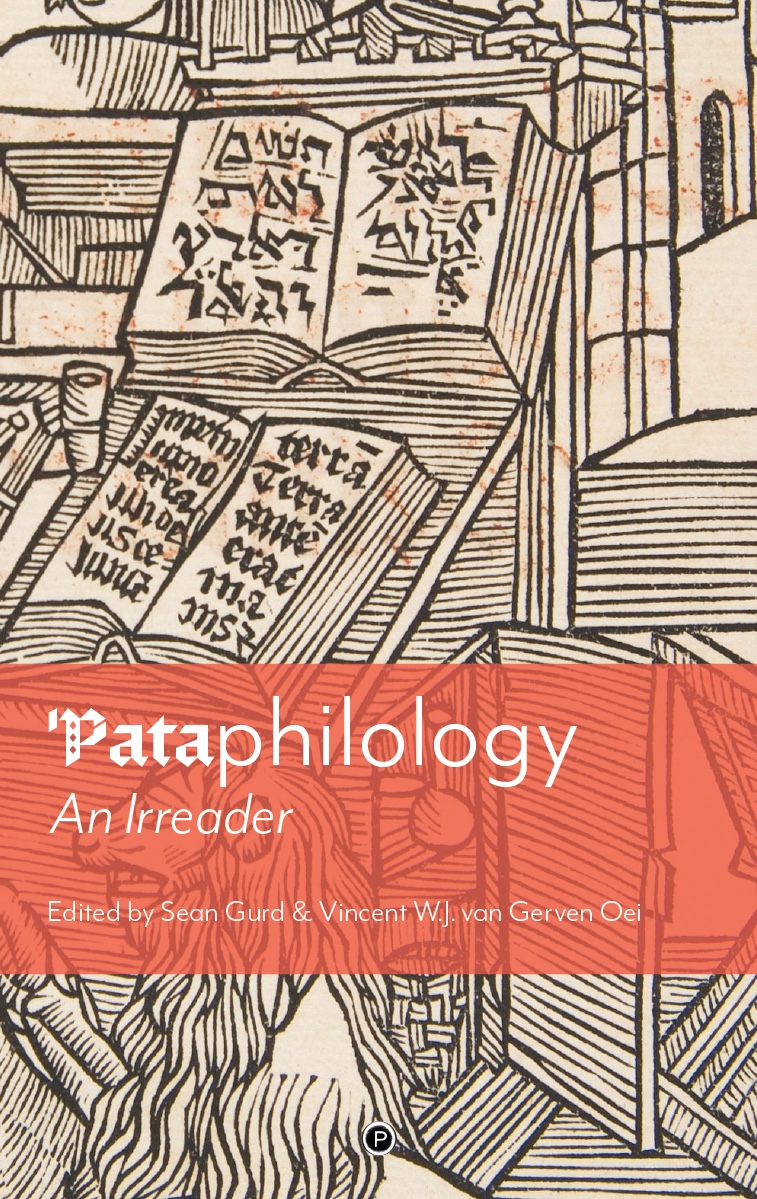
Book information
- Publisher
- punctum books
- Publication
- Published 19 November 2018
- Place
- Earth, Milky Way
- Catalogue record
- View in the catalogue
Abstract
1883. Jean-Pierre Brisset realizes that a close phonological analysis of spoken words will demonstrate that the French language, and therefore the human species, was evolved from frogs.
1896. Consulted as an expert in linguistics and comparative philology, Ferdinand de Saussure reports that the passages of Martian Language transcribed during the “sonambulistic glossolalias” of one (pseudonymously named) “Hélène Smith” (in fact Müller) may contain a few roots related to those found in Sanskrit and other Indo-Aryan languages.
1897. Using recognized techniques of historical reconstruction and close reading, Samuel Butler proposes that the composer of the Odyssey was not Homer but Nausikaa, a character in the epic.
What do the bizzare etymologies of Jean-Pierre Brisset, made-up languages for literary fiction, The Dialectic of Enlightenment, Latin grammarians, Horace’s Epodes, and the Papyrus of Ani have in common? Absolutely nothing. Yet, taken together they provide an unusually coherent picture of a hitherto unacknowledged non-tradition of linguistic investigation. At these moments, particularly within the traditions of European writing which can loosely be termed “avant-garde,” philology goes rogue, hearkening to unearthly imperatives and barely comprehended intimations, and producing results well beyond those generated by more respectable – and supposedly more grounded – philological endeavors. ‘Pataphilology: An Irreader seeks to document and analyze such moments of philological speculation, invention, and détournement.
In using the term ‘pataphilology, Gurd and van Gerven Oei are not proposing a facile analogy with ‘pataphysics, where ‘pataphilology would be philology’s wacky twin, always out for a lark, never doing anything real. This would presuppose an operation (even if parenthetical) on philology analogous to a shift from physics to ’pataphysics, something which Alfred Jarry, to whom this volume owes the latter neologism, appears to contradict in his initial definition: “Pataphysics […] is the science of that which is superinduced upon metaphysics, whether within or beyond the latter’s limitations, extending as far beyond metaphysics as the latter extends beyond physics.” Any way you cut it, ‘pataphysics is a physics that demands — or, better, that relies on — an utmost philological sensitivity to writing, unheard etymologies, unstable translations, incomplete formalizations, and haphazard decryptions. This volume seeks, then, to document how philological practices — no matter how non-standard, disreputable, or academically useless — have played a role in the production of avant-garde literature and knowledge, as well as forgotten, alternative, or fictitious scholarly projects.
Ranging from the papyrus of Ani to the future languages of speculative fiction, from the fictional tablets of Armand Schwerner to the Attic Nights of Aulus Gellius, from Horace to Lacan, ’Pataphilology: An Irreader is a cabinet of philological curiosity — and a map of the ever-changing constellations that emerge when human language loses its chains.
Chapters
| Chapter | Author | Institution at publication |
|---|---|---|
| Introduction | Sean Gurd | University of Missouri |
| "On Epic Naïveté” | James I. Porter | University of California, Berkeley |
| Backmatter | Sean Gurd, Vincent W.J. van Gerven Oei | University of Missouri |
| Frontmatter | Sean Gurd, Vincent W.J. van Gerven Oei | University of Missouri |
| Going Soft on Canidia | Paul Allen Miller | University of South Carolina |
| Pataphilological Lacan | Sean Braune | |
| Preamble: The Papyrus of Ani: Egyptian Book of the Dead: A Prototype of Ekphrastic Translation of Plate 1 | Steve McCaffery | University at Buffalo, State University of New York |
| The Paraphilologist as 'Pataphysician | Erik Gunderson | University of Toronto |
| The Walker and the Wake | Michael D. Gordin, Joshua T. Katz | Princeton University |
Where its authors and editors are based
Countries of the institutions the book's authors, editors and chapter authors were affiliated to when it was published.
- AUTHORS / EDITORS
- CITATIONS Phase 2
- USAGE Phase 3
| Country | Authors / editors |
|---|---|
| United States | 6 |
| Canada | 1 |
About this data
These figures cover 10 works. Each value comes from the most trusted source that has it; a correction made by OJC or OBC staff outranks every source.
| Source | Confidence | Works |
|---|---|---|
| Thoth | 90 / 100 | 10 |
| Works with a publication date | 100% |
|---|---|
| Works with a DOI | 100% |
| Works with a funder recorded | 0% |
| Authors with an affiliation | 71% |
| Affiliations matched to an institution (ROR) | 100% |
| Affiliations with a country | 100% |
Countries come from the institution each author was affiliated to when they published, as recorded in ROR. A country is never guessed, so authors without a matched institution are not counted on the maps.
Funders come from OpenAlex for articles and Thoth for books, where publishers recorded them. Most works record none, so a funder's figures show what is recorded, not everything it funded.
Chapters count as works: their authors and editors, and the countries of their institutions, are in every figure where Thoth records an affiliation for them.
Citations (Phase 2) and usage (Phase 3) are not collected yet.