Book view
The Poet-Architect
Spaces, Languages and Languages in Joan Margarit’s ‘Works’
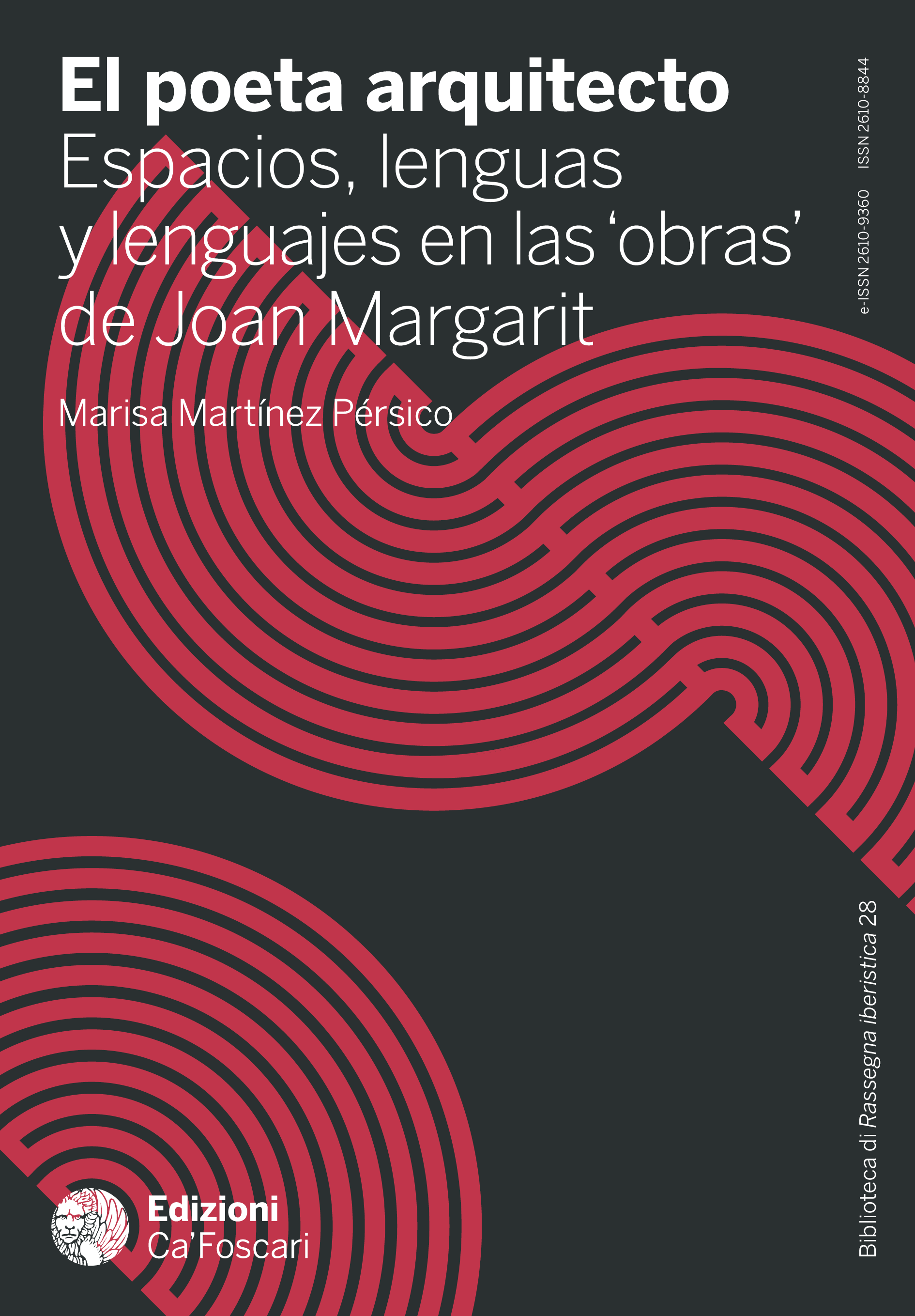
Book information
- Publisher
- Edizioni Ca' Foscari
- Publication
- Published 20 March 2023
- Place
- Venice, Italy
- Series
- Library of <i>Rassegna iberistica</i>
- Catalogue record
- View in the catalogue
Abstract
This volume studies the original communion between architecture and poetry in the work of the bilingual Catalan-Spanish writer Joan Margarit (1938-2021) through a comparative analysis of poems, essays on creation, technical writings on the calculation of structures, press releases on projects where he worked as an architect in Catalonia and private exchanges around the poetry-architecture axis. Through a historical-critical methodology that combines contributions from the spatial turn, geocriticism, transmediality, topoanalysis and the calculation of lexical frequency, some analogies are illuminated between the forms of architectural intervention – construction, restoration, reinforcement, demolition of houses or neighbourhoods – and the sentimental experiences, moral dilemmas and linguistic choices of his poetic characters. Margarite’s lyrical-architectural imagination proposes a pioneering ecological vision, linked to the defence of building recycling that is valid, in its metaphorical dimension, also for human relations. The deep imbrication of literature and architecture impacts the poetic idiolect, which is characterised by the prolific contamination of practices, knowledge and discourses coming from the different subjects of architecture and urbanism, to the point of constituting, in Margarit, a stylema. However, this contamination of practices and discourses never produces in Margarit a rupture of aesthetic homogeneity, a clash of styles. There are no gratuitous technicalities or dissonances due to the insertion of technolects or obscure references to a non-expert reader. However, there is a contamination of discursive isotopies: the architectural and literary discourses. The analysis of the lexical frequency of topoi reveals that the spaces that are most mentioned in Margarit’s poetry are houses (generally private homes, with gardens) as well as cemeteries, hospitals, hospices, orphanages and high school buildings.
Where its authors and editors are based
Countries of the institutions the book's authors, editors and chapter authors were affiliated to when it was published.
- AUTHORS / EDITORS
- CITATIONS Phase 2
- USAGE Phase 3
| Country | Authors / editors |
|---|---|
| Italy | 1 |
About this data
These figures cover 1 work. Each value comes from the most trusted source that has it; a correction made by OJC or OBC staff outranks every source.
| Source | Confidence | Works |
|---|---|---|
| Thoth | 90 / 100 | 1 |
| Works with a publication date | 100% |
|---|---|
| Works with a DOI | 100% |
| Works with a funder recorded | 0% |
| Authors with an affiliation | 100% |
| Affiliations matched to an institution (ROR) | 100% |
| Affiliations with a country | 100% |
Countries come from the institution each author was affiliated to when they published, as recorded in ROR. A country is never guessed, so authors without a matched institution are not counted on the maps.
Funders come from OpenAlex for articles and Thoth for books, where publishers recorded them. Most works record none, so a funder's figures show what is recorded, not everything it funded.
Chapters count as works: their authors and editors, and the countries of their institutions, are in every figure where Thoth records an affiliation for them.
Citations (Phase 2) and usage (Phase 3) are not collected yet.