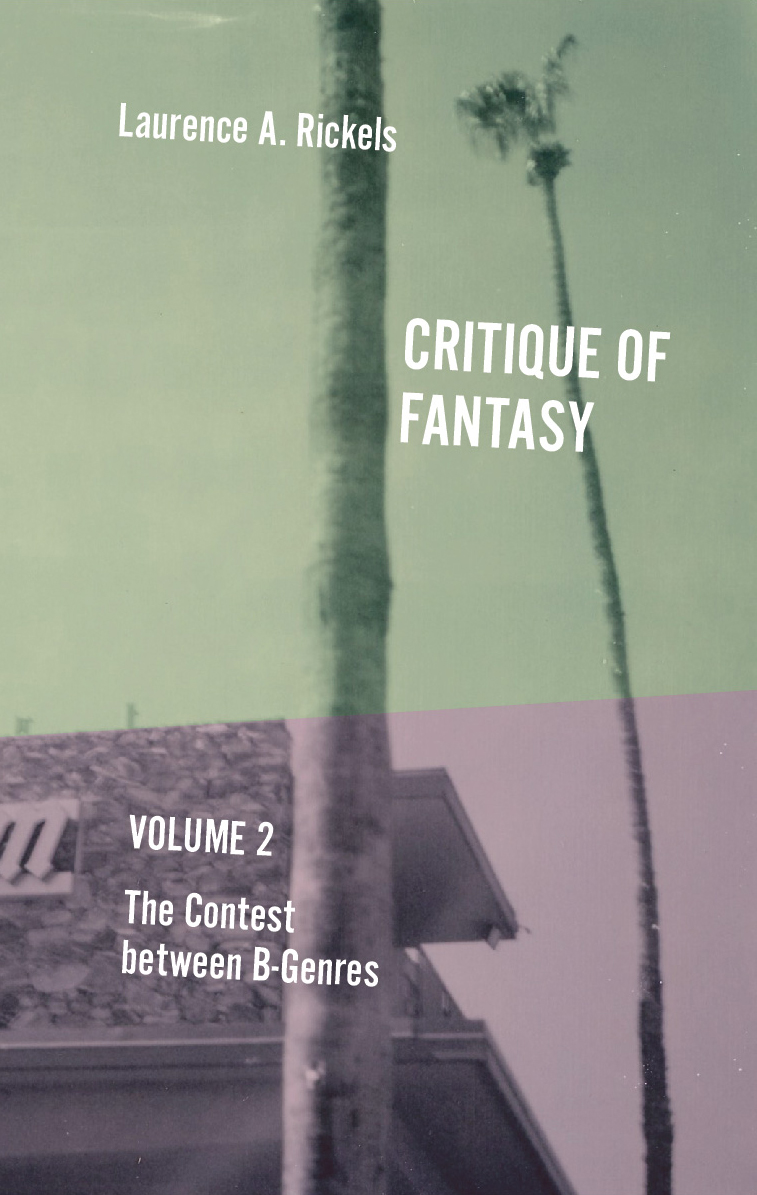
Book information
- Publisher
- punctum books
- Publication
- Published 24 November 2020
- Place
- Earth, Milky Way
- Catalogue record
- View in the catalogue
Abstract
In The Contest between B-Genres, the “Space Trilogy” by J.R.R. Tolkien’s friend and colleague C.S. Lewis and the roster of American science fictions that Gotthard Günther selected and glossed for the German readership in 1952 demarcate the ring in which the contestants face off. In carrying out in fiction the joust that Tolkien proclaimed in his manifesto essay “On Fairy-Stories,” Lewis challenged the visions of travel through time and space that were the mainstays of modern science fiction. In the facing corner, Günther recognized in American science fiction the first stirrings of a new mythic storytelling that would supplant the staple of an expiring metaphysics, the fairy-story basic to Tolkien and Lewis’s fantasy genre.
The B-genres science fiction and fantasy were contemporaries of cinema’s emergence out of the scientific and experimental study and recording of motion made visible. In an early work like H.G. Wells’s The Time Machine, which Tolkien credited as work of fantasy, the transport through time – the ununderstood crux of this literary experiment – is conveyed through a cinematic–fantastic component in the narrative, reflecting optical innovations and forecasting the movies to come. Although the historical onset of the rivalry between the B-genres is packed with literary examples, adaptation (acknowledged or not) followed out the rebound of wish fantasy between literary descriptions of the ununderstood and their cinematic counterparts, visual and special effects.
The arrival of the digital relation out of the crucible of the unknown and the special effect seemed at last to award the fantasy genre the trophy in its contest with science fiction. And yet, although science fiction indeed failed to predict the digital future, fantasy did not so much succeed as draw benefit from the mere resemblance of fantasying to the new relation. While it follows that digitization is the fantasy that is true (and not, as Tolkien had hoped, the Christian Gospel), the newly renewed B-genre without borders found support in another revaluation that was underway in the other B-genre. Once its future orientation was “history,” science fiction began indwelling the ruins of its faulty forecasts. By its new allegorical momentum, science fiction supplied captions of legibility and history to the reconfigured borderlands it cohabited with fantasy. The second volume also attends, then, to the hybrids that owed their formation to these changes, both anticipated and realized. Extending through the topography of the borderlands, works by J.G. Ballard, Ursula Le Guin, and John Boorman, among others, occupy and cathect a context of speculative fiction that suspended and blended the strict contest requirements constitutive of the separate B-genres.
Where its authors and editors are based
Countries of the institutions the book's authors, editors and chapter authors were affiliated to when it was published.
- AUTHORS / EDITORS
- CITATIONS Phase 2
- USAGE Phase 3
| Country | Authors / editors |
|---|---|
| Germany | 1 |
| Switzerland | 1 |
About this data
These figures cover 1 work. Each value comes from the most trusted source that has it; a correction made by OJC or OBC staff outranks every source.
| Source | Confidence | Works |
|---|---|---|
| Thoth | 90 / 100 | 1 |
| Works with a publication date | 100% |
|---|---|
| Works with a DOI | 100% |
| Works with a funder recorded | 0% |
| Authors with an affiliation | 100% |
| Affiliations matched to an institution (ROR) | 100% |
| Affiliations with a country | 100% |
Countries come from the institution each author was affiliated to when they published, as recorded in ROR. A country is never guessed, so authors without a matched institution are not counted on the maps.
Funders come from OpenAlex for articles and Thoth for books, where publishers recorded them. Most works record none, so a funder's figures show what is recorded, not everything it funded.
Chapters count as works: their authors and editors, and the countries of their institutions, are in every figure where Thoth records an affiliation for them.
Citations (Phase 2) and usage (Phase 3) are not collected yet.