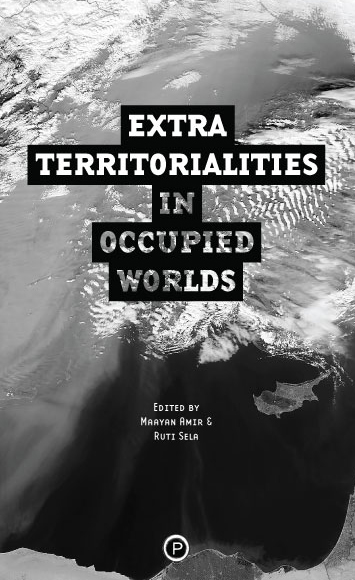
Book information
- Publisher
- punctum books
- Publication
- Published 16 February 2016
- Place
- Earth, Milky Way
- Catalogue record
- View in the catalogue
Abstract
The concept of extraterritoriality designates certain relationships between space, law, and representation. This collection of essays explores contemporary manifestations of extraterritoriality and the diverse ways in which the concept has been put to use in various disciplines. Some of the essays were written especially for this volume; others are brought here together for the first time. The inquiry into extraterritoriality found in these essays is not confined to the established boundaries of political, conceptual, and representational territories or fields of knowledge; rather, it is an invitation to navigate the margins of the legal–juridical and the political, but also the edges of forms of representation and poetics.
Within its accepted legal and political contexts, the concept of extraterritoriality has traditionally been applied to people and to spaces. In the first case, extraterritorial arrangements could either exclude or exempt an individual or a group of people from the territorial jurisdiction in which they were physically located; in the second, such arrangements could exempt or exclude a space from the territorial jurisdiction by which it was surrounded. The special status accorded to people and spaces had political, economic, and juridical implications, ranging from immunity and various privileges to extreme disadvantages. In both cases, a person or a space physically included within a certain territory was removed from the usual system of laws and subjected to another. In other words, the extraterritorial person or space was held at what could be described as a legal distance. (In this respect, the concept of extraterritoriality presupposes the existence of several competing or overlapping legal systems.) It is this notion of being held at a legal distance around which the concept of extraterritoriality may be understood as revolving.
This volume is a part of Amir and Sela’s Exterritory Project, an ongoing art project that wishes to encourage both the theoretical and practical exploration of ideas concerning extraterritoriality in an interdisciplinary context. The project aims not only to draw on existing definitions of extraterritoriality but seeks also to charge it with new meanings, searching for ways in which the notion of extraterritoriality could produce a critique of discriminating power structures and re-articulate new practical, conceptual, and poetical possibilities.
Chapters
Where its authors and editors are based
Countries of the institutions the book's authors, editors and chapter authors were affiliated to when it was published.
- AUTHORS / EDITORS
- CITATIONS Phase 2
- USAGE Phase 3
| Country | Authors / editors |
|---|---|
| United States | 9 |
| United Kingdom | 5 |
| The Netherlands | 2 |
| Australia | 1 |
| Canada | 1 |
| Egypt | 1 |
| Switzerland | 1 |
About this data
These figures cover 24 works. Each value comes from the most trusted source that has it; a correction made by OJC or OBC staff outranks every source.
| Source | Confidence | Works |
|---|---|---|
| Thoth | 90 / 100 | 24 |
| Works with a publication date | 100% |
|---|---|
| Works with a DOI | 100% |
| Works with a funder recorded | 4% |
| Authors with an affiliation | 58% |
| Affiliations matched to an institution (ROR) | 100% |
| Affiliations with a country | 100% |
Countries come from the institution each author was affiliated to when they published, as recorded in ROR. A country is never guessed, so authors without a matched institution are not counted on the maps.
Funders come from OpenAlex for articles and Thoth for books, where publishers recorded them. Most works record none, so a funder's figures show what is recorded, not everything it funded.
Chapters count as works: their authors and editors, and the countries of their institutions, are in every figure where Thoth records an affiliation for them.
Citations (Phase 2) and usage (Phase 3) are not collected yet.