Book view
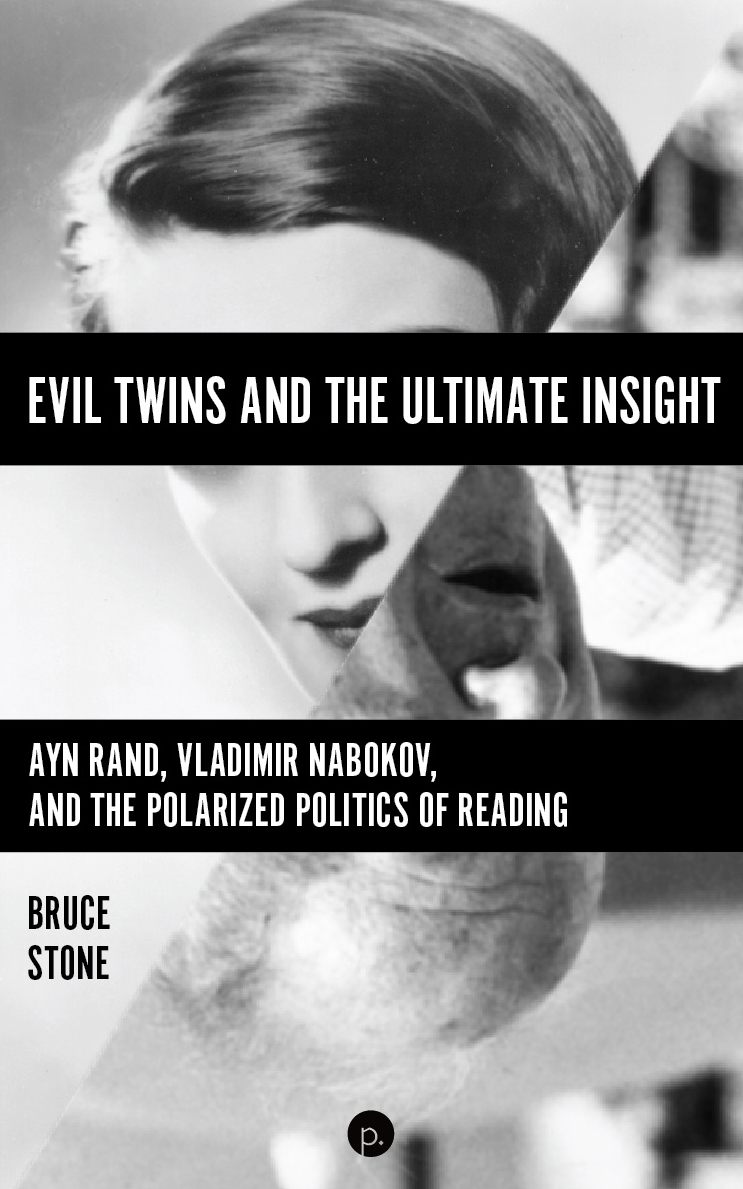
Evil Twins and the Ultimate Insight
Ayn Rand, Vladimir Nabokov, and the Polarized Politics of Reading
By Bruce Stone
Book information
- Publisher
- punctum books
- Publication
- Published 5 October 2023
- Place
- Earth, Milky Way
- Catalogue record
- View in the catalogue
Abstract
With the 2020 election, political polarization in the U.S. entered a ludicrous end-stage. Partisanship, once a pseudo-rational system of biases, has devolved to a conflict between incompatible realities. In search of some pathway toward consensus, Evil Twins and the Ultimate Insight: Ayn Rand, Vladimir Nabokov, and the Polarized Politics of Reading looks to the works of two iconic Russian-American writers whose literary rivalry mirrors the rift between political parties in the U.S. The matchup has all the markings of an evil-twin narrative, pitting Rand, the muse of libertarian conservatism, against Nabokov, the trickster-genius of the Western canon. Their mid-century novels afford a rare opportunity to arbitrate, by proxy, American political grievances and resolve, in print, its electoral dysfunction. Evil Twins and the Ultimate Insight mounts this critical intervention into the Blue/Red blood feud and contemplates, in the cognitive challenges of Nabokov’s fiction, a remedy for its polarized politics.
To guard against grandstanding, axe-grinding, deck-stacking, inaccuracy, or obfuscation, Stone’s book proceeds by indirection, exploring four scholarly books that all speak to the peculiar relationship between Rand and Nabokov: Gene Bell-Villada’s On Nabokov, Ayn Rand and the Libertarian Mind (2013), Adam Weiner’s How Bad Writing Destroyed the World: Ayn Rand and the Literary Origins of the Financial Crisis (2016), Michael Rodgers’s Nabokov and Nietzsche: Problems and Perspectives (2018), and Peter Roberts and Herner Saeverot’s Education and the Limits of Reason: Reading Dostoevsky, Tolstoy and Nabokov (2018). Each of these books is seriously flawed, but their numerous interlocking problems conspire to reveal, empirically, via negativa, how literature might tip the scales in America’s partisan deadlock. Ultimately, Stone argues that, when our books get tangled up in our politics, their promise—to help us see to the bottom of things and scooch closer to the asymptote of truth and reality—might be something more than a mirage.
Where its authors and editors are based
Countries of the institutions the book's authors, editors and chapter authors were affiliated to when it was published.
- AUTHORS / EDITORS
- CITATIONS Phase 2
- USAGE Phase 3
| Country | Authors / editors |
|---|---|
| United States | 1 |
About this data
These figures cover 1 work. Each value comes from the most trusted source that has it; a correction made by OJC or OBC staff outranks every source.
| Source | Confidence | Works |
|---|---|---|
| Thoth | 90 / 100 | 1 |
| Works with a publication date | 100% |
|---|---|
| Works with a DOI | 100% |
| Works with a funder recorded | 0% |
| Authors with an affiliation | 100% |
| Affiliations matched to an institution (ROR) | 100% |
| Affiliations with a country | 100% |
Countries come from the institution each author was affiliated to when they published, as recorded in ROR. A country is never guessed, so authors without a matched institution are not counted on the maps.
Funders come from OpenAlex for articles and Thoth for books, where publishers recorded them. Most works record none, so a funder's figures show what is recorded, not everything it funded.
Chapters count as works: their authors and editors, and the countries of their institutions, are in every figure where Thoth records an affiliation for them.
Citations (Phase 2) and usage (Phase 3) are not collected yet.