Book information
- Publisher
- punctum books
- Publication
- Published 28 May 2024
- Place
- Earth, Milky Way
- Catalogue record
- View in the catalogue
Abstract
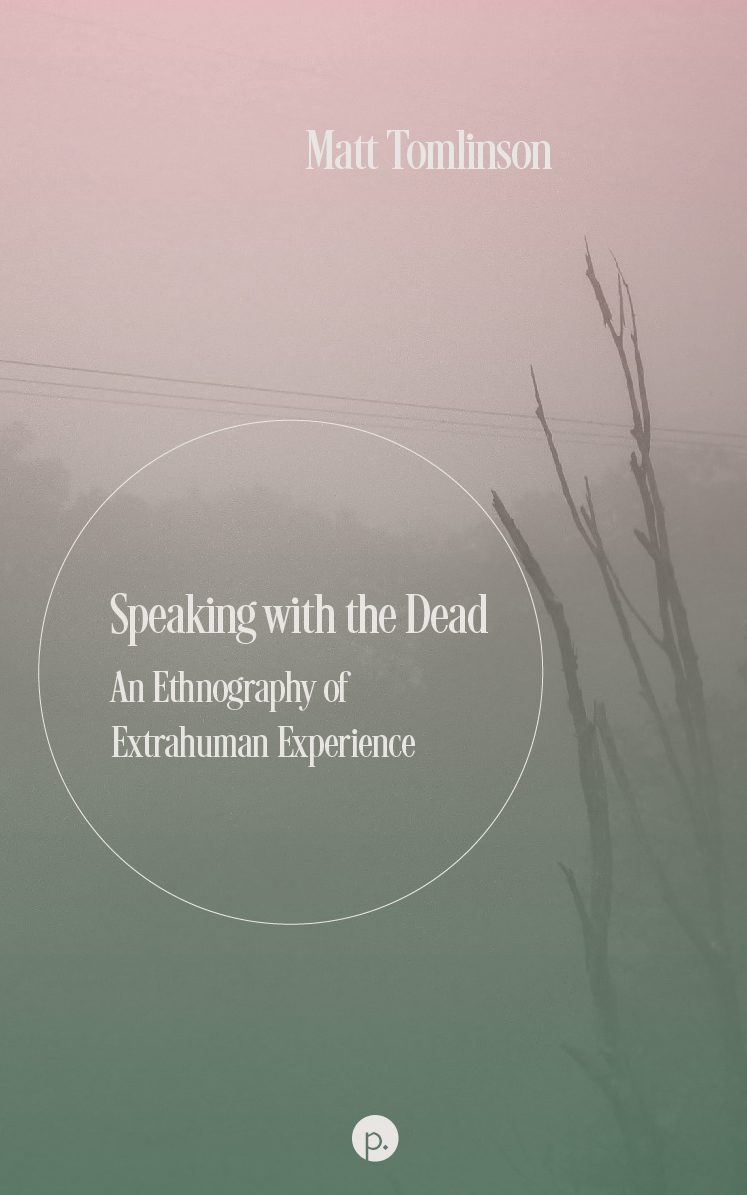
If you tried speaking with a dead person and they gave you a clear response, how would you react? Mediums develop their minds and bodies to communicate messages from the deceased to their living loved ones, and in Speaking with the Dead, anthropologist Matt Tomlinson describes his experiences training as a medium with a Spiritualist congregation in Canberra, Australia. The book is written in a first-person narrative style that brings “extrahuman” relationships to life, showing what it is like to learn and practice mediumship: the strategic suspension of skepticism; the wobbly first attempts; the embarrassing failures; and the moments, both unsettling and enthralling, when someone tells you that yes indeed, you’ve just described her grandfather who died in 1978.
Speaking with the Dead brims with stories of talented mediums and Tomlinson is not interested in proving or disproving mediumship, preferring instead to illustrate how mediums bring their practices to life. In contrast to the popular image of mediums as shameless frauds, Tomlinson describes earnest and committed seekers from a wide range of backgrounds who often struggle to understand their own experiences. Their profits are therapeutic rather than financial. And they worry about endings as much as anyone else: the passing of physical lives, the closure of beloved churches. Speaking with the Dead is ultimately a book about the lively side of death, grounded in Spiritualists’ conviction that life is eternal and your social network extends to the astral plane. It is a close examination of how mediumship works culturally, which is to say, how mediums and audiences work together to create senses of transcendent connection.
Where its authors and editors are based
Countries of the institutions the book's authors, editors and chapter authors were affiliated to when it was published.
- AUTHORS / EDITORS
- CITATIONS Phase 2
- USAGE Phase 3
| Country | Authors / editors |
|---|---|
| Australia | 1 |
About this data
These figures cover 1 work. Each value comes from the most trusted source that has it; a correction made by OJC or OBC staff outranks every source.
| Source | Confidence | Works |
|---|---|---|
| Thoth | 90 / 100 | 1 |
| Works with a publication date | 100% |
|---|---|
| Works with a DOI | 100% |
| Works with a funder recorded | 0% |
| Authors with an affiliation | 100% |
| Affiliations matched to an institution (ROR) | 100% |
| Affiliations with a country | 100% |
Countries come from the institution each author was affiliated to when they published, as recorded in ROR. A country is never guessed, so authors without a matched institution are not counted on the maps.
Funders come from OpenAlex for articles and Thoth for books, where publishers recorded them. Most works record none, so a funder's figures show what is recorded, not everything it funded.
Chapters count as works: their authors and editors, and the countries of their institutions, are in every figure where Thoth records an affiliation for them.
Citations (Phase 2) and usage (Phase 3) are not collected yet.