Book view
Vera Lex Historiae?
Constructions of Truth in Medieval Historical Narrative
Edited by Catalin Taranu, Michael J. Kelly
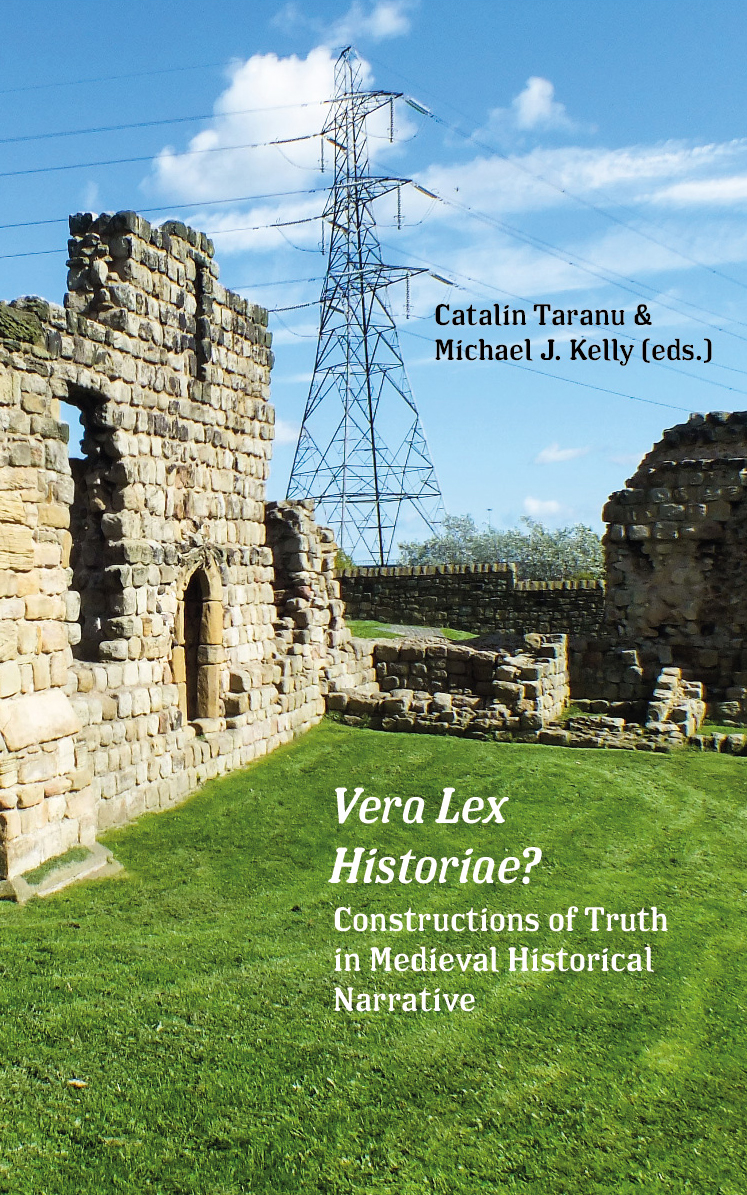
Book information
- Publisher
- punctum books
- Publication
- Published 18 August 2022
- Place
- Earth, Milky Way
- Catalogue record
- View in the catalogue
Abstract
In his Historia Ecclesiastica Gentis Anglorum (circa 731 CE), Bede says that he will write his account of the past of the English following only vera lex historiae (“the true law of history”). Whether explicitly or implicitly, historians narrate the past according to conceptions of what constitutes historical truth that emerge in the use of narrative strategies, formulae, and other textual forms, in establishing one’s ideological authority or that of one’s informants, and in faithfulness to a cultural, narrative, or poetic tradition. But what if we extend the scope of what we understand by history (especially in premodern settings) to include not just the writings of historians legitimated by the Latinate matrix of Christianized classical history writing, but also collective narratives, practices, rituals, oral poetry, liturgy, artistic representations, and acts of identity? In these genres of re-enacting the past as, or as representation of, the present, we find a plethora of modes of constructions of historical truth, narrative authority, and reliability.
Vera Lex Historiae? comprises contributions that reveal the variety of evental strategies by which historical truth was constructed in late antiquity and the earlier Middle Ages, and the range of procedures by which such narratives were first established as being historical and then as “true” histories. This is not only a matter of narrative strategies, but also of habitus—ways of living and acting in the world that are deeply imbricated with the commemoration and re-enactment of the past by communities and by individuals. In doing this, Vera Lex Historiae? aims to recover something of the plurality of modes of preserving and reenacting the past available in late antiquity and the earlier middle ages which we often overlook because of preconceived notions of what constitutes history writing.
Chapters
| Chapter | Author | Institution at publication |
|---|---|---|
| Introduction | Catalin Taranu, Ralph O’Connor | New Europe College; University of Aberdeen |
| Preface | Michael J. Kelly | Binghamton University |
| "Narratio Probabilis" in Early Medieval Historiography | Justin Lake | Texas A&M University |
| Alternative Histories | Catherine E. Karkov | University of Leeds |
| Contributors | Catalin Taranu, Michael J. Kelly | New Europe College; Binghamton University |
| Frontmatter | Catalin Taranu, Michael J. Kelly | New Europe College; Binghamton University |
| How the Barking Nuns Forgot Their Abbesses | Cynthia Turner Camp | University of Georgia |
| Romance, Legend, and the Remote Past | Ralph O’Connor | University of Aberdeen |
| The Literary Imaginary of the Past as the Truth of the Present | Ingela Nilsson | Uppsala University |
| The Shoemaker and the Troubadour Knight, and Other Stories | Kim Bergqvist | Stockholm University |
| “Truth is the trickiest” | Catalin Taranu | New Europe College |
| Index | Catalin Taranu, Michael J. Kelly | New Europe College; Binghamton University |
Where its authors and editors are based
Countries of the institutions the book's authors, editors and chapter authors were affiliated to when it was published.
- AUTHORS / EDITORS
- CITATIONS Phase 2
- USAGE Phase 3
| Country | Authors / editors |
|---|---|
| Sweden | 2 |
| United Kingdom | 2 |
| United States | 2 |
| Georgia | 1 |
| Romania | 1 |
About this data
These figures cover 13 works. Each value comes from the most trusted source that has it; a correction made by OJC or OBC staff outranks every source.
| Source | Confidence | Works |
|---|---|---|
| Thoth | 90 / 100 | 13 |
| Works with a publication date | 100% |
|---|---|
| Works with a DOI | 100% |
| Works with a funder recorded | 0% |
| Authors with an affiliation | 100% |
| Affiliations matched to an institution (ROR) | 100% |
| Affiliations with a country | 100% |
Countries come from the institution each author was affiliated to when they published, as recorded in ROR. A country is never guessed, so authors without a matched institution are not counted on the maps.
Funders come from OpenAlex for articles and Thoth for books, where publishers recorded them. Most works record none, so a funder's figures show what is recorded, not everything it funded.
Chapters count as works: their authors and editors, and the countries of their institutions, are in every figure where Thoth records an affiliation for them.
Citations (Phase 2) and usage (Phase 3) are not collected yet.