Book information
- Publisher
- punctum books
- Publication
- Forthcoming 1 January 2027
- Place
- Earth, Milky Way
- Catalogue record
- View in the catalogue
Abstract
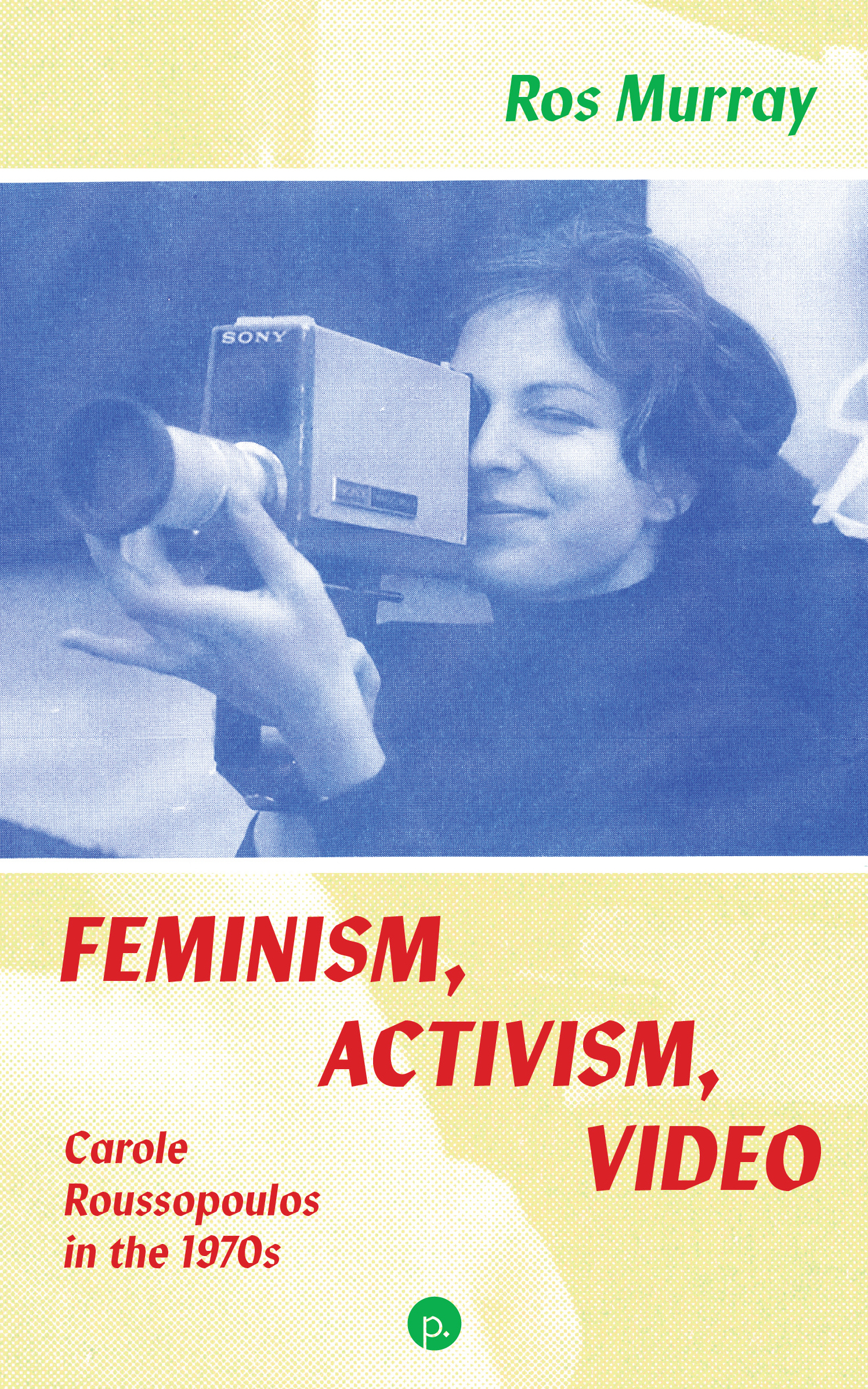
In 1968, following the largest general strike in French history, and the inauguration of a student and worker movement that built on and intersected with anti-colonial and anti-imperialist activism, a revolutionary new tool arrived on the French market: the Sony Portapak. The Portapak was a battery-powered, portable, self-contained electronic video recording system that enabled a whole new approach towards documenting activist interventions. Feminism, Activism, Video: Carole Roussopoulos in the 1970s explores the early work of video activist Carole Roussopoulos, who, forming the collectives Vidéo Out and Les Insoumuses, made over 150 videotapes documenting an extensive range of activist causes, starting with the Black Panthers, the Young Lords and the Palestine Liberation Organization. Vidéo Out made tapes with and about the Homosexual Front for Revolutionary Action and the Women’s Liberation Movement; a cycle of six tapes about the Lip factory takeover, where workers at a watch factory seized the means of production and paid themselves; and a tape about the first prostitutes’ occupation of a church in Lyon in 1975.
With the feminist collective Les Insoumuses, Roussopoulos, alongside Ioana Wieder, Delphine Seyrig, and Nadja Ringart, highlighted the participatory, inclusive aspects enabled by video technology to explore the possibilities offered by alternative feminist media. This book covers a rich period of activist history, with Roussopoulos’ engagement with militant video coinciding with the aftermath of 1968 as it continued to reverberate throughout the 1970s and beyond. It asks what video as a medium and technology brought to the struggle; why video activism differs from cinéma militant and other forms of documentary work, and why it is often said to be without a history. It argues that video collectives privilege participation, immediacy and action, resulting in a DIY politicized aesthetics that thrives on its antagonistic relationship to television and cinema.
Where its authors and editors are based
Countries of the institutions the book's authors, editors and chapter authors were affiliated to when it was published.
- AUTHORS / EDITORS
- CITATIONS Phase 2
- USAGE Phase 3
| Country | Authors / editors |
|---|---|
| United Kingdom | 1 |
About this data
These figures cover 1 work. Each value comes from the most trusted source that has it; a correction made by OJC or OBC staff outranks every source.
| Source | Confidence | Works |
|---|---|---|
| Thoth | 90 / 100 | 1 |
| Works with a publication date | 100% |
|---|---|
| Works with a DOI | 100% |
| Works with a funder recorded | 0% |
| Authors with an affiliation | 100% |
| Affiliations matched to an institution (ROR) | 100% |
| Affiliations with a country | 100% |
Countries come from the institution each author was affiliated to when they published, as recorded in ROR. A country is never guessed, so authors without a matched institution are not counted on the maps.
Funders come from OpenAlex for articles and Thoth for books, where publishers recorded them. Most works record none, so a funder's figures show what is recorded, not everything it funded.
Chapters count as works: their authors and editors, and the countries of their institutions, are in every figure where Thoth records an affiliation for them.
Citations (Phase 2) and usage (Phase 3) are not collected yet.