Book information
- Publisher
- punctum books
- Publication
- Published 11 February 2020
- Place
- Earth, Milky Way
- Catalogue record
- View in the catalogue
Abstract
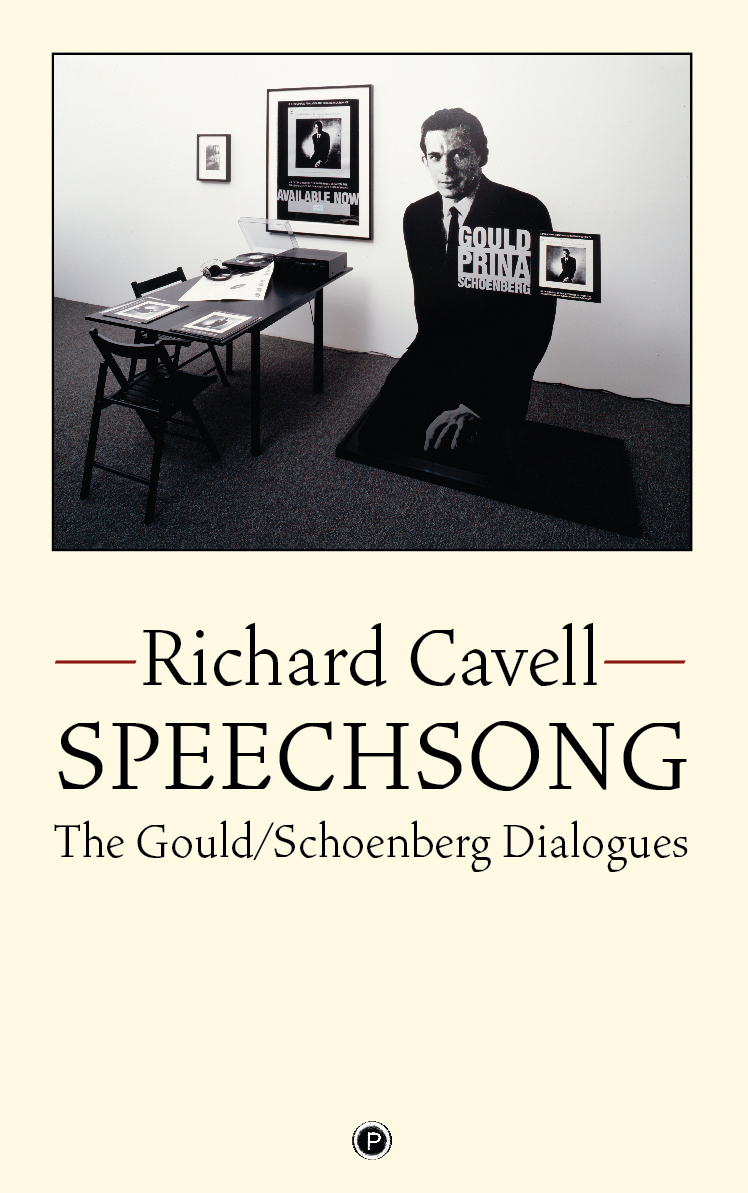
Speechsong is a work of imaginative musicology that addresses the engimas of Schoenberg and Gould, of singing and speaking, of Moses und Aron, of technology and being. Its point of departure is Gould’s last public performance, given at the Wilshire Ebell Theatre in Los Angeles, where a number of Schoenberg’s works were performed during his California exile. It is here, after that last performance, that Gould encounters a spectral Schoenberg in a staged conversation that explores Schoenberg’s travails in rethinking the fundamentals of Western music. This first part of Speechsong recalls Schoenberg’s operatic masterpiece, Moses und Aron, in which the divinely inspired Moses seeks the help of his brother to relate his vision: Moses speaks and Aron sings. Written as a twelve-tone composition, the opera produces an involution of harmonics that was Schoenberg’s response to Richard Wagner’s diatribes about synagogue noise. For Gould, Schoenberg’s is a formalist revolution; Schoenberg’s life, however, suggests that it was a search for personal and political freedom.
The second half of Speechsong is a critical essay in twelve “moments” that re-articulates the staged conversation as an inquiry into the intersections of music and mediation. Gould’s turn to the recording studio emerges as a post-humanist inquiry into recorded music as a repudiation of the virtuoso tradition and a liberation from unitary notions of selfhood. Schoenberg’s exodus from musical tradition likewise takes his twelve-tone invention beyond musical performance, where it emerges, along with Gould’s soundscapes, as a prototype of acoustic installations by artists such as Stephen Prina and Cory Arcangel. In these works, music abandons the concert hall and the exigencies of harmony for an acoustic space that embraces at once the recordings of Gould and the performances of Schoenberg that have found their home on the internet.
Where its authors and editors are based
Countries of the institutions the book's authors, editors and chapter authors were affiliated to when it was published.
- AUTHORS / EDITORS
- CITATIONS Phase 2
- USAGE Phase 3
| Country | Authors / editors |
|---|---|
| Canada | 1 |
About this data
These figures cover 1 work. Each value comes from the most trusted source that has it; a correction made by OJC or OBC staff outranks every source.
| Source | Confidence | Works |
|---|---|---|
| Thoth | 90 / 100 | 1 |
| Works with a publication date | 100% |
|---|---|
| Works with a DOI | 100% |
| Works with a funder recorded | 100% |
| Authors with an affiliation | 100% |
| Affiliations matched to an institution (ROR) | 100% |
| Affiliations with a country | 100% |
Countries come from the institution each author was affiliated to when they published, as recorded in ROR. A country is never guessed, so authors without a matched institution are not counted on the maps.
Funders come from OpenAlex for articles and Thoth for books, where publishers recorded them. Not every work records one, so a funder's figures show what is recorded, not everything it funded.
Chapters count as works: their authors and editors, and the countries of their institutions, are in every figure where Thoth records an affiliation for them.
Citations (Phase 2) and usage (Phase 3) are not collected yet.