Book view
The Art of Compilation
Manuscripts and Networks in the Early Medieval Latin West
Edited by Anna Dorofeeva, Michael J. Kelly
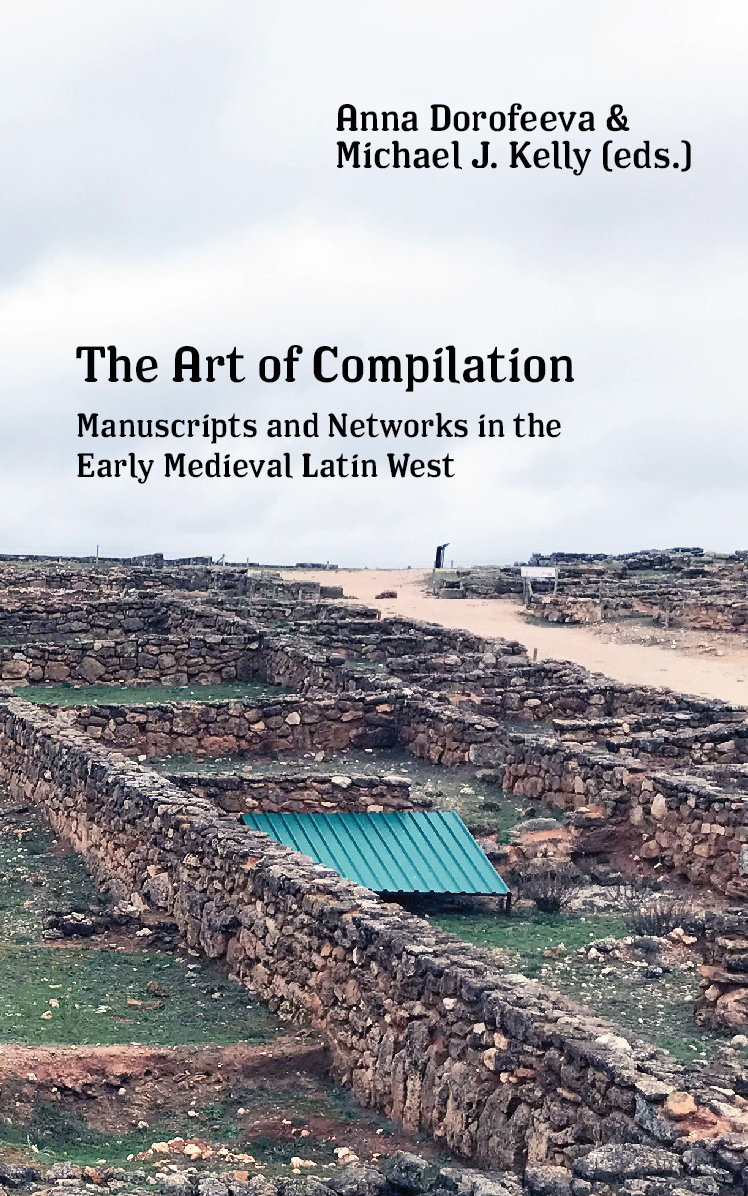
Book information
- Publisher
- punctum books
- Publication
- Published 4 March 2025
- Place
- Earth, Milky Way
- Catalogue record
- View in the catalogue
Abstract
The Art of Compilation: Manuscripts and Networks in the Early Medieval Latin West interrogates the medieval manuscript book as a dynamic, constantly changing object entangled in intellectual and cultural networks, constructed and deconstructed by different people, and transmuting in form and meaning over time. Medieval manuscripts are not static, permanently bound, and delimited, but rather serve as evidence for the layered relationships between texts and their material supports, and when we realize that, we gain a clearer view of medieval manuscript culture as driven by the agency and intellectual exchange of the people behind it. This volume of essays investigates early medieval Western European manuscript culture as a field of entangled objects, focusing on the connections between knowledge selection, material representation, and scribal agency.
The complex road of compiling selected texts into manuscripts (compilatio) in the early Middle Ages is still not well understood, yet it is the key to the historical context surrounding medieval manuscript culture. The practice of knowledge selection consisted of three key stages: the intellectual selection of the textual content of manuscript collections; the pragmatic action of arranging the textual content in a draft form by authors or editors; and the material representation and aesthetic exposition of texts in manuscripts. These stages were part of a linear development, but also exercised reciprocal influence upon one another. By tracing this process in surviving manuscript collections, we can better understand in what practical ways knowledge was encoded and how these often innovative and experimental practices contributed to the emergence and consolidation of intellectual and scribal traditions. This has important implications for how we understand education, reform, and the exercise of power in the early Middle Ages.
Chapters
Where its authors and editors are based
Countries of the institutions the book's authors, editors and chapter authors were affiliated to when it was published.
- AUTHORS / EDITORS
- CITATIONS Phase 2
- USAGE Phase 3
| Country | Authors / editors |
|---|---|
| Germany | 2 |
| Italy | 2 |
| United States | 2 |
| Austria | 1 |
| Ireland | 1 |
| The Netherlands | 1 |
About this data
These figures cover 15 works. Each value comes from the most trusted source that has it; a correction made by OJC or OBC staff outranks every source.
| Source | Confidence | Works |
|---|---|---|
| Thoth | 90 / 100 | 15 |
| Works with a publication date | 100% |
|---|---|
| Works with a DOI | 100% |
| Works with a funder recorded | 0% |
| Authors with an affiliation | 63% |
| Affiliations matched to an institution (ROR) | 100% |
| Affiliations with a country | 100% |
Countries come from the institution each author was affiliated to when they published, as recorded in ROR. A country is never guessed, so authors without a matched institution are not counted on the maps.
Funders come from OpenAlex for articles and Thoth for books, where publishers recorded them. Most works record none, so a funder's figures show what is recorded, not everything it funded.
Chapters count as works: their authors and editors, and the countries of their institutions, are in every figure where Thoth records an affiliation for them.
Citations (Phase 2) and usage (Phase 3) are not collected yet.