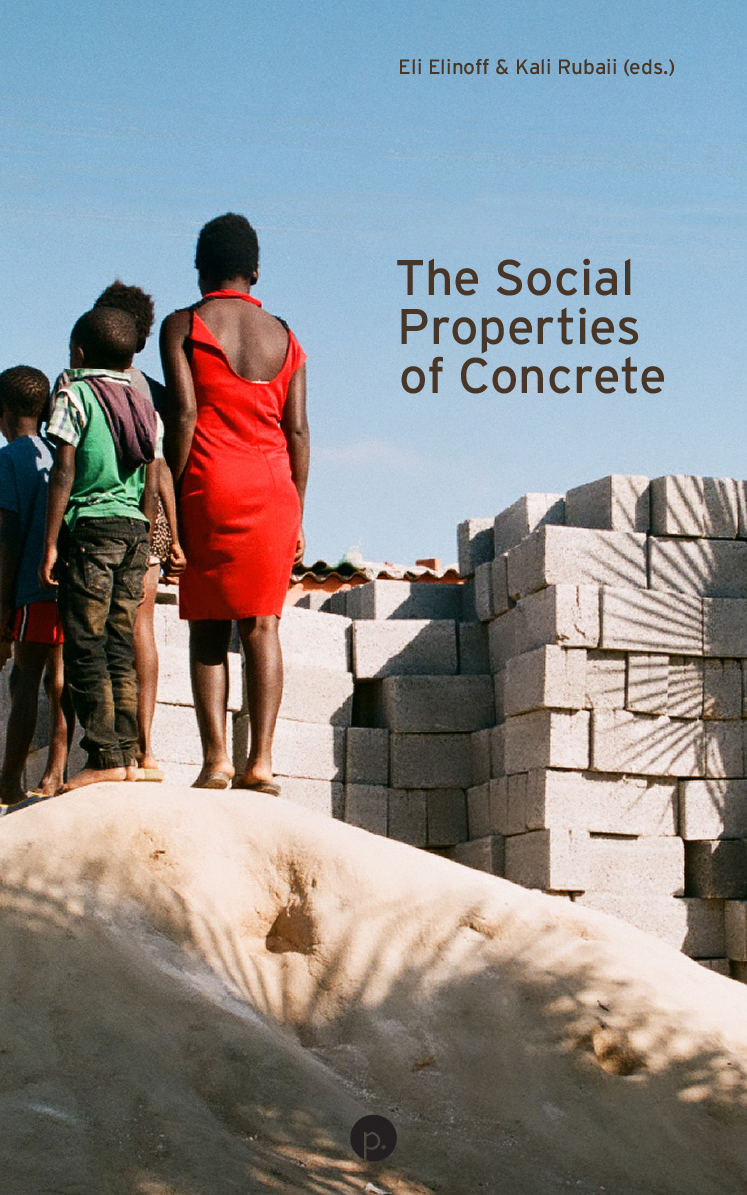
Book information
- Publisher
- punctum books
- Publication
- Published 9 May 2025
- Place
- Earth, Milky Way
- Catalogue record
- View in the catalogue
Abstract
Concrete is a ubiquitous part of our world. It composes our dwellings and shapes our infrastructures. It unites and divides urban space and is used to wage both war and peace. Concrete is simultaneously an indicator of freedom and development and is an essential part of the carceral apparatus. The Social Properties of Concrete begins from the premise that concrete is as richly social as it is densely material. Just as concrete’s materiality permeates our everyday life, our political projects, social practices, religious concepts, environmental transformations, and ethical questions suffuse concrete structures.
Like concrete itself, The Social Properties of Concrete is an aggregate: it draws together essays by social scientists, historians, architects, artists, and urban planners who each blend social theory, material science, and empirical analysis to explore the ways in which social life is embedded within concrete and to inquire about how concrete shapes social life. Across forty globally situated chapters, these essays open new conversations around our relationships with anthropogenic stone and serve as a teachable introduction to the social and political lives of materials. By taking this approach, this volume develops a conceptual language and methodological approach that should inform new understandings of material politics and our built environment.
The social properties of concrete are neither metaphors nor are they simple reflections of the social. Instead, they are modes of materially enacting social, economic, and political life itself.
Chapters
| Chapter | Author | Institution at publication |
|---|---|---|
| Introduction | Eli Elinoff, Kali Rubaii | Victoria University of Wellington; Purdue University System |
| Aggregate | Eli Elinoff | Victoria University of Wellington |
| Becoming | Penny Harvey, Constance Smith | University of Manchester |
| Belonging | Claudia Gastrow | North Carolina State University |
| Churning | Malini Sur | Western Sydney University |
| Connections | Austin Zeiderman | London School of Economics |
| Contracting | Pinai Sirikiatikul | Silpakorn University |
| Contributors | Eli Elinoff, Kali Rubaii | Victoria University of Wellington; Purdue University System |
| Corruption | Cassandra Hartblay | University of Toronto |
| Curing | Rachel Cypher | University of California, Santa Cruz |
| Demolition | Tim Oakes | University of Colorado Boulder |
| Depth | Matt Edgeworth | University of Leicester |
| Edgework | Lukas Ley | Max Planck Institute for Social Anthropology |
| Entombment | Greg Dvorak | Waseda University |
| Erasure | Nasser Abourahme | Bowdoin College |
| Exoskeleton | Denis Byrne | Western Sydney University |
| Extraction | Vanessa Lamb | York University; The University of Melbourne |
| Fear | Mona Chettri | |
| Foundation | Rebecca Bowers | London School of Economics |
| Frontmatter | Eli Elinoff, Kali Rubaii | Victoria University of Wellington; Purdue University System |
| Grayscale | Erik Harms | Yale University |
| Impermeability | Rosalie Stolz | University of Cologne |
| Improvisation | Rowan McCormick | Victoria University of Wellington |
| Incompleteness | Siddharth Menon | University of Wisconsin–Madison |
| Kinship | Heid Jerstad | |
| Magic | Naomi Haynes | University of Edinburgh |
| Microbiome | Matthew Gandy | University of Cambridge |
| Plasticity | Elihu Rubin | Yale University |
| Progress | Julie Soleil Archambault | Concordia University |
| Progressivism | Gabriel Lee | |
| Resonance | Marina Peterson | The University of Texas at Austin |
| Risk | Tyson Vaughan | |
| Scarcity | Emily Brownell | University of Edinburgh |
| Settler Colonialism | Lila Sharif | Arizona State University |
| Shredding | Duncan McDuie-Ra | Monash University Malaysia |
| Speculation | Tong Lam | University of Toronto |
| Stability | Diana Martinez | Tufts University |
| Standardization | Christina Schwenkel | University of California, Riverside |
| Time | Cristián Simonetti | Pontificia Universidad Católica de Chile |
| Uncertainties | Jerome Whitington | New York University |
| Uniformity | Mo H. Zareei | Victoria University of Wellington |
| Warscaping | Kali Rubaii | Purdue University System |
Where its authors and editors are based
Countries of the institutions the book's authors, editors and chapter authors were affiliated to when it was published.
- AUTHORS / EDITORS
- CITATIONS Phase 2
- USAGE Phase 3
| Country | Authors / editors |
|---|---|
| United States | 13 |
| United Kingdom | 8 |
| Canada | 4 |
| Australia | 3 |
| New Zealand | 3 |
| Germany | 2 |
| Chile | 1 |
| Japan | 1 |
All 10 countries
| Country | Authors / editors |
|---|---|
| United States | 13 |
| United Kingdom | 8 |
| Canada | 4 |
| Australia | 3 |
| New Zealand | 3 |
| Germany | 2 |
| Chile | 1 |
| Japan | 1 |
| Malaysia | 1 |
| Thailand | 1 |
About this data
These figures cover 43 works. Each value comes from the most trusted source that has it; a correction made by OJC or OBC staff outranks every source.
| Source | Confidence | Works |
|---|---|---|
| Thoth | 90 / 100 | 43 |
| Works with a publication date | 100% |
|---|---|
| Works with a DOI | 100% |
| Works with a funder recorded | 2% |
| Authors with an affiliation | 92% |
| Affiliations matched to an institution (ROR) | 96% |
| Affiliations with a country | 100% |
Countries come from the institution each author was affiliated to when they published, as recorded in ROR. A country is never guessed, so authors without a matched institution are not counted on the maps.
Funders come from OpenAlex for articles and Thoth for books, where publishers recorded them. Most works record none, so a funder's figures show what is recorded, not everything it funded.
Chapters count as works: their authors and editors, and the countries of their institutions, are in every figure where Thoth records an affiliation for them.
Citations (Phase 2) and usage (Phase 3) are not collected yet.