Book information
- Publisher
- punctum books
- Publication
- Published 26 January 2015
- Place
- Brooklyn, NY
- Catalogue record
- View in the catalogue
Abstract
“Experience” is a concept paradoxically deployed to accentuate the aconceptual. Although thinking, knowing, reflecting, and analyzing are kinds of experiences, invocations of “experience” typically direct our attention to what is immediate, embodied, unrepresented, unthought, even unthinkable. And yet, whether by learning experience, traumatic experience, life experience, mystical experience, or all of these, we hope most fervently that our experience will teach us, transform us, become part of us. Why do we strive to find, profit from, and possess experience while insisting upon experience’s intellectual elusiveness? What do we intend when we petition (and re-petition) experience for truth, for growth, for strength? To whom or to what do we sing when we sing experience’s song?
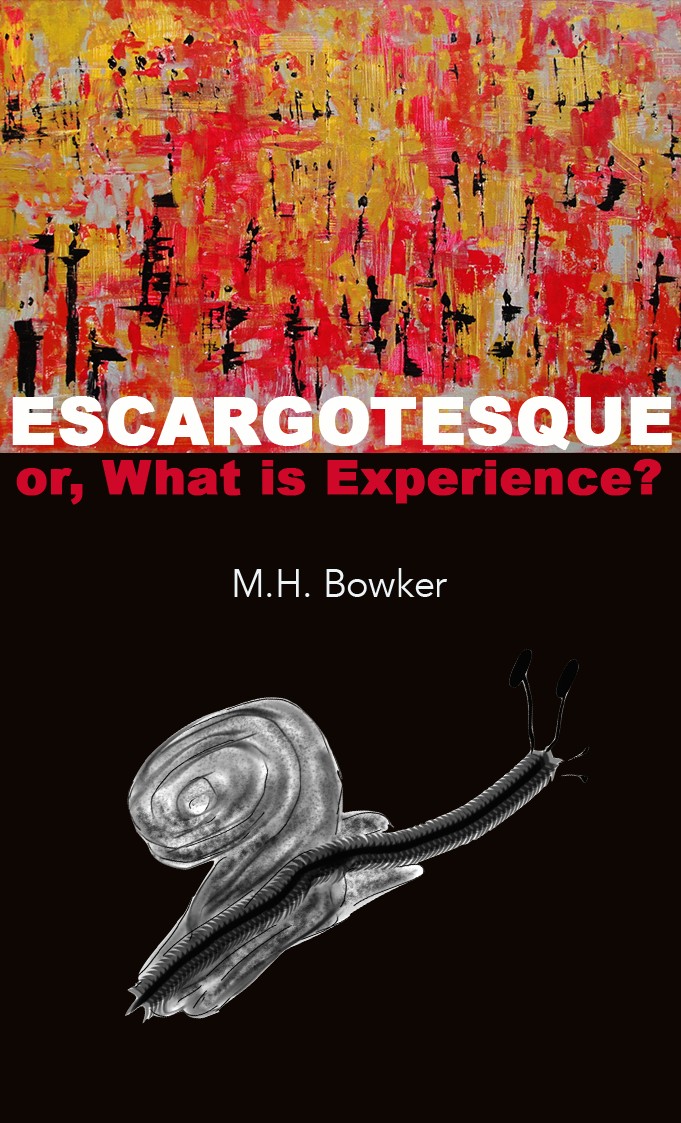
Escargotesque, or, What is Experience? asks why both our lived experiences and our mythologies of experience so often fold inward, repeat, return. Departing from his unusual experience of working as a garbage-collector in the West African country of Benin, M.H. Bowker converses with several champions of experience (from Michel de Montaigne to John Dewey, from Søren Kierkegaard to Ralph Waldo Emerson, from Simone Weil to R.D. Laing) to pose radical questions about the intentions and dynamics that guide our quest for experience, intentions and dynamics that are more destructive and more melancholy than celebrants of experience would care to admit.
Across Escargotesque’s six loosely linear parts, fragments of prose memoir intersect with poetry, sketch art, philosophical reflection, cultural criticism, and psychological examination in ways that both evoke and unsettle the thinking person’s experience. Escargotesque both testifies to an experience and reveals surprising fantasies driving the modern and postmodern turn to experience as a source of truth and hope. Such fantasies include the sacredness of even the most violent ‘pure experience,’ the necessity of supplicating experience’s objects, and the ultimate demise of the one who experiences.
Where its authors and editors are based
Countries of the institutions the book's authors, editors and chapter authors were affiliated to when it was published.
- AUTHORS / EDITORS
- CITATIONS Phase 2
- USAGE Phase 3
| Country | Authors / editors |
|---|---|
| United States | 1 |
About this data
These figures cover 1 work. Each value comes from the most trusted source that has it; a correction made by OJC or OBC staff outranks every source.
| Source | Confidence | Works |
|---|---|---|
| Thoth | 90 / 100 | 1 |
| Works with a publication date | 100% |
|---|---|
| Works with a DOI | 100% |
| Works with a funder recorded | 0% |
| Authors with an affiliation | 100% |
| Affiliations matched to an institution (ROR) | 100% |
| Affiliations with a country | 100% |
Countries come from the institution each author was affiliated to when they published, as recorded in ROR. A country is never guessed, so authors without a matched institution are not counted on the maps.
Funders come from OpenAlex for articles and Thoth for books, where publishers recorded them. Most works record none, so a funder's figures show what is recorded, not everything it funded.
Chapters count as works: their authors and editors, and the countries of their institutions, are in every figure where Thoth records an affiliation for them.
Citations (Phase 2) and usage (Phase 3) are not collected yet.