Book information
- Publisher
- punctum books
- Publication
- Published 28 November 2019
- Place
- Earth, Milky Way
- Catalogue record
- View in the catalogue
Abstract
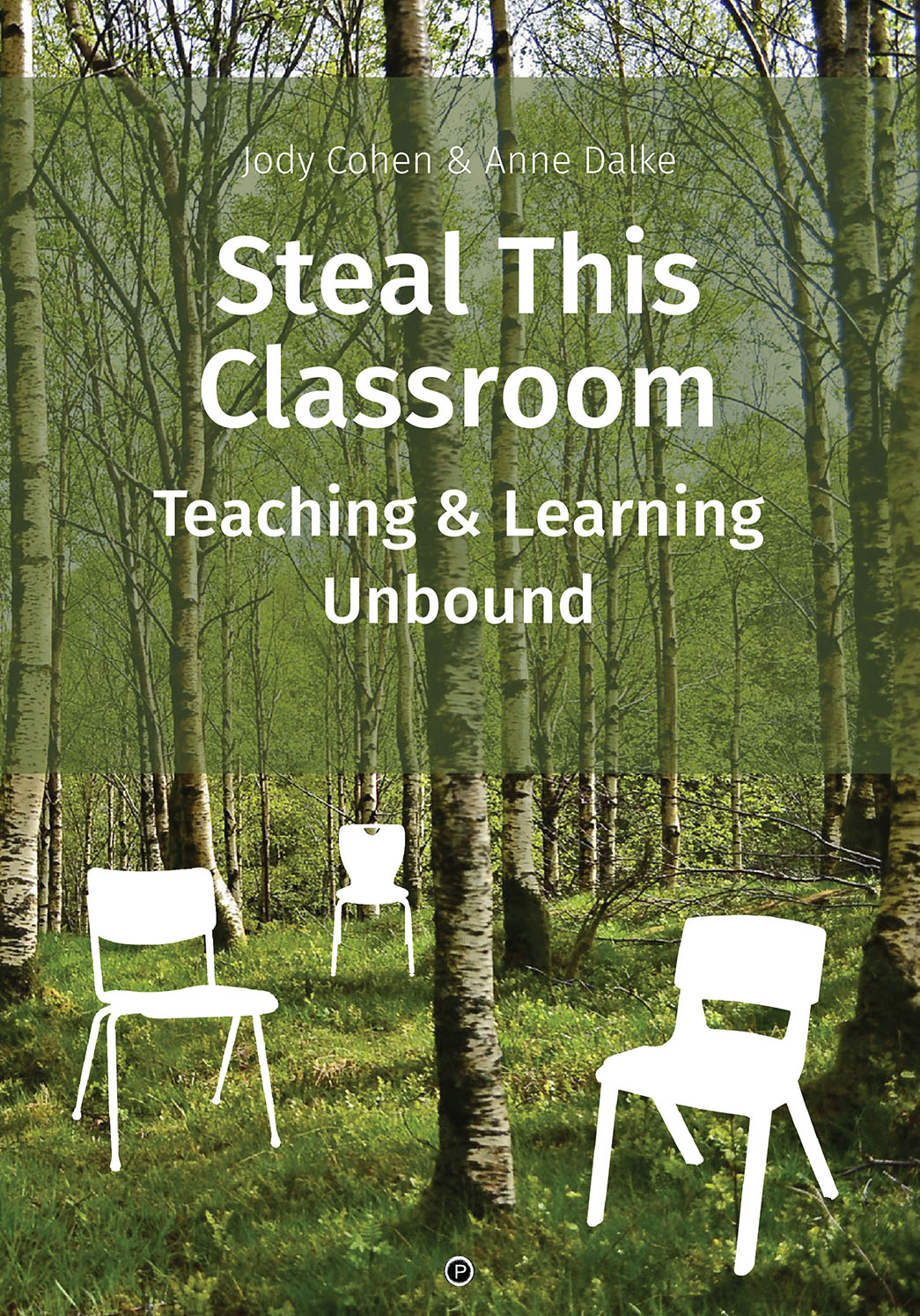
Jody Cohen and Anne Dalke construe “classrooms” as testing grounds, paradoxically boxed-in spaces that cannot keep their promise to enclose, categorize, or name. Exploring what is usually left out can create conditions ripe for breaking through, where real and abstract reverse and melt, the distinction between them disappearing. These are ecotones, transitional spaces that are testing grounds, places of danger and opportunity.
In college classrooms, an urban high school, a public library, a playground, and a women’s prison, Anne and Jody share scenes where teaching and learning take them by surprise; these are moments of uncertainty, sometimes constructed as failure. Digging into and exploding such moments reveals that they might be results of institutional pressures, socioeconomic and other diversities not acknowledged but operating and entangling individuals and ideas. Classrooms are sometimes “stolen” by the complex systems surrounding and permeating the activities that take place there; Jody and Anne explore ways to steal them back. Examining what is hidden but present in such moments can turn them into breakthroughs, powerful learning for educators and students—revealing how failure itself might not be what it seems.
Moving back and forth between micro and macro in a continual interplay across individuals, groups, and institutions, and organizing their experiences and philosophies of teaching under the rubrics of Playing, Haunting, Silencing, Unbecoming, Leaking, Befriending, Slipping, and Reassembling, Anne and Jody try out alternative tales, exploring a pedagogical orientation that is ecological in the largest sense, engaging teachers and students in re-thinking learning and teaching in classrooms, and in their larger lives, as complex, enmeshed, volatile eco-systems.
Jody and Anne weave through their own voices those of students and colleagues, demonstrating the complex playfulness of collaborative and transdisciplinary forms of teaching and learning. Not solving the contradictions, but abstracting from the immediate, they offer a dialogue, telling hard stories and funny ones, involving others’ stories in response, demonstrating the complex playfulness of collaborative and transdisciplinary work. They make concrete suggestions about how academic and other structures might open up; they also remain porous and interactive, inviting reader-participants to join in transfiguring what spaces of teaching and learning are and can be-and-do.
Where its authors and editors are based
Countries of the institutions the book's authors, editors and chapter authors were affiliated to when it was published.
- AUTHORS / EDITORS
- CITATIONS Phase 2
- USAGE Phase 3
| Country | Authors / editors |
|---|---|
| United States | 2 |
About this data
These figures cover 1 work. Each value comes from the most trusted source that has it; a correction made by OJC or OBC staff outranks every source.
| Source | Confidence | Works |
|---|---|---|
| Thoth | 90 / 100 | 1 |
| Works with a publication date | 100% |
|---|---|
| Works with a DOI | 100% |
| Works with a funder recorded | 100% |
| Authors with an affiliation | 100% |
| Affiliations matched to an institution (ROR) | 100% |
| Affiliations with a country | 100% |
Countries come from the institution each author was affiliated to when they published, as recorded in ROR. A country is never guessed, so authors without a matched institution are not counted on the maps.
Funders come from OpenAlex for articles and Thoth for books, where publishers recorded them. Not every work records one, so a funder's figures show what is recorded, not everything it funded.
Chapters count as works: their authors and editors, and the countries of their institutions, are in every figure where Thoth records an affiliation for them.
Citations (Phase 2) and usage (Phase 3) are not collected yet.