Book view
Urban Liquefaction
Rethinking the Relationship between Land and Sea
Edited by Cristián Simonetti, Michel Lussault, Tim Ingold
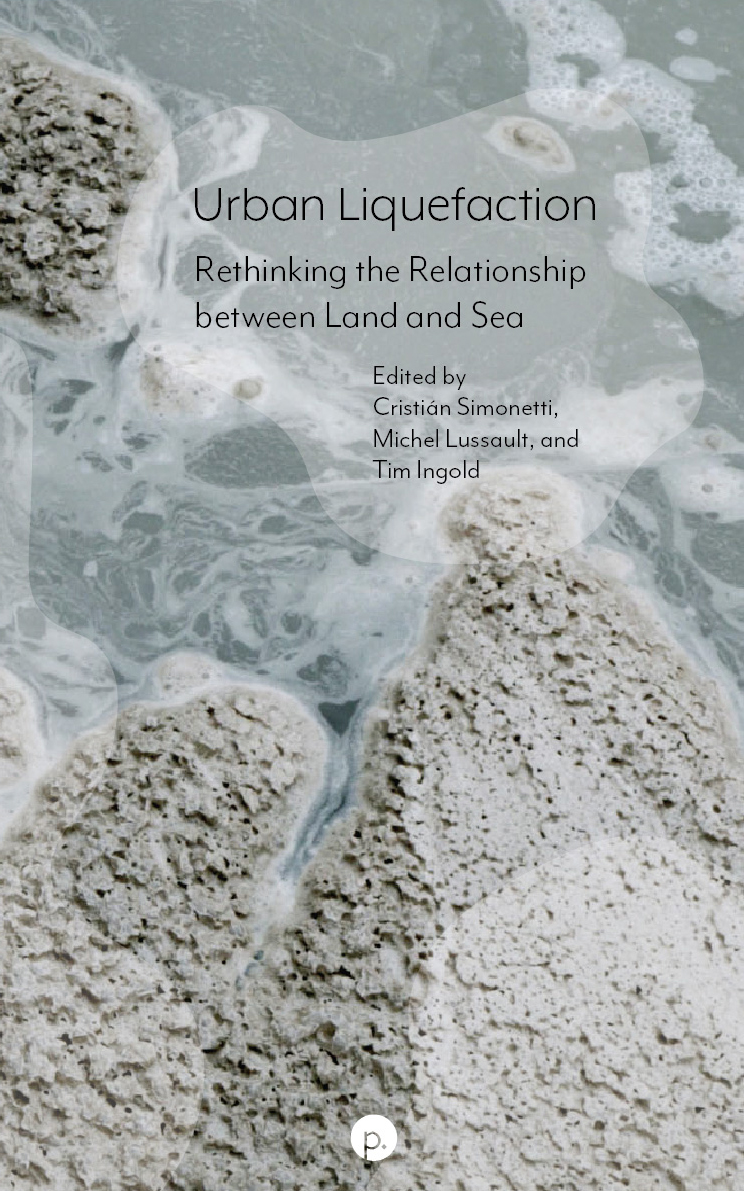
Book information
- Publisher
- punctum books
- Publication
- Published 28 January 2026
- Place
- Earth, Milky Way
- Catalogue record
- View in the catalogue
Abstract
From classical times until today, cities have been conceived in the western imagination as ideally confined to the fixities of the land, a space defined in opposition to the fluxes of the sea. Whereas solid land afforded a durable platform for the establishment of property and citizenship, the fluid sea allowed markets—isolated within the secure boundaries of cities—to be connected across the globe though navigation.
Urban Liquefaction: Rethinking the Relationship between Land and Sea attends to the concurrent tensions between solidity and fluidity, permanence and impermanence, and substance and change that remain at the core of the western intellectual tradition, often dividing what is perceived as social from what is perceived as natural in life. Sea level rise poses unprecedented threats to this oppositional relationship, forcing us to reconsider the tension between solidity and fluidity in the design of the built environment. Nearly ten percent of all major cities are likely to be impacted by sea level rise in the coming decades, compromising the necessary infrastructure on which urban life depends. In reality, urban landscapes have been continually in flux, which becomes dramatically visible to urban dwellers mostly in catastrophic events such as earthquakes, tsunamis, alluvions, sinkholes, and, above all, soil liquefaction.
Urban Liquefaction gathers contributions from scholars and practitioners working across continents and fields interested in urban life in (and after) the Anthropocene, including anthropology, archaeology, art, architecture, design, human geography, and science studies, to open up an inquiry into these categorical tensions and to speculate on alternative futures for the built environment.
Chapters
Where its authors and editors are based
Countries of the institutions the book's authors, editors and chapter authors were affiliated to when it was published.
- AUTHORS / EDITORS
- CITATIONS Phase 2
- USAGE Phase 3
About this data
These figures cover 23 works. Each value comes from the most trusted source that has it; a correction made by OJC or OBC staff outranks every source.
| Source | Confidence | Works |
|---|---|---|
| Thoth | 90 / 100 | 23 |
| Works with a publication date | 100% |
|---|---|
| Works with a DOI | 100% |
| Works with a funder recorded | 0% |
| Authors with an affiliation | 92% |
| Affiliations matched to an institution (ROR) | 100% |
| Affiliations with a country | 100% |
Countries come from the institution each author was affiliated to when they published, as recorded in ROR. A country is never guessed, so authors without a matched institution are not counted on the maps.
Funders come from OpenAlex for articles and Thoth for books, where publishers recorded them. Most works record none, so a funder's figures show what is recorded, not everything it funded.
Chapters count as works: their authors and editors, and the countries of their institutions, are in every figure where Thoth records an affiliation for them.
Citations (Phase 2) and usage (Phase 3) are not collected yet.