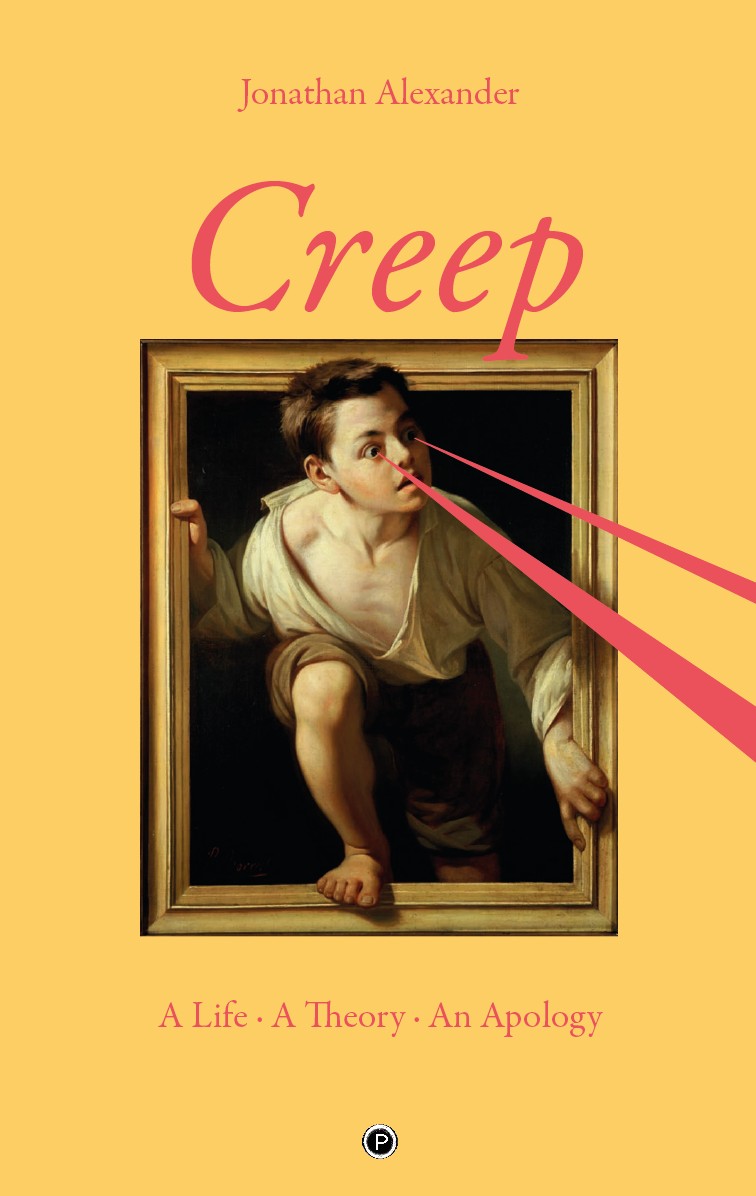
Book information
- Publisher
- punctum books
- Publication
- Published 29 August 2017
- Place
- Earth, Milky Way
- Catalogue record
- View in the catalogue
Abstract
Creeps surround us, seemingly everywhere. People creep up on each other both on the streets and online, with digital technologies vectoring a lot of cyber-stalking. It’s so easy to spy on people that “creep catching” has even become a form of news entertainment in shows such as “To Catch a Predator.” But what defines a creep is so broad that nearly anyone can be a creep at times. Many of us wonder if we ourselves have been creepy, or if perhaps we engage in behavior that, if others knew, would easily earn us the title “creep.” Even Donald Trump, during the raucous 2016 campaign, was called a “creep” on several occasions by various news media.
Indeed, for many of us, the specter of the creep is not just threatening, but exciting – exciting perhaps in the possibility of threat. Yes, we get creeped out. But we are also fascinated by creeps, perhaps in part because we all sense the potential inside ourselves for creepy behavior.
In this provocative and engaging new book, Jonathan Alexander interweaves personal narrative and cultural analyses to explore what it means to be a creep. Calling this work a critical memoir, he draws on his own experiences growing up gay in the deep south, while also interrogating examples from literature and popular film and media, to approach the figure of the creep with some sympathy. Ranging widely over contemporary culture, especially the ever-creeping presence of nearly ubiquitous surveillance, Alexander confesses his own creepiness while also explaining to us what being creepy can show us in turn about our culture. He also resurrects some famous “creeps” from the past, such as J.R. Ackerley, to explore what makes a creep creepy, and how even the best of us succumb at times to being creeps. Ultimately, Alexander argues, a study of creepiness might offer us critical insight into the fundamental perversity of how we live. Creep: A Life, A Theory, an Apology is a timely meditation for our strange and creepy times.
Where its authors and editors are based
Countries of the institutions the book's authors, editors and chapter authors were affiliated to when it was published.
- AUTHORS / EDITORS
- CITATIONS Phase 2
- USAGE Phase 3
| Country | Authors / editors |
|---|---|
| United States | 1 |
About this data
These figures cover 1 work. Each value comes from the most trusted source that has it; a correction made by OJC or OBC staff outranks every source.
| Source | Confidence | Works |
|---|---|---|
| Thoth | 90 / 100 | 1 |
| Works with a publication date | 100% |
|---|---|
| Works with a DOI | 100% |
| Works with a funder recorded | 0% |
| Authors with an affiliation | 100% |
| Affiliations matched to an institution (ROR) | 100% |
| Affiliations with a country | 100% |
Countries come from the institution each author was affiliated to when they published, as recorded in ROR. A country is never guessed, so authors without a matched institution are not counted on the maps.
Funders come from OpenAlex for articles and Thoth for books, where publishers recorded them. Most works record none, so a funder's figures show what is recorded, not everything it funded.
Chapters count as works: their authors and editors, and the countries of their institutions, are in every figure where Thoth records an affiliation for them.
Citations (Phase 2) and usage (Phase 3) are not collected yet.