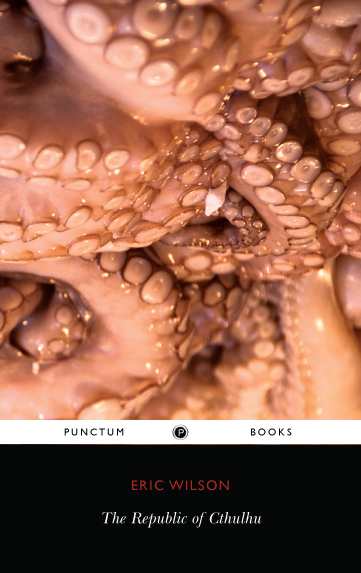
Book information
- Publisher
- punctum books
- Publication
- Published 7 November 2016
- Place
- Earth, Milky Way
- Catalogue record
- View in the catalogue
Abstract
If parapolitics, a branch of radical criminology that studies the interactions between public entities and clandestine agencies, is to develop as an academic discipline, then it must develop a coherent theory of aesthetics in order to successfully perform its primary function: to render perceptible extra-judicial phenomena that have hitherto resisted formal classification.
Wilson offers the work of H.P. Lovecraft (1890–1937) as an example of the relevance of subversive literature—in this case, cosmic horror and the weird tale—to the parapolitical criminologist. Cosmic horror is a form of writing that relies heavily upon the epistemological assumption of a radical and irreconcilable disjunction between appearance and reality, perception and truth. In many ways, the well-constructed weird tale strongly resembles the hard-boiled detective story or the noir thriller in that the resolution of the narrative hinges upon a dramatically shattering confrontation with an unspeakable reality. Apart from its obvious utilization of conspiracy theory, the primary attraction of the Lovecraftian text lies with its remarkably sophisticated utilization of two central tropes of classical aesthetic theory—the sublime and the grotesque. Not only does Lovecraft’s oeuvre represent a remarkable use of both of these motifs, but the raw literary power of the Lovecraftian weird tale serves as an outstanding exemplar for the parapolitical scholar to emulate in formulating an alternative mode of discourse, or poetics.
Where its authors and editors are based
Countries of the institutions the book's authors, editors and chapter authors were affiliated to when it was published.
- AUTHORS / EDITORS
- CITATIONS Phase 2
- USAGE Phase 3
| Country | Authors / editors |
|---|---|
| Australia | 1 |
About this data
These figures cover 1 work. Each value comes from the most trusted source that has it; a correction made by OJC or OBC staff outranks every source.
| Source | Confidence | Works |
|---|---|---|
| Thoth | 90 / 100 | 1 |
| Works with a publication date | 100% |
|---|---|
| Works with a DOI | 100% |
| Works with a funder recorded | 0% |
| Authors with an affiliation | 100% |
| Affiliations matched to an institution (ROR) | 100% |
| Affiliations with a country | 100% |
Countries come from the institution each author was affiliated to when they published, as recorded in ROR. A country is never guessed, so authors without a matched institution are not counted on the maps.
Funders come from OpenAlex for articles and Thoth for books, where publishers recorded them. Most works record none, so a funder's figures show what is recorded, not everything it funded.
Chapters count as works: their authors and editors, and the countries of their institutions, are in every figure where Thoth records an affiliation for them.
Citations (Phase 2) and usage (Phase 3) are not collected yet.