Book view
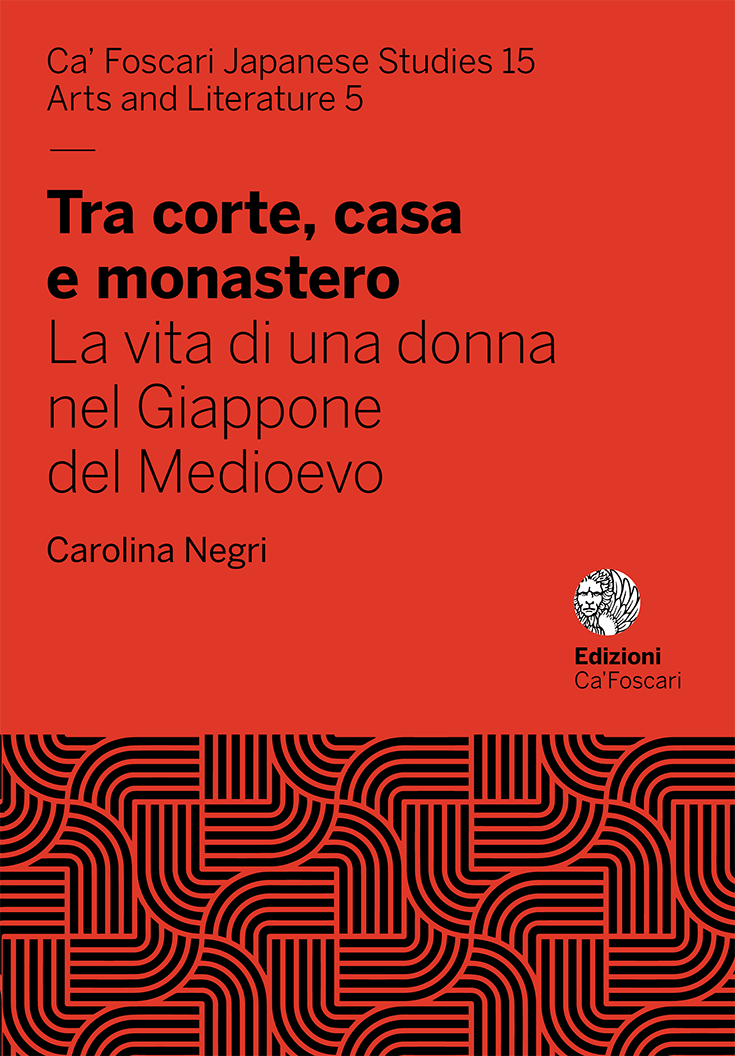
Between Court, House and Monastery
The Life of a Woman in Medieval Japan
Book information
- Publisher
- Edizioni Ca' Foscari
- Publication
- Published 20 October 2021
- Place
- Venice, Italy
- Series
- Ca’ Foscari Japanese Studies
- Catalogue record
- View in the catalogue
Abstract
In Japanese history the establishment of the ie, or family system, on which patriarchal authority was based, represents one of the most important turning points. The ie that came into being from the late eleventh century onwards, differs from the uji that had characterised previous eras, not so much on account of its patriarchal system but because it would place the married couple in prime position. The family, previously made up of a man engaging in occasional relationships with a number of women, would gradually become a more stable nucleus comprising of a husband with a wife who enjoyed a legally recognised position of privilege compared with all the other concubines. After her husband’s death, she would naturally become a sort of substitute figure, often gaining considerable authority and prestige. With the threat of the Mongolian invasions (from 1274 and 1281) and the consequent increase in limitations on women’s inheritance rights, many widows were forced to take vows as a sign of loyalty and tangible proof of their choice not to remarry if they were to secure their husband’s property. The literary production of Nun Abutsu (1225 ca.-1283 ca.) written in a period which led to the inevitable breakdown of the economic, social, and political balance of Japan, offers a realistic description of women’s ambitions, duties and concerns in an era of great transformation. In a close reading of her major works Abutsu no fumi (The letter of Abutsu, 1264 ca.), Utatane (Fitful slumbers, XIII century) and Izayoi nikki (The Diary of the sixteenth night moon, 1280 ca.), the book casts light on some important issues in Japanese women’s history: the gradual shift from uxorical to virilocal marriage, the consequences of this process for inheritance patterns, the meaning of women’s participation in the intellectual life of their time.
Where its authors and editors are based
Countries of the institutions the book's authors, editors and chapter authors were affiliated to when it was published.
- AUTHORS / EDITORS
- CITATIONS Phase 2
- USAGE Phase 3
| Country | Authors / editors |
|---|---|
| Italy | 1 |
About this data
These figures cover 1 work. Each value comes from the most trusted source that has it; a correction made by OJC or OBC staff outranks every source.
| Source | Confidence | Works |
|---|---|---|
| Thoth | 90 / 100 | 1 |
| Works with a publication date | 100% |
|---|---|
| Works with a DOI | 100% |
| Works with a funder recorded | 0% |
| Authors with an affiliation | 100% |
| Affiliations matched to an institution (ROR) | 100% |
| Affiliations with a country | 100% |
Countries come from the institution each author was affiliated to when they published, as recorded in ROR. A country is never guessed, so authors without a matched institution are not counted on the maps.
Funders come from OpenAlex for articles and Thoth for books, where publishers recorded them. Most works record none, so a funder's figures show what is recorded, not everything it funded.
Chapters count as works: their authors and editors, and the countries of their institutions, are in every figure where Thoth records an affiliation for them.
Citations (Phase 2) and usage (Phase 3) are not collected yet.