Book view
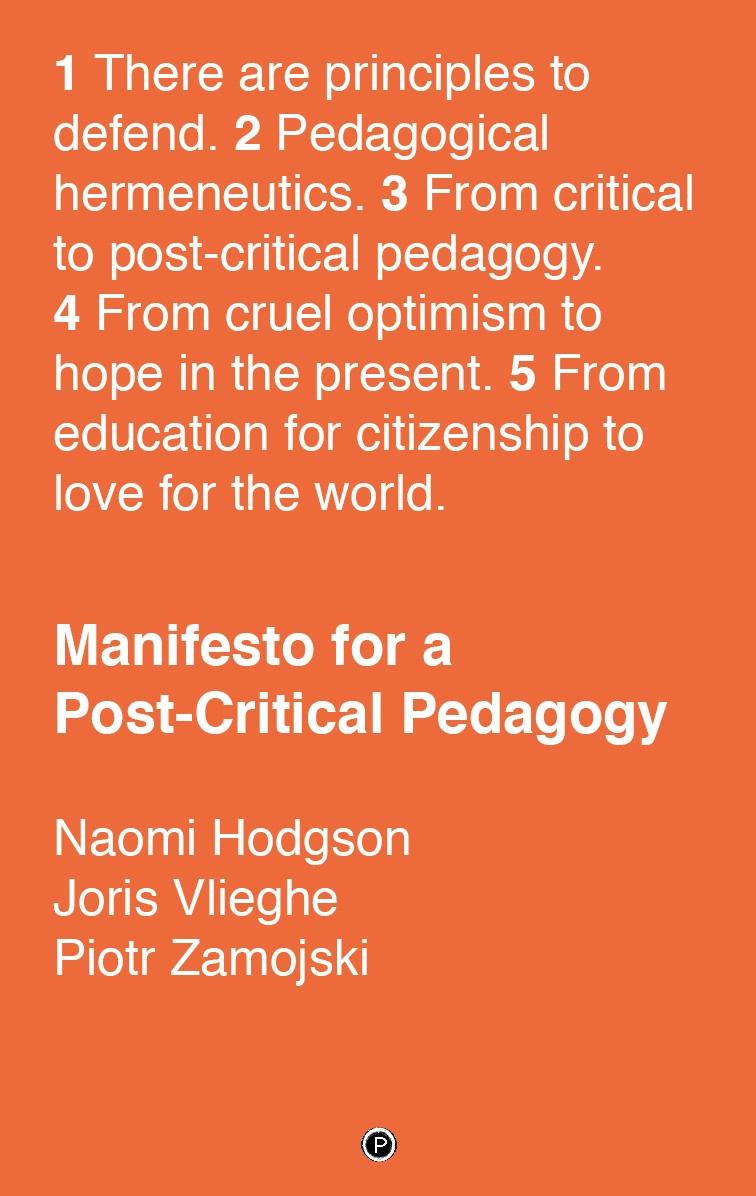
Manifesto for a Post-Critical Pedagogy
Edited by Naomi Hodgson, Joris Vlieghe, Piotr Zamojski
Book information
- Publisher
- punctum books
- Publication
- Published 11 January 2018
- Place
- Earth, Milky Way
- Catalogue record
- View in the catalogue
Abstract
The belief in the transformative potential of education has long underpinned critical educational theory. But its concerns have also been largely political and economic, using education as the means to achieve a better – or ideal – future state: of equality and social justice. Our concern is not whether such a state can be realized. Rather, the belief in the transformative potential of education leads us to start from the assumption of equality and to attend to what is “educational” about education.
In Manifesto for a Post-Critical Pedagogy we set out five principles that call not for an education as a means to achieve a future state, but rather that make manifest those educational practices that do exist today and that we wish to defend. The Manifesto also acts as a provocation, as the starting point of a conversation about what this means for research, pedagogy, and our relation to our children, each other, and the world.
Manifesto for a Post-Critical Pedagogy invites a shift from a critical pedagogy premised on revealing what is wrong with the world and using education to solve it, to an affirmative stance that acknowledges what is educational in our existing practices. It is focused on what we do and what we can do, if we approach education with love for the world and acknowledge that education is based on hope in the present, rather than on optimism for an eternally deferred future.
Chapters
Where its authors and editors are based
Countries of the institutions the book's authors, editors and chapter authors were affiliated to when it was published.
- AUTHORS / EDITORS
- CITATIONS Phase 2
- USAGE Phase 3
| Country | Authors / editors |
|---|---|
| United Kingdom | 5 |
| United States | 2 |
| Belgium | 1 |
| Israel | 1 |
About this data
These figures cover 12 works. Each value comes from the most trusted source that has it; a correction made by OJC or OBC staff outranks every source.
| Source | Confidence | Works |
|---|---|---|
| Thoth | 90 / 100 | 12 |
| Works with a publication date | 100% |
|---|---|
| Works with a DOI | 100% |
| Works with a funder recorded | 8% |
| Authors with an affiliation | 100% |
| Affiliations matched to an institution (ROR) | 100% |
| Affiliations with a country | 100% |
Countries come from the institution each author was affiliated to when they published, as recorded in ROR. A country is never guessed, so authors without a matched institution are not counted on the maps.
Funders come from OpenAlex for articles and Thoth for books, where publishers recorded them. Most works record none, so a funder's figures show what is recorded, not everything it funded.
Chapters count as works: their authors and editors, and the countries of their institutions, are in every figure where Thoth records an affiliation for them.
Citations (Phase 2) and usage (Phase 3) are not collected yet.