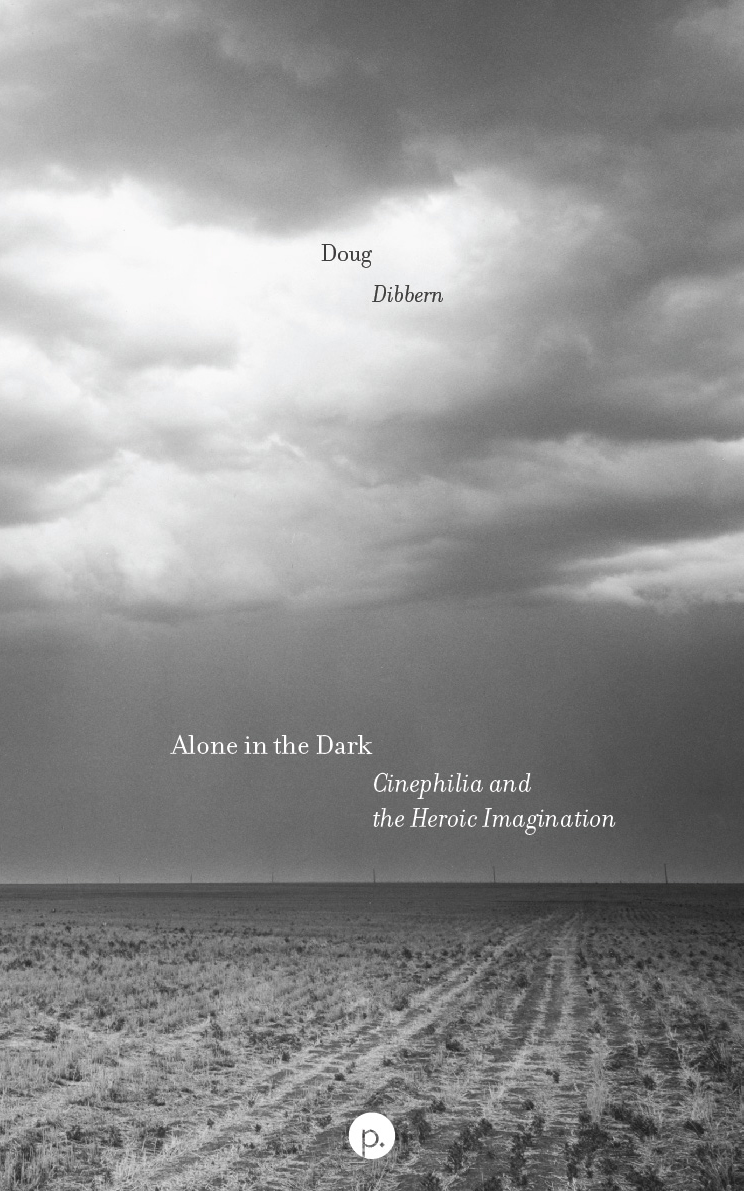
Book information
- Publisher
- punctum books
- Publication
- Published 15 April 2024
- Place
- Earth, Milky Way
- Catalogue record
- View in the catalogue
Abstract
Alone in the Dark is an experimental memoir – or perhaps, more accurately, an anti-memoir or fabulist memoir, some unruly combination of essay, prose poem, and floating reverie that examines the relationship between one’s cultural heritage and one’s aesthetic devotions. Unlike a traditional autobiography that details the chronological events of a person’s life, the book begins with the obsessive moviegoing of Dibbern’s early years in New York and then unfurls as a fevered rumination on the role that an excessive love of art plays in shaping ideas about one’s identity.
The book opens with the American premiere of the Hungarian filmmaker Béla Tarr’s harrowing, eight-hour-long magnum opus Sátántangó in 1998 as an emblematic cinephile experience. Dibbern then frames the book by asking, why would anyone devote the bulk of their waking hours to such a compulsive pursuit of a seemingly passive experience of art? Sitting alone in a darkened movie theater, he suggests, is not a passive, but a creative act: developing an aesthetic taste, after all, is central to defining our identities. And taste is the product of two contradictory impulses: the will to simultaneously embrace and escape the values of our cultural backgrounds that made us who we are.
With these conjectures as the jumping-off point, the book commences its discursive explorations, wending and weaving between topics as diverse as Carl Jung’s theories of the collective unconscious, Carl Theodor Dreyer’s Ordet, old family photo albums, nineteenth-century immigration to North Dakota, the actress Gena Rowlands’s histrionic mental breakdowns, the self-portraits that the Mandan chief Mato-Tope made in the 1830s, and the dizzyingly joyful suicidal games in Howard Hawks’s film about aviation, Only Angels Have Wings.
Where its authors and editors are based
Countries of the institutions the book's authors, editors and chapter authors were affiliated to when it was published.
- AUTHORS / EDITORS
- CITATIONS Phase 2
- USAGE Phase 3
| Country | Authors / editors |
|---|---|
| United States | 1 |
About this data
These figures cover 1 work. Each value comes from the most trusted source that has it; a correction made by OJC or OBC staff outranks every source.
| Source | Confidence | Works |
|---|---|---|
| Thoth | 90 / 100 | 1 |
| Works with a publication date | 100% |
|---|---|
| Works with a DOI | 100% |
| Works with a funder recorded | 0% |
| Authors with an affiliation | 100% |
| Affiliations matched to an institution (ROR) | 100% |
| Affiliations with a country | 100% |
Countries come from the institution each author was affiliated to when they published, as recorded in ROR. A country is never guessed, so authors without a matched institution are not counted on the maps.
Funders come from OpenAlex for articles and Thoth for books, where publishers recorded them. Most works record none, so a funder's figures show what is recorded, not everything it funded.
Chapters count as works: their authors and editors, and the countries of their institutions, are in every figure where Thoth records an affiliation for them.
Citations (Phase 2) and usage (Phase 3) are not collected yet.