Book view
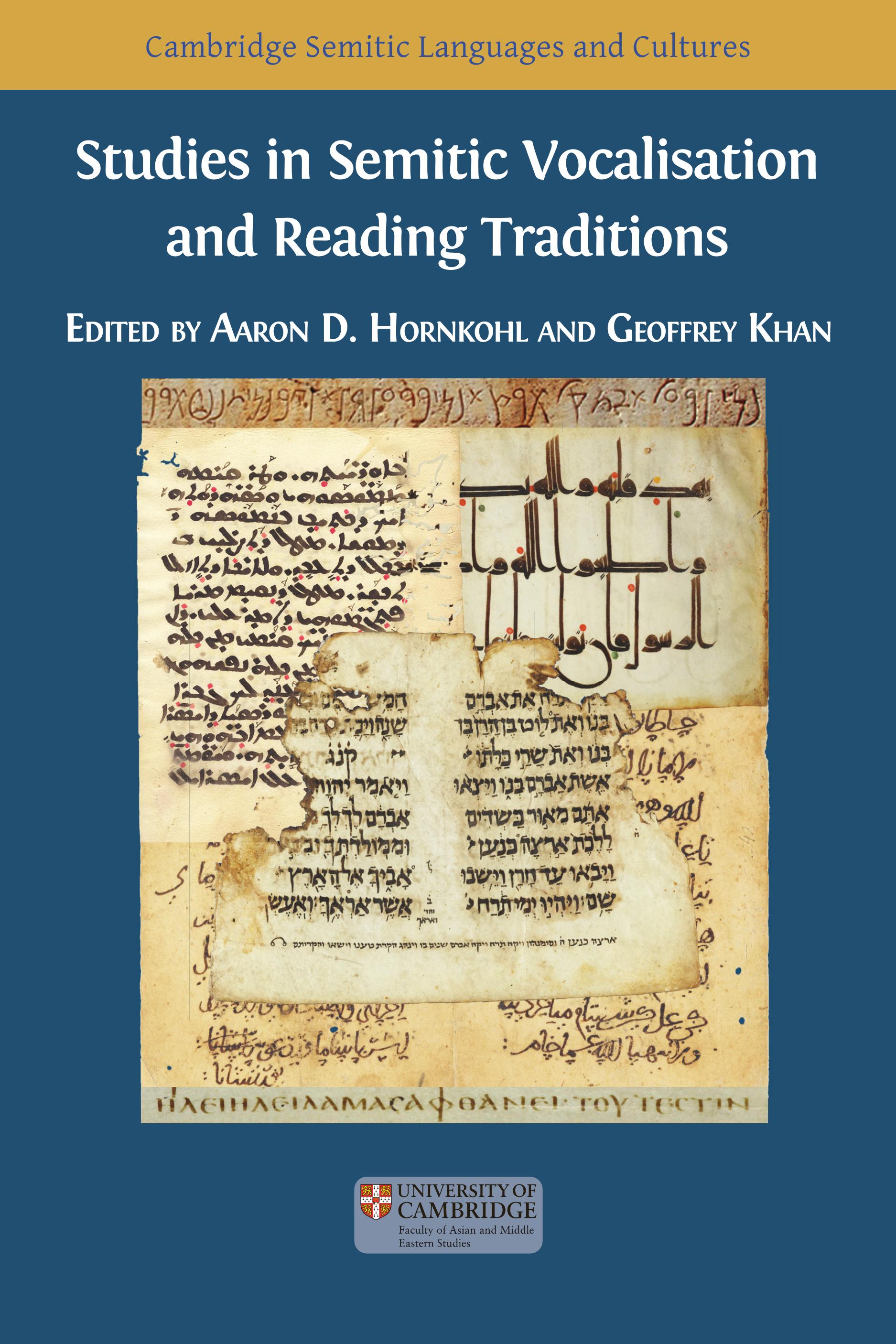
Studies in Semitic Vocalisation and Reading Traditions
Edited by Aaron D. Hornkohl, Geoffrey Khan
Book information
- Publisher
- Open Book Publishers
- Publication
- Published 1 June 2020
- Place
- Cambridge, UK
- Series
- Semitic Languages and Cultures
- Catalogue record
- View in the catalogue
Abstract
This volume brings together papers relating to the pronunciation of Semitic languages and the representation of their pronunciation in written form. The papers focus on sources representative of a period that stretches from late antiquity until the Middle Ages. A large proportion of them concern reading traditions of Biblical Hebrew, especially the vocalisation notation systems used to represent them. Also discussed are orthography and the written representation of prosody.
Beyond Biblical Hebrew, there are studies concerning Punic, Biblical Aramaic, Syriac, and Arabic, as well as post-biblical traditions of Hebrew such as piyyuṭ and medieval Hebrew poetry. There were many parallels and interactions between these various language traditions and the volume demonstrates that important insights can be gained from such a wide range of perspectives across different historical periods.
Chapters
Where its authors and editors are based
Countries of the institutions the book's authors, editors and chapter authors were affiliated to when it was published.
- AUTHORS / EDITORS
- CITATIONS Phase 2
- USAGE Phase 3
| Country | Authors / editors |
|---|---|
| United Kingdom | 11 |
| Belgium | 1 |
| Canada | 1 |
| France | 1 |
| Israel | 1 |
| Italy | 1 |
| Spain | 1 |
| The Netherlands | 1 |
About this data
These figures cover 18 works. Each value comes from the most trusted source that has it; a correction made by OJC or OBC staff outranks every source.
| Source | Confidence | Works |
|---|---|---|
| Thoth | 90 / 100 | 18 |
| Works with a publication date | 100% |
|---|---|
| Works with a DOI | 100% |
| Works with a funder recorded | 0% |
| Authors with an affiliation | 91% |
| Affiliations matched to an institution (ROR) | 100% |
| Affiliations with a country | 100% |
Countries come from the institution each author was affiliated to when they published, as recorded in ROR. A country is never guessed, so authors without a matched institution are not counted on the maps.
Funders come from OpenAlex for articles and Thoth for books, where publishers recorded them. Most works record none, so a funder's figures show what is recorded, not everything it funded.
Chapters count as works: their authors and editors, and the countries of their institutions, are in every figure where Thoth records an affiliation for them.
Citations (Phase 2) and usage (Phase 3) are not collected yet.