Book view
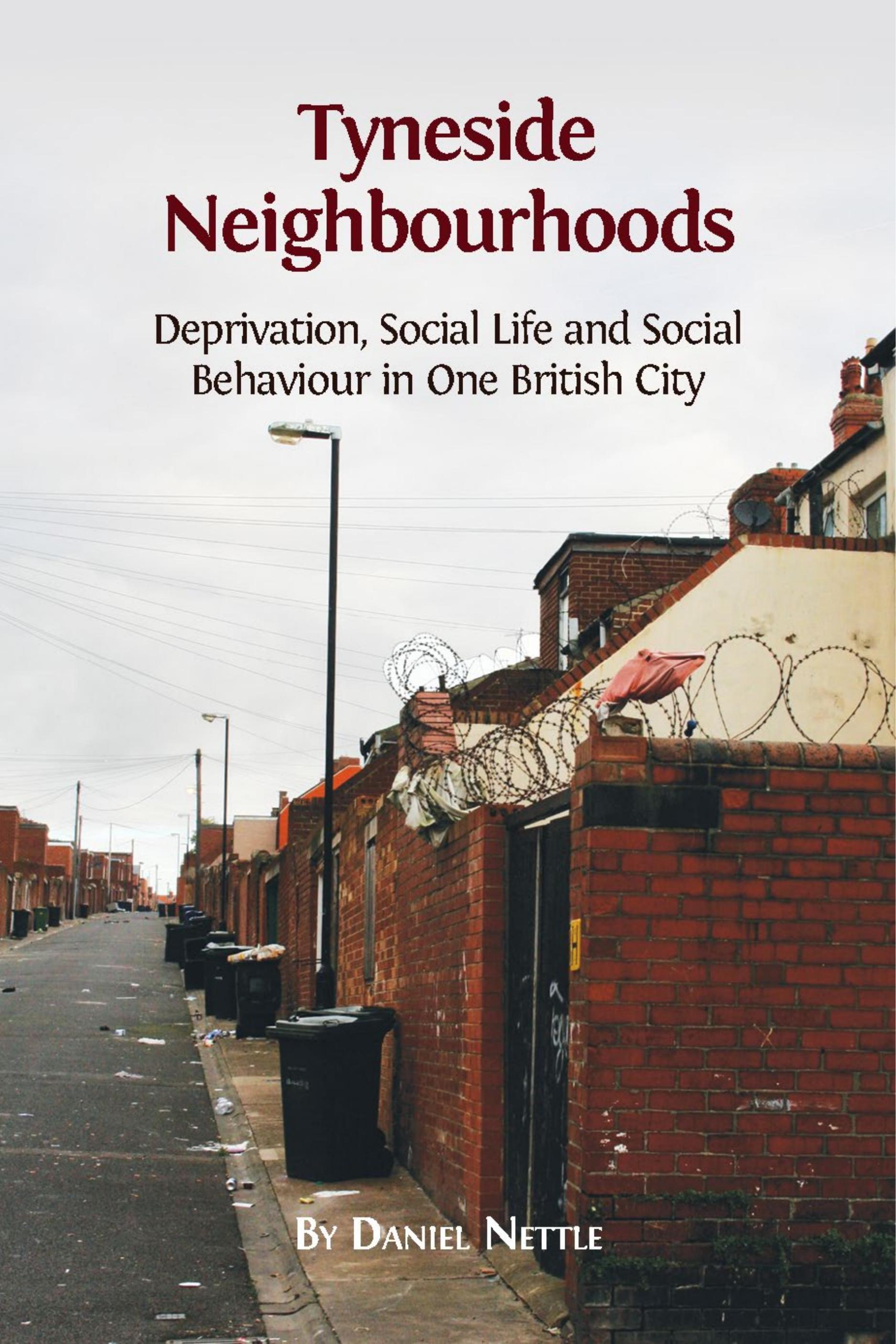
Tyneside Neighbourhoods
Deprivation, Social Life and Social Behaviour in One British City
Book information
- Publisher
- Open Book Publishers
- Publication
- Published 15 December 2015
- Place
- Cambridge, UK
- Catalogue record
- View in the catalogue
Abstract
Nettle’s book presents the results of five years of comparative ethnographic fieldwork in two different neighbourhoods of the same British city, Newcastle upon Tyne. The neighbourhoods are only a few kilometres apart, yet whilst one is relatively affluent, the other is amongst the most economically deprived in the UK. Tyneside Neighbourhoods uses multiple research methods to explore social relationships and social behaviour, attempting to understand whether the experience of deprivation fosters social solidarity, or undermines it. The book is distinctive in its development of novel quantitative methods for ethnography: systematic social observation, economic games, household surveys, crime statistics, and field experiments. Nettle analyses these findings in the context of the cultural, psychological and economic consequences of economic deprivation, and of the ethical difficulties of representing a deprived community. In so doing the book sheds light on one of the main issues of our time: the roles of culture and of socioeconomic factors in determining patterns of human social behaviour.
Tyneside Neighbourhoods is a must read for scholars, students, individual readers, charities and government departments seeking insight into the social consequences of deprivation and inequality in the West.
Nettle’s book presents the results of five years of comparative ethnographic fieldwork in two different neighbourhoods of the same British city, Newcastle upon Tyne. The neighbourhoods are only a few kilometres apart, yet whilst one is relatively affluent, the other is amongst the most economically deprived in the UK. Tyneside Neighbourhoods uses multiple research methods to explore social relationships and social behaviour, attempting to understand whether the experience of deprivation fosters social solidarity, or undermines it. The book is distinctive in its development of novel quantitative methods for ethnography: systematic social observation, economic games, household surveys, crime statistics, and field experiments. Nettle analyses these findings in the context of the cultural, psychological and economic consequences of economic deprivation, and of the ethical difficulties of representing a deprived community. In so doing the book sheds light on one of the main issues of our time: the roles of culture and of socioeconomic factors in determining patterns of human social behaviour. Tyneside Neighbourhoods is a must read for scholars, students, individual readers, charities and government departments seeking insight into the social consequences of deprivation and inequality in the West.
Chapters
| Chapter | Author | Institution at publication |
|---|---|---|
| 1. Introduction | Daniel Nettle | Newcastle University |
| 2. Study sites and methods | Daniel Nettle | Newcastle University |
| 3. Mutual aid | Daniel Nettle | Newcastle University |
| 4. Crime and punishment | Daniel Nettle | Newcastle University |
| 5. From cradle to grave | Daniel Nettle | Newcastle University |
| 6. Being there | Daniel Nettle | Newcastle University |
| 7. Conclusions and reflections | Daniel Nettle | Newcastle University |
Where its authors and editors are based
Countries of the institutions the book's authors, editors and chapter authors were affiliated to when it was published.
- AUTHORS / EDITORS
- CITATIONS Phase 2
- USAGE Phase 3
| Country | Authors / editors |
|---|---|
| United Kingdom | 1 |
About this data
These figures cover 8 works. Each value comes from the most trusted source that has it; a correction made by OJC or OBC staff outranks every source.
| Source | Confidence | Works |
|---|---|---|
| Thoth | 90 / 100 | 8 |
| Works with a publication date | 100% |
|---|---|
| Works with a DOI | 100% |
| Works with a funder recorded | 12% |
| Authors with an affiliation | 100% |
| Affiliations matched to an institution (ROR) | 100% |
| Affiliations with a country | 100% |
Countries come from the institution each author was affiliated to when they published, as recorded in ROR. A country is never guessed, so authors without a matched institution are not counted on the maps.
Funders come from OpenAlex for articles and Thoth for books, where publishers recorded them. Most works record none, so a funder's figures show what is recorded, not everything it funded.
Chapters count as works: their authors and editors, and the countries of their institutions, are in every figure where Thoth records an affiliation for them.
Citations (Phase 2) and usage (Phase 3) are not collected yet.