Book information
- Publisher
- Open Book Publishers
- Publication
- Published 25 September 2023
- Place
- Cambridge, UK
- Series
- Semitic Languages and Cultures
- Catalogue record
- View in the catalogue
Abstract
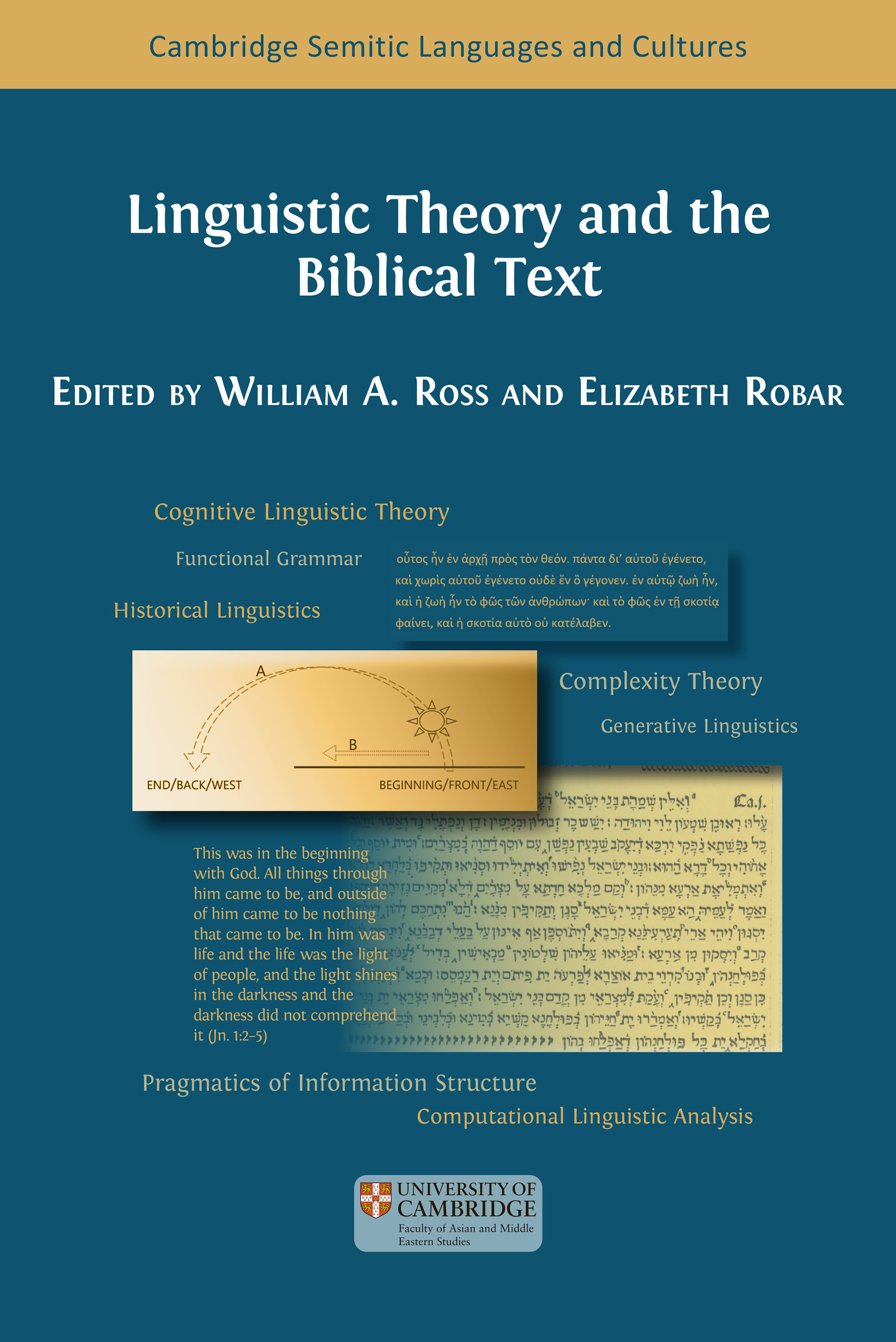
This volume is the result of the 2021 session of the Linguistics and the Biblical Text research group of the Institute for Biblical Research, which addresses the history, relevance, and prospects of broad theoretical linguistic frameworks in the field of biblical studies. Cognitive Linguistics, Functional Grammar, generative linguistics, historical linguistics, complexity theory, and computational analysis are each allotted a chapter, outlining the key theoretical commitments of each approach, their major concepts and/or methods, and their important contributions to contemporary study of the biblical text.
As academic disciplines and academic publishing proliferate and become more complex in a digital and global context, synthesising volumes such as this one have taken on new importance for both specialists and generalists alike. That is particularly the case in interdisciplinary areas of research. This volume therefore sets out to make linguistic theory clearer and more accessible to biblical scholars in particular, not only by careful explanation but also by specific illustration, drawing upon ancient Hebrew, Aramaic, and Greek languages within the Christian biblical corpus. The volume assists the reader in distinguishing the separate assumptions and scope of study for the separate theories, recognising methods of approach that can be applied to any of the theories, and the role of an umbrella theory to enable all the others to fruitfully interact.
The bibliographies provided are structured for the non-specialist, noting handbooks, companions, and glossaries, general introductions, and foundational texts.
In so doing, this volume presents not only a fully up-to-date cross-section of linguistic research in biblical scholarship but also an explicit path into the field, while highlighting important avenues for continued investigation and collaboration.
Chapters
| Chapter | Author | Institution at publication |
|---|---|---|
| Introduction | Elizabeth Robar | University of Cambridge |
| Cognitive Linguistic Theory and the Biblical Languages | William A. Ross | Reformed Theological Seminary |
| Computational Linguistic Analysis of the Biblical Text | Willem Th. van Peursen | Vrije Universiteit Amsterdam |
| Emerging from Silos of Analysis: A Complexity Theory Approach to the Study of Biblical Texts | Sophia L. Pitcher | University of the Free State; North Central University |
| Functional Grammar and the Pragmatics of Information Structure for Biblical Languages | Randall Buth | The Whole Word Institute |
| Generative Linguistics as a Theoretical Framework for the Explanation of Problematic Constructions in Biblical Hebrew | Jacobus A. Naudé, Cynthia L. Miller-Naudé | University of the Free State |
| Historical Linguistics and the Biblical Languages | Kaspars Ozoliņš | Southern Baptist Theological Seminary |
Where its authors and editors are based
Countries of the institutions the book's authors, editors and chapter authors were affiliated to when it was published.
- AUTHORS / EDITORS
- CITATIONS Phase 2
- USAGE Phase 3
| Country | Authors / editors |
|---|---|
| South Africa | 3 |
| United States | 3 |
| Israel | 1 |
| The Netherlands | 1 |
| United Kingdom | 1 |
About this data
These figures cover 8 works. Each value comes from the most trusted source that has it; a correction made by OJC or OBC staff outranks every source.
| Source | Confidence | Works |
|---|---|---|
| Thoth | 90 / 100 | 8 |
| Works with a publication date | 100% |
|---|---|
| Works with a DOI | 100% |
| Works with a funder recorded | 0% |
| Authors with an affiliation | 100% |
| Affiliations matched to an institution (ROR) | 64% |
| Affiliations with a country | 100% |
Countries come from the institution each author was affiliated to when they published, as recorded in ROR. A country is never guessed, so authors without a matched institution are not counted on the maps.
Funders come from OpenAlex for articles and Thoth for books, where publishers recorded them. Most works record none, so a funder's figures show what is recorded, not everything it funded.
Chapters count as works: their authors and editors, and the countries of their institutions, are in every figure where Thoth records an affiliation for them.
Citations (Phase 2) and usage (Phase 3) are not collected yet.