Book information
- Publisher
- punctum books
- Publication
- Published 24 December 2017
- Place
- Earth, Milky Way
- Catalogue record
- View in the catalogue
Abstract
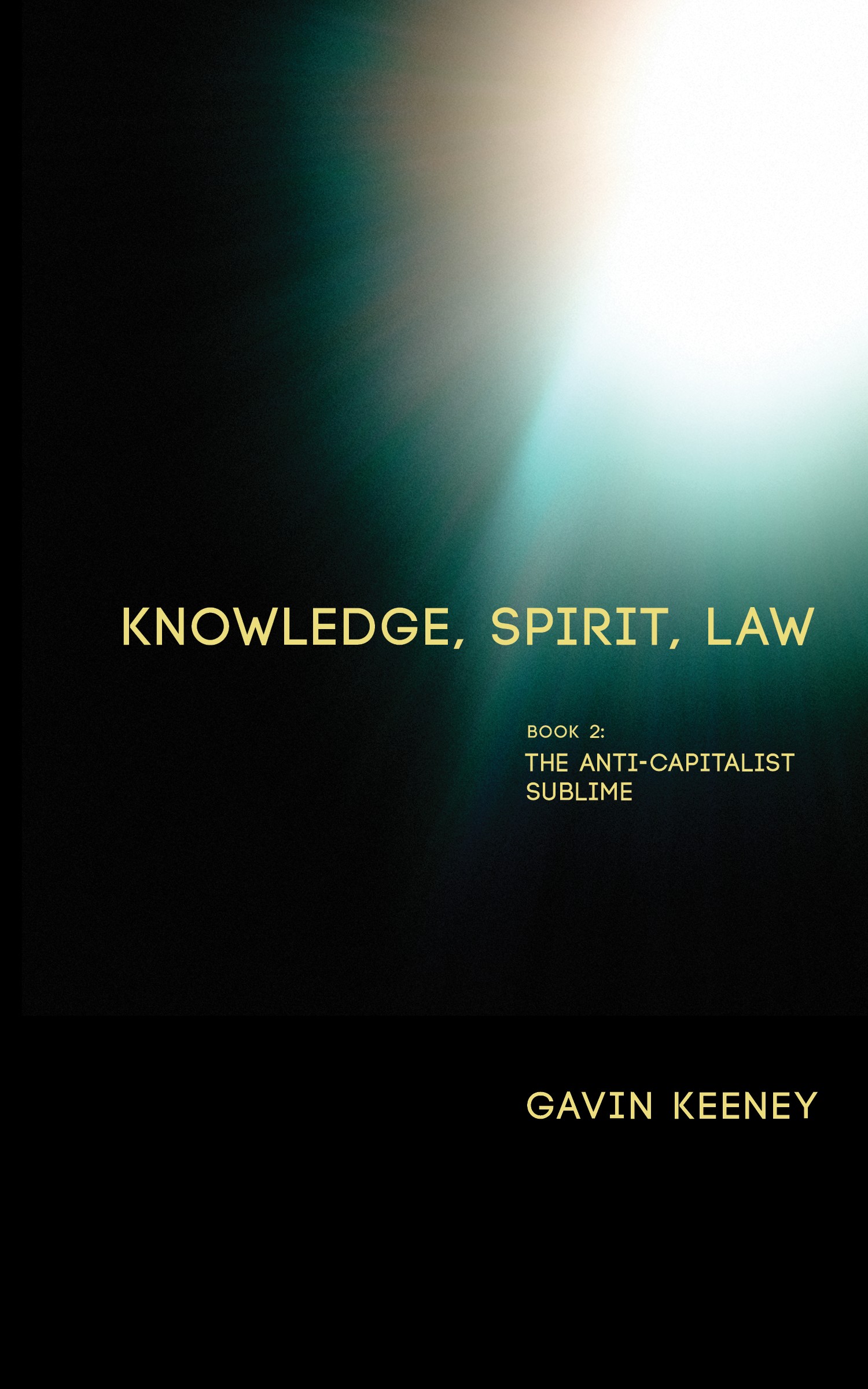
Knowledge, Spirit, Law // Book 2: The Anti-capitalist Sublime takes up where Knowledge, Spirit, Law // Book 1: Radical Scholarship left off, foremost in terms of a critique of neo-liberal academia and its demotion of the book in favor of various mediatic practices that substitute, arguably, for the one form of critical inquiry that might safeguard speculative intellectual inquiry as long-form and long-term project, especially in relationship to the archive or library (otherwise known as the “public domain”).
This ongoing critique of neo-liberal academia is a necessary corrective to processes underway today toward the further marginalization of radical critique, with many of the traditional forms of sustained analysis being replaced by pseudo-empirical studies that abandon themes only presentable in the Arts and Humanities through the “arcanian closure” that the book as long-form inquisition represents (whether as novel, non-fictional critique, or something in-between). As a tomb for thought, this privileging of the shadowy recesses of the book preserves, through the very apparatuses of long- and slow-form scholarship, the premises presented here as indicative of an anti-capitalist project embedded in works that might otherwise shun such a characterization.
The perverse capitalist capture of knowledge through mass digitalization is — paradoxically — the negative corollary for the reduction by abstraction of everyday works to a philosophical and moral inquest against Capital. The latter actually constitutes a transversal reduction for works (across works) toward the age-old antithesis to instrumentalized socio-cultural production — Spirit. For similar reasons, the anti-capitalist sublime as presented here is primarily a product of the imaginative, magical-realist regimes of thought in service to “no capital” — to no capitalization of thought.
This book seeks to re-establish paradigmatic, a-historical, and universalizing practices in humanistic scholarship associated with speculative inquiry as a form of art, utilizing in passing forms of art and exemplary paradigmatic practices that are also first-order forms of speculative inquiry — suggesting that first-order works in the Arts and Humanities are those works that may “suffer” second-order incorporations without the attendant loss of the impress of sublimity (Spirit).
Where its authors and editors are based
Countries of the institutions the book's authors, editors and chapter authors were affiliated to when it was published.
- AUTHORS / EDITORS
- CITATIONS Phase 2
- USAGE Phase 3
No affiliations with a known country in these years yet.
About this data
These figures cover 1 work. Each value comes from the most trusted source that has it; a correction made by OJC or OBC staff outranks every source.
| Source | Confidence | Works |
|---|---|---|
| Thoth | 90 / 100 | 1 |
| Works with a publication date | 100% |
|---|---|
| Works with a DOI | 100% |
| Works with a funder recorded | 0% |
| Authors with an affiliation | 0% |
Countries come from the institution each author was affiliated to when they published, as recorded in ROR. A country is never guessed, so authors without a matched institution are not counted on the maps.
Funders come from OpenAlex for articles and Thoth for books, where publishers recorded them. Most works record none, so a funder's figures show what is recorded, not everything it funded.
Chapters count as works: their authors and editors, and the countries of their institutions, are in every figure where Thoth records an affiliation for them.
Citations (Phase 2) and usage (Phase 3) are not collected yet.