Book information
- Publisher
- punctum books
- Publication
- Published 13 November 2014
- Place
- Brooklyn, NY
- Catalogue record
- View in the catalogue
Abstract
In a Trance is just the sort of genre-defying work we at Peanut and punctum and, as it happens, Jeffrey Skoblow, revel in. It is a book-length essay by a fiction writer. It is a fictional essay by a literary scholar. It is a gallant assay by a smart man who thinks while he walks, and he walks a lot.
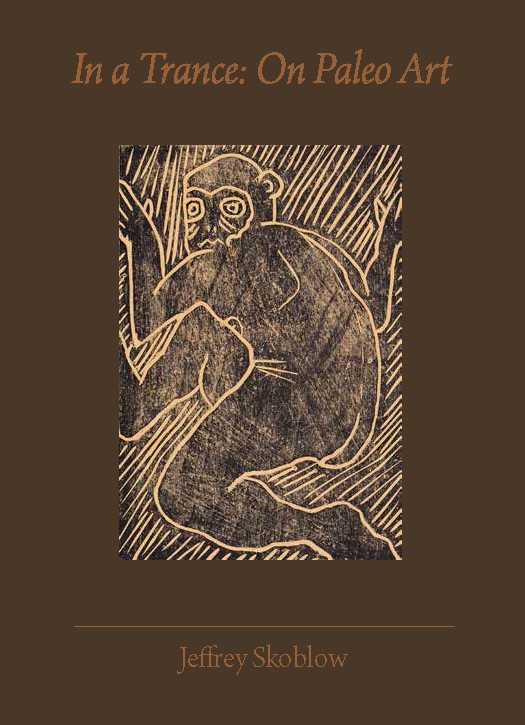
The book is a meta-meditation on Paleolithic cave drawings and the humans who ponder them. It is fact-based and entrancing just as the cave drawings are actual (existing in time — loosely — and space — more definitively) and mesmerizing. Skoblow is devising stories as “we” (humans) have always devised stories though in a less familiar mode, along a less travelled path.
The essay draws on (!) the careful/thoughtful/whimsical notebooks kept by Skoblow over a dozen years. The notebooks record/illuminate/complicate his visits to twelve Paleolithic art sites as well as his deep, eccentric reading of texts concerned in some way with the subject of cave drawings by an array of scientists, anthropologists, archeologists, art historians, and other sundry enthusiasts and experts, so-called and otherwise.
These are one man’s marks made about making marks. Skoblow’s meticulous descriptions attempt the impossible: to provide the “information” that will allow us to see what is visible, invisible, restricted, unseen, hidden, and lost (in the sense of not yet found, or destroyed, or degraded by human presence) beneath the ground at El Castillo and Niaux (for instance). Lines, dots, dashes, body parts, animals, and “hum-animal” figures — things/creatures we have given name to (bison? rhino? vulva? phallus?) in our helplessly homo-sapien-centric attempts to understand (and/or to master our non-understanding).
We follow Skoblow as he steps onto an electric train in the caves at Rouffignac and steps out in Southern Illinois, where he cautiously crosses a snake-ridden (maybe) meadow. This is where he meanders further — literally and figuratively: further from the actual caves, furtherest from certainty. These furtherings are exactly what we might expect from a book that from its opening pages declares as one if its themes the difficulties inherent in considering Paleolithic art.
The pleasures of this book are found in Skoblow’s intense, vigilant exploration of these problems and questions, which are in themselves irresistible. Who are we? In what ways, specifically, and to what degree do we resemble these ancient humans who spray- and brush-painted, smudged, carved, and stenciled images into and onto cave walls and floors and ceilings?
Where its authors and editors are based
Countries of the institutions the book's authors, editors and chapter authors were affiliated to when it was published.
- AUTHORS / EDITORS
- CITATIONS Phase 2
- USAGE Phase 3
| Country | Authors / editors |
|---|---|
| United States | 1 |
About this data
These figures cover 1 work. Each value comes from the most trusted source that has it; a correction made by OJC or OBC staff outranks every source.
| Source | Confidence | Works |
|---|---|---|
| Thoth | 90 / 100 | 1 |
| Works with a publication date | 100% |
|---|---|
| Works with a DOI | 100% |
| Works with a funder recorded | 0% |
| Authors with an affiliation | 100% |
| Affiliations matched to an institution (ROR) | 100% |
| Affiliations with a country | 100% |
Countries come from the institution each author was affiliated to when they published, as recorded in ROR. A country is never guessed, so authors without a matched institution are not counted on the maps.
Funders come from OpenAlex for articles and Thoth for books, where publishers recorded them. Most works record none, so a funder's figures show what is recorded, not everything it funded.
Chapters count as works: their authors and editors, and the countries of their institutions, are in every figure where Thoth records an affiliation for them.
Citations (Phase 2) and usage (Phase 3) are not collected yet.